Is Weed Legal in North Carolina? Hemp Yes, Marijuana No (2026)

This article is for informational purposes only and does not constitute legal, medical, or product advice. Consult a qualified professional for guidance specific to your situation.
No. Marijuana is not legal in North Carolina, for recreational or medical use. Hemp-derived THC products are, and they are sold openly across the Triangle with no card and no state age limit. That split is the entire answer, and almost every argument about cannabis in this state is really an argument about where the line between those two words sits.
North Carolina is one of a shrinking number of states with no adult-use program and no comprehensive medical program. It is also one of the easiest states in the country to walk into a shop and buy something that gets you high. Both of those are true at the same time, legally, which is why the question keeps getting asked.
Marijuana is illegal in NC at any amount. Possessing half an ounce or less is a Class 3 misdemeanor with a $200 fine cap and no jail for a first offense, but it is still a criminal conviction. Hemp-derived products like THCa flower, delta-8 and delta-9 gummies are legal today because state law defines hemp by delta-9 content alone. The federal definition changes on December 11, 2026, and counts total THC instead. North Carolina has no ballot initiative process, so only the General Assembly can legalize marijuana here.
Update, October 10, 2026: The delay is law, and nothing since has changed it. The President signed H.R. 6500 on September 2, 2026, and it became Public Law 119-103, after the Senate passed it 90-6 on August 8 and the House agreed to the Senate's version 370-48 on September 1. Its Section 2019 splits the P.L. 119-37 hemp rewrite across two dates. On November 12, 2026, one narrow piece takes effect: intermediate and final products containing cannabinoids that a Cannabis sativa L. plant cannot naturally produce. Everything else waits until December 11, 2026 (Section 2019, enrolled text). That remainder is the part that reaches the shelf: the 0.3 percent total-THC test that counts THCa, the exclusion for cannabinoids the plant can make but that were synthesized outside it (which is where delta-8 made from CBD falls), and the 0.4mg total-THC-per-container cap that reaches nearly every gummy, tincture, and vape. December 11 is also the day the stopgap funding law runs out, so Congress could still move the date in its next funding bill; as of this update it has not. Our NC hemp bill tracker follows what happens next, and our December 11 report counts what the change reaches across Triangle shops.
North Carolina status, October 10, 2026: HB 328, the state hemp crackdown, passed the Senate in July but still awaits a House vote, which can come in the reconvened sessions between October 26 and December 18. Today North Carolina sets no minimum age for hemp products, though many shops card at 21. Details in our NC hemp bill tracker.
Is Weed Legal in North Carolina in 2026?
Marijuana is illegal in North Carolina. There is no recreational program, no medical program, no patient registry and no state-licensed dispensary anywhere in the state outside tribal land. Possession of any amount is a crime, and selling it is a Class H felony under G.S. 90-95(b)(2), with one narrow exception: handing someone less than five grams for no payment is not a delivery. The federal Schedule III rescheduling order announced in April 2026 did not change that, because Schedule III did not legalize marijuana in NC; it reaches marijuana handled under a state medical license and FDA-approved products, neither of which exists here.
Hemp is a different legal category entirely. Under both federal and North Carolina law, cannabis that tests at or below 0.3 percent delta-9 THC by dry weight is hemp, and hemp is not a controlled substance. Everything above that line is marijuana. The plants can be the same plant. The difference is a lab number.
That is the loophole, and it is why the question has been getting more popular rather than less. We track search demand for this cluster through DataForSEO, and the combined monthly volume for the three main phrasings of the question ("is weed legal in north carolina," "is pot legal in nc," and "weed legalized in north carolina") has climbed steadily through 2026, from a low of 31,300 searches in February to 61,100 in August. That is close to double in six months, and the inflection points line up with state legislative events rather than federal ones.
The two labeled spikes are not coincidences. Demand rose after the Governor's Advisory Council on Cannabis released its interim report in early April 2026 recommending a regulated adult market, and again in July when the state Senate adopted a conference report that would tighten the hemp rules rather than loosen them. People search this question when they think something is about to change.
What the curve does not show is any response to federal news. The hemp redefinition was signed in November 2025 and its effective date moved in September 2026, and neither event produced a visible bump in this particular cluster. That fits what the phrasing suggests. Someone typing "is weed legal in north carolina" is asking a state question about their own situation, not following appropriations law. The practical consequence is that the answer people need is almost always the local one: what can I buy here today, what happens if I am caught with something else, and is any of that about to move.
All three of those have precise answers, and the rest of this guide gives them in order. The short version is that the hemp side of the line is wide open and about to narrow, the marijuana side is closed and not moving, and the mechanism that would change the marijuana side does not exist in this state in the form most people assume it does.
For a deeper look at how the hemp and marijuana line works in practice, including why a shop can sell flower that smells and tests like marijuana, read our guide on hemp vs. marijuana under NC law.
What the Law Actually Says: The Statutes That Decide It
Most articles about this topic paraphrase. It is worth reading the actual provisions, because the whole legal structure rests on three short passages, and one of them is a single clause.
North Carolina's hemp definition is at G.S. 90-87(13a). It defines hemp as the plant and all its derivatives "with a delta-9 tetrahydrocannabinol concentration of not more than three-tenths of one percent (0.3%) on a dry weight basis." Note what it does not say: it does not mention THCa, delta-8, delta-10, or total THC. Delta-9 only.
The marijuana definition at G.S. 90-87(16) then does the decisive work in one sentence at the very end: "The term does not include hemp or hemp products." That clause is the reason a Triangle shop can sell THCa flower. Hemp is carved out of the controlled substances schedule entirely, and that carve-out is permanent rather than a pilot program. It came from Session Law 2022-32, titled "An act to conform the hemp laws with federal law by permanently excluding hemp from the state Controlled Substances Act," signed June 30, 2022.
| Provision | What it does | Why it matters to you |
|---|---|---|
| G.S. 90-87(13a) | Defines hemp at 0.3% delta-9 THC, dry weight | THCa and delta-8 are not counted, so high-THCa flower qualifies |
| G.S. 90-87(16) | Defines marijuana, then excludes hemp and hemp products | The clause that makes hemp retail legal in NC |
| G.S. 90-95(d)(4) | Marijuana possession penalties by weight | Class 3 misdemeanor at 0.5 oz or less, felony above 1.5 oz |
| G.S. 90-94.1 | Hemp extract exemption for intractable epilepsy | The state's only medical-style carve-out, and it is narrow |
| G.S. 90-113.22A | Marijuana paraphernalia | A separate Class 3 misdemeanor on top of possession |
One practical consequence of this structure is that North Carolina's hemp line is currently looser than the incoming federal one, not tighter. State law still measures delta-9 alone. Federal law stops doing that on December 11, 2026. Our THCa legality guide works through what that gap means for flower specifically.
What Are the Penalties for Marijuana Possession in NC?
Small-amount marijuana possession in North Carolina carries no jail time for a first offense, but it is not decriminalized. Those are different things, and the difference shows up on a background check.
Possessing half an ounce or less is a Class 3 misdemeanor under G.S. 90-95(d)(4). For someone with no prior convictions, the misdemeanor punishment chart at G.S. 15A-1340.23 authorizes community punishment only, with no active imprisonment, and the fine is capped at $200. That is mild by national standards. It is still a criminal conviction, entered on a public record, and it still requires a court date.
The distinction is worth holding onto, because "decriminalized" gets used loosely in coverage of North Carolina. In a genuinely decriminalized state, a small amount is handled as a civil infraction with no criminal record attached. Here it is a crime with a light penalty, which means it can surface in a background check, a professional licensing review or an immigration proceeding years later. Prior convictions also move you up the punishment chart, so a second or third Class 3 offense can authorize active days where the first could not.
Above half an ounce the ladder gets steep quickly.
Two details catch people out. First, more than an ounce and a half is a felony, not an aggravated misdemeanor, and an ounce and a half is not a large amount. Second, paraphernalia is charged separately: using or possessing with intent to use drug paraphernalia with marijuana is its own Class 3 misdemeanor under G.S. 90-113.22A, so a grinder or a pipe in the same bag can add a second count.
North Carolina also has no expungement pathway specific to marijuana and no local decriminalization, because cities cannot change state criminal law. A city council can direct how its own police department prioritizes enforcement, and several North Carolina municipalities have debated doing so, but no resolution of that kind changes what the offense is or what a district attorney may charge. The statute is the statute statewide.
Weight is also measured as charged, not as consumed. Edibles and infused products are weighed as a whole where they are treated as marijuana, which is how a modest quantity of product can land above a threshold that sounds generous when you picture loose flower.
Can Police Search You Just for the Smell?
This question got a real answer in 2026, and it is one of the few genuinely new legal developments in this area.
Because legal hemp and illegal marijuana smell identical, the odor of cannabis stopped being a reliable signal of a crime the moment hemp became legal. North Carolina courts had been working through what that means for probable cause for years. On May 22, 2026, the North Carolina Supreme Court decided two cases on the point, State v. Dobson and State v. Rowdy, and in August it disposed of a third, State v. Scheine, as improvidently granted (UNC School of Government, 2026).
The holding is narrower than either side wanted. The court kept the existing framework: whether probable cause exists is judged on the totality of the circumstances, and the odor of cannabis is one factor within that analysis rather than a standalone trigger. It did not rule that odor alone is always enough, and it did not rule that odor alone is never enough. Both opinions upheld the searches in front of them, but they did so on the full set of facts, not on smell by itself.
The practical read for a consumer is unchanged and worth stating plainly: carrying legal hemp flower does not immunize you from a stop, and the burden of showing a product is compliant hemp generally falls on you, in the moment, with whatever documentation you have. That is why keeping product in its original labeled packaging and holding onto the certificate of analysis matters more in North Carolina than in a state with legal marijuana. Our guide on traveling with hemp in NC covers the same problem on the road.
Does North Carolina Have Medical Marijuana?
No. North Carolina has no medical cannabis program, no patient registry and no dispensary licensing system. You do not need, and cannot get, a state medical card here. You also do not need one to buy hemp products, which is the source of most of the confusion. Our guide on medical cards and THCa in NC explains why the cards sold online do not do anything in this state.
This is not for lack of trying. The NC Compassionate Care Act passed the state Senate 36-7 in 2022 as SB 711, then died without a House vote. Its successor, SB 3, passed the Senate 36-10 in March 2023 and met the same fate. A 2025 version, HB 1011, has sat in House Rules since April 2025 and cannot be taken up before this session ends.
The National Conference of State Legislatures counts 41 states, three territories and the District of Columbia allowing medical use of cannabis products, and 24 states plus D.C. and three territories allowing adult non-medical use. North Carolina appears on neither list. It does appear on a secondary NCSL table of limited-access low-THC programs, which is a generous description of what the state actually offers: G.S. 90-94.1 lets a person with intractable epilepsy, or their designated caregiver, possess hemp extract containing less than 0.9 percent THC and at least 5 percent CBD, with a certificate of analysis and no other psychoactive substance. There is no supply system attached to it. Notably, Section 3(a) of the pending HB 328 conference report would repeal that section outright.
There is one place in the state where cannabis is genuinely legal, and it is not under state law. The Eastern Band of Cherokee Indians opened Great Smoky Cannabis Co. on the Qualla Boundary in western North Carolina, beginning adult-use sales to members of federally recognized tribes on July 4, 2024 (NORML, 2024) and to all adults 21 and older on September 7, 2024. Two years in, the tribe reports more than 750,000 orders filled for customers from North Carolina, South Carolina, Georgia and Tennessee. It operates under tribal law on tribal land. Carrying its product off the Qualla Boundary puts you back under G.S. 90-95.
What Hemp Products Can You Legally Buy Right Now?
Until the federal definition changes, a wide range of hemp-derived THC products are legal to buy in North Carolina without a card, and in most cases without a state-mandated age check.
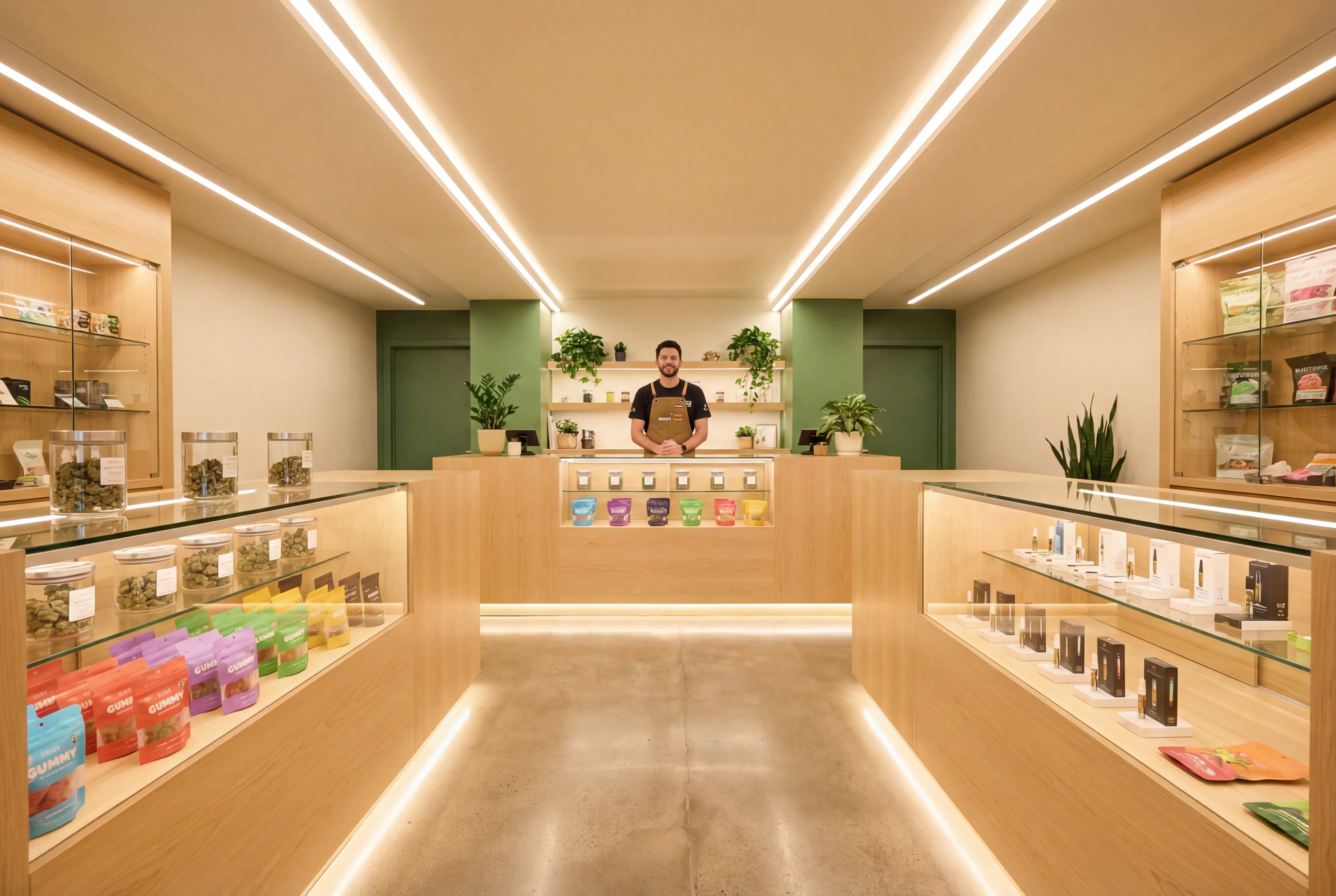
THCa flower is the closest thing to traditional marijuana and the most widely stocked category in the Triangle. THCa is not delta-9 THC, so it does not count against the state's 0.3 percent delta-9 test, but it converts to delta-9 THC when heated. Our THCa flower guide covers strains and pricing.
Delta-8 THC is milder than delta-9 and typically made by converting CBD. North Carolina has not banned it the way several states have. Read our delta-8 legality guide.
Delta-9 gummies and edibles stay compliant by weight rather than by dose. A 10 mg gummy can sit under 0.3 percent delta-9 because the gummy itself is heavy. Our delta-9 gummies guide works through that math.
CBD, vapes, concentrates and beverages round out the shelf. For drinks specifically, see our THC drinks guide.
One thing North Carolina does not require anywhere in that list is an age check. There is no state minimum age for hemp-derived products today, because none of the bills that would set one has become law. Many Triangle shops card at 21 as store policy, which is a business decision rather than a legal obligation, and it is one of the few points on which the hemp industry and its critics in the legislature actually agree.
What actually sits on Triangle shelves is also narrower than the full catalog suggests. Across the 81 shops in our directory, the distribution is heavily weighted toward flower:
| Category | Shops carrying it | Share of directory |
|---|---|---|
| THCa flower | 74 | 91% |
| Edibles | 53 | 65% |
| CBD | 45 | 56% |
| Delta-9 products | 41 | 51% |
| Vapes | 33 | 41% |
| Delta-8 | 27 | 33% |
| Concentrates | 23 | 28% |
That concentration matters for the next section. The single most-stocked category in the Triangle, carried by nine shops in ten, is also the category the new federal total-THC test removes most directly. For tips on shopping safely in the meantime, see what to look for in an NC dispensary.
How Does the Federal Rewrite Change This on December 11, 2026?
The federal definition of hemp was rewritten by Section 781 of Public Law 119-37, signed November 12, 2025. Section 2019 of Public Law 119-103 then split its arrival across two dates. The statutory language is short and worth quoting, because the numbers are the whole story.
Section 781 redefines hemp as cannabis "with a total tetrahydrocannabinols concentration (including tetrahydrocannabinolic acid) of not more than 0.3 percent on a dry weight basis." That phrase, "including tetrahydrocannabinolic acid," is what ends THCa flower as a federal hemp product. It then excludes from hemp any final product containing "greater than 0.4 milligrams combined total per container" of total THC and similar-effect cannabinoids.
A container, not a serving. A single compliant gummy today may hold 10 mg or 25 mg of delta-9 THC. A gram of THCa flower at 20 percent THCa holds roughly 200 mg. Against a 0.4 mg per-container ceiling, neither is close.
North Carolina's own statute does not change on that date. G.S. 90-87(13a) still reads delta-9 only, which is why a state bill to match the federal standard exists at all. For the full federal breakdown see the hemp ban explained and our 2026 NC hemp law update. If you are weighing whether to buy ahead, read stock up before the deadline first.
It is worth being precise about what December 11 does and does not do. It changes a federal definition. It does not create a new state crime, it does not repeal G.S. 90-87(13a), and it does not make anything legal that is illegal today. What it does is strip federal hemp protection from products that currently rely on it, which is what exposes them to enforcement and shuts off the interstate supply chain that stocks them.
Why Hasn't North Carolina Legalized Marijuana?
Not because voters oppose it. The September 2026 Elon University Poll, conducted online by YouGov between August 21 and 31, interviewed 1,121 North Carolina adults matched down to a sample of 800, with a margin of error for all adults of plus or minus 5.09 percentage points. It found 75 percent in favor of legalizing medical marijuana against only 11 percent opposed, and 55 percent in favor of recreational legalization against 30 percent opposed with 15 percent unsure.
Majority support has existed for years without producing a law. Elon noted that these levels of support are mostly unchanged from its own January 2021 poll, which is the more telling finding: a decade of stable majority support has produced no statute. Medical legalization in particular is not a partisan question in North Carolina by the numbers, with 89 percent of Democrats and 57 percent of Republicans in favor.
The structural reason is specific to this state, and it is the part most national coverage skips. Twenty-four states have legalized adult use, and a large share of them did it by ballot initiative, where organizers gather signatures and voters decide directly without the legislature's consent. That route produced legalization in states whose legislatures would never have passed it. North Carolina does not have that route, and never has.
That omission is not an oversight or a gap waiting to be filled by a court. It is written into the state constitution as an exclusive list, which means the only way to create a citizen initiative in North Carolina would itself require the General Assembly to propose one and voters to ratify it. The legislature would have to vote to give away its own monopoly on the question first.
Article XIII of the North Carolina Constitution reserves to the people the power to amend it, then limits how: by an act of the General Assembly adopted by three-fifths of all the members of each house and ratified by voters, or by a convention called by two-thirds of each house. Section 2 says that power may be exercised by those methods "and in no other way." There is no citizen petition, no statutory initiative and no advisory referendum. Every path to legal marijuana in North Carolina runs through the legislature, which is why a 75 percent polling number and zero legislative movement can coexist indefinitely.
What Would Have to Happen for Marijuana to Be Legal Here?
Three things, in some order: a bill, a chamber willing to vote on it, and a signature. None of the three is currently in place, and the 2026 calendar makes it harder rather than easier.
The calendar constraint is specific. The 2025 regular session adjourned in August 2026 under a resolution that lists exactly what the reconvened sessions may take up, and ordinary bills sitting in committee are not on that list. A bill that has not already cleared a chamber or reached a conference committee is effectively frozen until the 2027 long session, no matter how much support it gathers in the meantime.
| Pathway | Current status | Realistic timing |
|---|---|---|
| Adult-use bill (H 413, S 350) | In Rules committees since March 2025, not eligible in the reconvened sessions | 2027 long session at the earliest |
| Medical-only bill (HB 1011) | In House Rules since April 2025, not eligible this session | 2027 long session |
| Advisory Council framework | Interim report April 2026 recommended a regulated adult market; final report due December 31, 2026 | Would still need a sponsor and a bill |
| Constitutional amendment (S 1072) | Filed May 2026, in Senate Rules | Needs three-fifths of both chambers plus a statewide vote |
| Federal rescheduling | Schedule III order announced April 2026 | Does not legalize anything at the state level |
The nearest thing to live legislative action on cannabis in North Carolina right now is HB 328, and it moves in the opposite direction: it would tighten the hemp definition rather than loosen the marijuana one. Our HB 328 breakdown and our NC hemp bill tracker follow it vote by vote. The Advisory Council's December 31 final report is the realistic thing to watch, because a drafted framework from a governor-appointed body is what a 2027 bill would be built from. Our analysis of what the council's recommendation means covers that in detail.
Is It Worth Driving to a Legal State?
This is one of the most common follow-up questions, and the honest answer is that the nearest options are worse than they sound.
Virginia is the closest state where adult possession is legal. Under Va. Code 4.1-1100, a person 21 or older may lawfully possess up to two ounces of marijuana. What Virginia does not have is anywhere legal to buy it. The Virginia Cannabis Control Authority states that retail cannabis sales in Virginia begin July 1, 2027. Legal to hold, with no legal store, is a strange combination to drive three hours for.
Maryland has operating adult-use retail, but it is roughly six hours from Raleigh. And whichever state you choose, the return trip is the problem. Carrying marijuana back across the state line is a federal offense in itself, and once you are inside North Carolina you are squarely under G.S. 90-95 regardless of where it was purchased legally. A receipt from another state is not a defense here.
The practical answer for most Triangle residents is the legal hemp market that already exists within a few miles, at least until the federal definition narrows it.
Where Can You Buy Legal Products in the Triangle?
Hemp-derived products are sold openly at dedicated shops, smoke shops and specialty retailers across the Raleigh, Durham and Chapel Hill area. Our directory lists 81 shops across the Triangle, and Raleigh alone accounts for 35 of them, more than four in ten.
Start by city:
- Raleigh: the largest selection in the state. See our best dispensaries in Raleigh guide.
- Durham: 11 shops. Read our Durham dispensary guide.
- Cary: 7 shops serving western Wake. See the Cary guide.
- Wake Forest: 5 locally owned shops. See the Wake Forest guide.
- Chapel Hill and Apex: smaller scenes, covered in our Chapel Hill and Apex and Holly Springs guides.
If this is your first visit, our guide on what to expect at your first dispensary visit walks through it. If you are subject to workplace testing, read hemp products and drug tests in NC before buying anything, because hemp-derived THC triggers the same screens that marijuana does.
Frequently Asked Questions
Is weed legal in Raleigh, North Carolina?
Marijuana is illegal in Raleigh and everywhere else in North Carolina. Hemp-derived THC products including THCa flower, delta-8 and delta-9 gummies are legal, and Raleigh has 36 shops in our directory selling them. Possession of half an ounce of marijuana or less is a Class 3 misdemeanor under G.S. 90-95(d)(4), with a $200 fine cap and no active sentence for a first offense.
Will NC legalize weed in 2026?
No. There is no adult-use bill eligible for a vote in what remains of the 2026 session. H 413 and S 350 have been in Rules committees since March 2025 and the adjournment resolution does not allow them to be taken up in the reconvened sessions. The Governor's Advisory Council on Cannabis delivers its final recommendations by December 31, 2026, which makes 2027 the first realistic year for a serious bill.
Why won't NC legalize weed?
Public opinion is not the obstacle. The September 2026 Elon University Poll found 75 percent support for medical legalization and 55 percent for recreational. The obstacle is structural: North Carolina has no citizen ballot initiative. Article XIII of the state constitution allows amendment only by a three-fifths vote of both chambers followed by a statewide vote, or by a convention, "and in no other way." Voters cannot put legalization on the ballot themselves, so it requires legislative leadership that has not materialized.
Does North Carolina have weed dispensaries?
Not in the licensed-marijuana sense. North Carolina issues no dispensary licenses and has no state-regulated cannabis retail. What it has are hemp retailers, which operate without any state licensing, age requirement or product testing mandate. The one genuine dispensary in the state is Great Smoky Cannabis Co. on the Qualla Boundary, which operates under Eastern Band of Cherokee Indians tribal law rather than North Carolina law.
What state closest to NC is weed legal?
Virginia, for possession only. Virginia law allows adults 21 and older to possess up to two ounces, but the Virginia Cannabis Control Authority says retail sales do not begin until July 1, 2027, so there is no legal place to buy it there yet. Maryland has operating retail roughly six hours from Raleigh. Bringing any of it back into North Carolina is a crime here regardless of where it was bought.
Is NC 420 friendly?
Culturally, in parts of the Triangle, yes. Legally, no. The state has no adult-use or medical program, no decriminalization, and public consumption of marijuana is prosecutable at any amount. The hemp market creates a lot of visible retail activity that can read as tolerance, but it is a separate legal category and it does not change how marijuana itself is treated.
Can you go to jail for weed in NC?
Not for a first offense of half an ounce or less, which authorizes community punishment only. Above half an ounce it becomes a Class 1 misdemeanor carrying up to 45 days, and above an ounce and a half it is a Class I felony with a presumptive range of four to six months for someone with no prior record. Trafficking begins at 10 pounds and carries a mandatory minimum of 25 months.
Will THCa flower still be legal after December 11, 2026?
Not under federal law. Section 781 of P.L. 119-37 redefines hemp using a total THC concentration "including tetrahydrocannabinolic acid," which counts THCa directly, and caps finished products at 0.4 mg of total THC per container. THCa flower typically tests between 15 and 30 percent THCa, so it fails both tests by a wide margin. North Carolina's own statute still measures delta-9 alone, which is exactly the gap HB 328 was written to close.
Marijuana is illegal in North Carolina and will stay that way at least into 2027. The hemp market that grew in its absence is legal today and narrower from December 11. Those two facts are the whole landscape, and most of the confusion about cannabis in this state comes from treating them as one question instead of two.
If you want to see what is currently on shelves, browse the full dispensary directory. If you are new to this, start with our beginner's buying guide.