Marijuana Is Now Schedule III. Here's What That Means in North Carolina
This article is for informational purposes only and does not constitute legal, medical, or product advice. Consult a qualified professional for guidance specific to your situation.
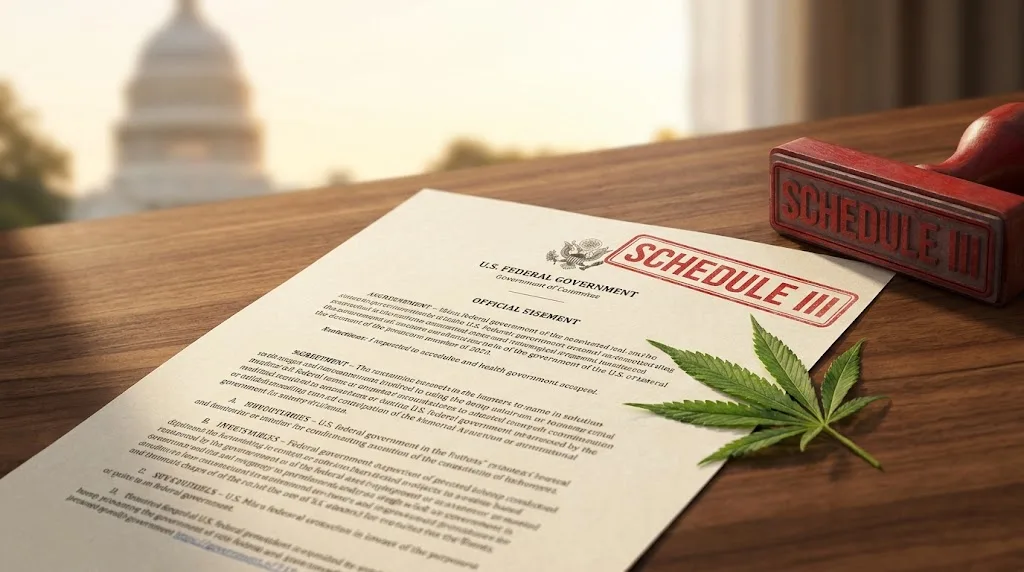
On April 23, 2026, Acting Attorney General Todd Blanche signed an executive order moving state-licensed medical marijuana from Schedule I to Schedule III (PBS NewsHour, 2026). National headlines called it the most significant federal cannabis policy shift in 50 years.
For North Carolina hemp consumers, the legal answer is simple: nothing changed. The political answer is more interesting.
NC is one of about 11 states that don't operate a state-licensed medical marijuana program. The federal order applies only to programs that exist. So the immediate practical effect on the 85 hemp dispensaries across the Triangle, on the products on their shelves, and on the laws governing what NC residents can legally buy is exactly zero.
What did change is political. The day after the order, NC Senate Leader Phil Berger said his chamber would revisit medical marijuana legalization, his most direct opening on the issue in eight years.
This article is for informational purposes only and does not constitute legal advice.
Update, September 12, 2026: The federal hemp deadline referenced below has shifted. H.R. 6500 became Public Law 119-103 on September 2, 2026, and its Section 2019 delays most of the new hemp definition, including the 0.4mg per container THC cap and the total-THC test that counts THCa, to December 11, 2026. A narrow piece covering cannabinoids the plant cannot naturally produce still begins November 12, 2026. Track it in our NC hemp bill tracker.
- On April 23, 2026, Acting AG Todd Blanche moved state-licensed medical marijuana from Schedule I to Schedule III (PBS NewsHour, 2026).
- NC has no state medical marijuana program, so the order has no direct effect on NC consumers, businesses, or laws today.
- Hemp products under P.L. 119-37 are unaffected. The December 11, 2026 hemp redefinition still stands.
- Senate Leader Phil Berger said April 24 his chamber will revisit medical marijuana, the most concrete legislative opening in eight years (WRAL, 2026).
What Exactly Did Trump Do on April 23?
The order is an executive action signed by Acting Attorney General Todd Blanche, not a final DEA rule. It moves marijuana under state-licensed medical programs from Schedule I (drugs with no recognized medical use and high abuse potential) to Schedule III (drugs with moderate to low dependence risk and accepted medical applications) (PBS NewsHour, 2026).
The legal mechanism matters. Blanche used a provision of federal drug law that lets the attorney general determine classifications for substances regulated under international treaty. That bypasses the multi-year DEA rulemaking process. A separate, broader rescheduling hearing through the DEA is scheduled to begin in late June 2026 and could expand the Schedule III designation beyond state-licensed medical programs.
Three things actually change at the federal level. First, licensed medical marijuana operators in the 40 states with medical programs become exempt from IRS Code Section 280E, which had blocked them from deducting standard business expenses like rent and payroll (CNBC, 2026). Second, federal cannabis research becomes far easier because Schedule III drugs don't require the heavy DEA Schedule I researcher registration. Third, Schedule III status opens limited banking access for licensed operators that had been blocked under Schedule I.
What stays the same matters more. The order does not legalize marijuana. It does not affect any state's criminal laws. It does not touch hemp. And critically, it does not apply to marijuana sold or possessed outside state-licensed medical programs. That second sentence is the one most national outlets buried.
Industry groups praised the move. Michael Bronstein, president of the American Trade Association for Cannabis and Hemp (ATACH), called it "the most significant federal advancement in cannabis policy in over 50 years." That framing is accurate at the federal level. It does not translate into state-level effects in places like North Carolina.
Does Schedule III Legalize Marijuana in North Carolina?
No. Possessing, selling, or distributing marijuana in North Carolina remains a state crime, exactly as it was on April 22 (NC General Assembly). The Schedule III order applies only to marijuana under state-licensed medical programs, and NC doesn't have one. About 11 states don't, and NC is one of them.
This is the part that confused a lot of news consumers. Federal reclassification doesn't override state law. A North Carolinian who possesses marijuana on April 25 faces the same charges as one who possessed it on April 22: a Class 3 misdemeanor for under 0.5 ounce, a Class 1 misdemeanor for 0.5 to 1.5 ounces, and a Class I felony above 1.5 ounces. The Schedule III order gives the state no new authority and creates no medical defense. It simply doesn't reach NC.
Why doesn't NC have a medical marijuana program? Not for lack of trying. The NC Senate has passed the Compassionate Care Act, sponsored by Republican Sen. Bill Rabon, in multiple sessions. It cleared the chamber 36 to 10 in March 2023 (as SB 3) with strong bipartisan support, after a similar Senate passage of SB 711 in 2022 (NC General Assembly). The NC House has never allowed a floor vote, and the bill has died each time in the House Rules Committee.
The neighboring picture looks different. Virginia legalized adult-use cannabis and is moving toward licensed retail sales. South Carolina has a limited CBD-only program. Georgia and Tennessee operate restricted medical CBD frameworks but no comprehensive medical cannabis. NC is the regional outlier on broad medical access.
For the full breakdown of NC's current cannabis laws and the historical reasons for the gap, see our guide on whether weed is legal in North Carolina and the hemp vs. marijuana legal distinction.
Does This Affect Hemp, THCa, or Delta-8 in NC?
No. Hemp-derived products operate under a completely separate federal framework: the 2018 Farm Bill (and starting December 11, 2026, P.L. 119-37). Schedule III applies only to marijuana under state-licensed medical programs and has no legal connection to hemp (Congressional Research Service, 2025). Triangle dispensaries continue selling THCa flower, Delta-8, Delta-9 gummies, and CBD products under the existing rules.
This separation isn't a quirk. Hemp and marijuana are defined as legally distinct substances under federal law, even though both come from the same Cannabis sativa plant. The Farm Bill carved hemp out of the Controlled Substances Act in 2018 by defining it as cannabis with no more than 0.3% Delta-9 THC by dry weight. That definitional carve-out is what made NC's hemp market possible. Schedule III doesn't touch the Farm Bill or the hemp definition, so hemp-derived products remain on their parallel track.
The track that does matter for hemp is P.L. 119-37, signed in November 2025. It redefines hemp using total THC (counting THCa, Delta-8, and other variants) and caps finished products at 0.4mg of total THC per container. The U.S. Hemp Roundtable estimates that change will eliminate roughly 95% of current hemp products when it takes effect on December 11, 2026 (Frier Levitt, 2026).
That's the deadline NC hemp consumers and dispensary operators should actually plan around. Schedule III doesn't help and doesn't hurt. Two parallel federal frameworks now govern cannabis policy: one for marijuana (which moved on April 23) and one for hemp (which changes on November 12). For a complete breakdown of what survives and what disappears, read our comprehensive NC hemp law update and the P.L. 119-37 dispensary preparation guide.
How NC Lawmakers Responded, and Why Berger's Reaction Matters
The day after the federal order, NC Senate Leader Phil Berger told reporters his chamber would revisit medical marijuana legalization. "We'll have a conversation within our caucus as to whether or not we do something if they're interested," Berger said (WRAL, 2026). For NC cannabis politics, that's the most direct legislative opening in eight years.
Why does that one quote matter so much? Because the NC Senate has already passed the Compassionate Care Act, the medical-only bill sponsored by Republican Sen. Bill Rabon. It's the House that has refused to vote. Berger's caucus controls the chamber that has been the consistent yes. The political holdup has always been the House, where Speaker Destin Hall (and previously Speaker Tim Moore) declined to bring the bill to the floor.
Hall did not respond to WRAL's requests for comment after the federal order. Sen. Rabon, who has spoken publicly about supporting medical cannabis based on his personal experience with cancer treatment, also declined an interview. The on-record reactions were limited. But Berger's statement is the one that carries weight, because it suggests the Senate is willing to act if there's a path forward.
Governor Josh Stein's NC Advisory Council on Cannabis added context. Earlier in April, the 25-member panel had already recommended legalizing marijuana for adults 21 and older through a regulated retail system (WRAL, 2026). The council pointed out that states with regulated adult-use cannabis collect between roughly $33 million and $552 million annually in tax revenue. Stein's office reiterated that argument the day of the federal order.
The political math just shifted. For eight years, NC Republican leadership had a built-in reason to stall: federal Schedule I status made any state-level move politically risky for socially conservative voters. Schedule III removes most of that cover. A medical-only bill would now align NC with both federal acknowledgment of medical use and the bipartisan policy direction Berger seems prepared to consider.
What's still missing is a House signal. Until Hall or another senior House Republican publicly opens the door, the path remains theoretical. The earliest realistic passage window is the 2027 long session, after Stein's Cannabis Council issues its final recommendations on December 31, 2026. For more on the council's framework, see our coverage of Stein's marijuana legalization recommendation.
What Happens at the Dispensary Counter Tomorrow?
Nothing. If you walked into one of the 85 hemp dispensaries across the Triangle on April 22 and walked back in on April 24, the products, the prices, and the laws governing the sale are identical. Schedule III didn't reach NC, didn't touch hemp, and didn't open any new product categories. The law that will change everything at the counter is still P.L. 119-37, hitting on December 11, 2026.
The Triangle hemp market remains exactly what it was last week. THCa flower is still sold legally at dispensaries from Raleigh to Chapel Hill to Apex. Delta-8 gummies, Delta-9 edibles, and CBD products continue to operate under SB 455 (the 2022 NC law that aligned the state with the federal hemp definition). Age verification, third-party testing, and existing labeling rules stay in place.
What's worth noting: the Schedule III order won't unlock medical access for NC veterans, won't open dispensary licenses to anyone, won't legalize home cultivation, and won't help anyone with a prior NC marijuana conviction. The order's benefits (research access, banking, the 280E exemption) accrue to licensed operators in states that already have programs. NC has none, so the benefits land elsewhere.
If you're shopping at a Triangle hemp shop today, the relevant calendar still has one date circled: November 12. Read our guide to legally buying cannabis in Raleigh for the current product landscape, or browse the full Triangle dispensary directory for shops near you.
The 2026 Federal and NC Timeline Ahead
Three milestones in 2026 will determine NC's cannabis path. The DEA's broader rescheduling hearing begins in late June and could expand Schedule III beyond state-licensed medical programs. P.L. 119-37 takes effect November 12 and rewrites the hemp definition. Stein's Cannabis Council issues final recommendations on December 31. None of those events depends on NC's General Assembly, but each will shape what the legislature confronts in the 2027 long session.
The DEA hearing is the federal wildcard. The Schedule III order Blanche signed used a treaty provision to skip the formal rulemaking process for state-licensed medical programs only. The June 2026 hearing follows the standard DEA process and could result in a broader, more durable Schedule III designation that covers more than just state-licensed medical use. If that happens, the federal pressure on NC's holdout status increases.
P.L. 119-37 is the bigger immediate disruptor. The U.S. Hemp Roundtable's estimate of 95% product elimination affects a NC hemp industry that supports roughly 9,000 jobs and generates up to $1.1 billion in annual sales (Port City Daily, 2025). The November 12 deadline isn't theoretical. There's no grace period, no grandfather clause for existing inventory, and no federal indication that the deadline will move.
The NC Cannabis Council's December 31 final recommendations close out the year. The interim report already endorses adult-use legalization with a "molecule-based" framework that would unify hemp and marijuana regulation under one system. That report becomes the legislative blueprint Republican leadership has at their disposal entering 2027. Berger's April 24 caucus comment, paired with the council's December roadmap, sets up a more concrete legislative session than NC has seen since the Compassionate Care Act first passed the Senate.
What This Means for NC Hemp Consumers
Two dates matter for anyone buying hemp in NC: December 11, 2026 (real, immediate, affects everything you buy) and the 2027 NC General Assembly session (the realistic earliest passage window for any state cannabis legislation). The Schedule III order doesn't change either timeline. It just changed the political backdrop.
What to do now? Nothing urgent. Triangle hemp shops continue operating under existing law. Products on shelves today remain legal until November 12. If you want to stock up before the federal hemp deadline, the next several months are the relevant window. After November 12, the legal product mix will shift toward CBD, CBN, CBG, and other non-THC compounds while NC waits to see whether the legislature acts.
Watch Berger and Hall in the 2026 short session and the 2027 long session. Watch the December 31 council report. Watch the late-June DEA hearing. None of those moments will change the November 12 hemp deadline, but together they'll determine whether NC has a state cannabis market by 2028 or stays the regional outlier for another decade.
Frequently Asked Questions
Did Trump legalize marijuana on April 23, 2026?
No. Acting Attorney General Todd Blanche signed an executive order moving state-licensed medical marijuana from Schedule I to Schedule III (PBS NewsHour, 2026). Marijuana remains federally controlled and remains illegal in any state without a medical program, including North Carolina. No federal or state law was repealed.
Can I buy medical marijuana in NC now?
No. The Schedule III order applies to state-licensed medical marijuana programs, and NC is one of about 11 states that don't operate one. Possessing or distributing marijuana in North Carolina remains a state crime. The NC Senate has passed the Compassionate Care Act multiple times, but the House has never allowed a floor vote.
Does Schedule III affect THCa flower or Delta-8 in NC?
No. Hemp-derived products fall under the 2018 Farm Bill (and starting December 11, 2026, P.L. 119-37), not the Controlled Substances Act drug schedules. The Schedule III order doesn't touch hemp. THCa, Delta-8, Delta-9 gummies, and CBD products continue to operate under existing federal and NC state hemp law.
Will NC pass medical marijuana now that it's federally Schedule III?
Possibly, but not immediately. Senate Leader Phil Berger said April 24 his chamber would revisit medical marijuana, his most direct opening in eight years (WRAL, 2026). The bigger obstacle is the NC House. The realistic earliest passage window is the 2027 long session, after Stein's Cannabis Council issues its final recommendations on December 31, 2026.
Does Schedule III change anything at NC dispensaries today?
No. The 69 Triangle hemp shops continue selling under existing state and federal law. The December 11, 2026 hemp deadline (P.L. 119-37) is the change you should plan for, not Schedule III. For an operational breakdown of what dispensary owners need to do before the federal hemp redefinition takes effect, see our P.L. 119-37 preparation guide.
The Bottom Line
The Schedule III order is real federal news. Its NC effect is real federal silence. Three things to remember:
- It doesn't apply to NC consumers. No medical program means no Schedule III benefit, and the order doesn't override NC's state criminal laws on marijuana possession.
- Hemp is on a separate track. The December 11, 2026 P.L. 119-37 deadline is the change you should actually plan for. THCa, Delta-8, and Delta-9 products on Triangle shelves today remain legal until that date.
- Watch Berger. His April 24 statement is the most concrete NC legislative opening on medical marijuana in eight years. The 2027 long session is the earliest realistic passage window.
Want to see what's currently legal at NC dispensaries? Browse the Triangle dispensary directory for 86 shops across the region. For the federal hemp law that does affect you, read our comprehensive NC hemp law update.