Hemp vs. Marijuana in NC: What's the Difference?
This article is for informational purposes only and does not constitute legal, medical, or product advice. Consult a qualified professional for guidance specific to your situation.
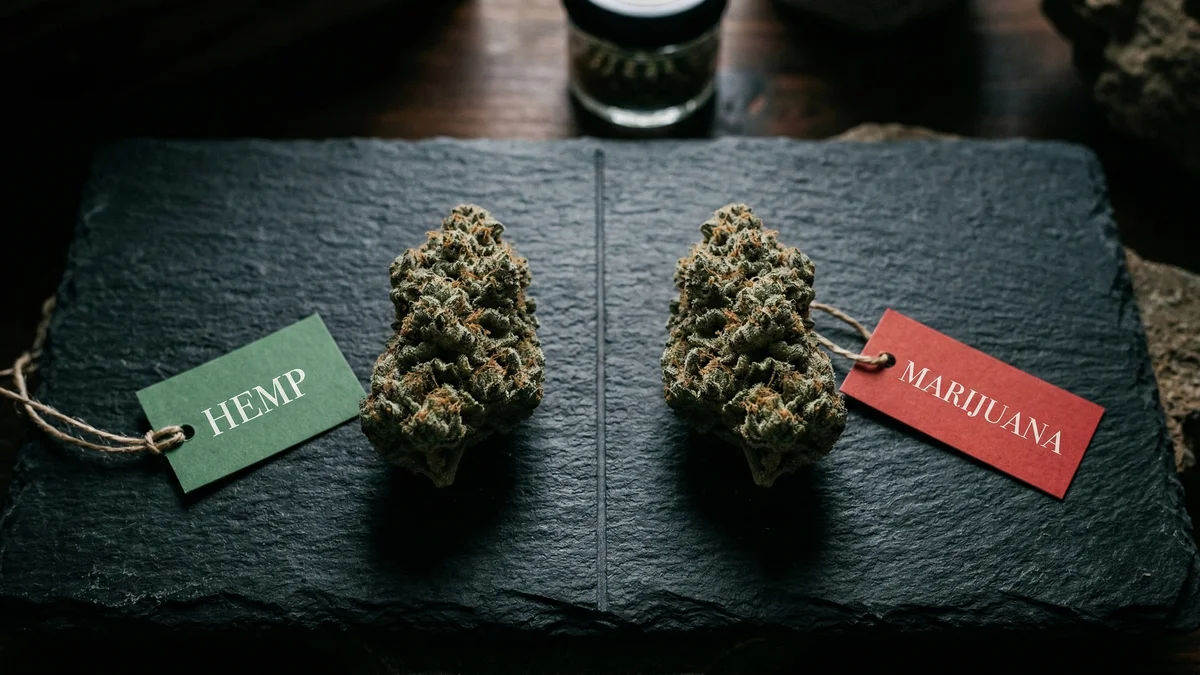
Hemp and marijuana are the same plant. Genetically, botanically, and visually, they're both Cannabis sativa L. The NC State Bureau of Investigation has warned that hemp and marijuana look the same and have the same odor, burned or unburned. The only difference is legal, based on how much THC the plant contains at harvest.
In North Carolina, that single number, 0.3% Delta-9 THC by dry weight, determines whether you're holding a legal product or a Schedule VI controlled substance.
Hemp and marijuana are the same species (Cannabis sativa L.). NC law defines hemp as cannabis with ≤0.3% Delta-9 THC (legal under SB 455 and the Farm Bill) and marijuana as cannabis exceeding that threshold (Schedule VI, with penalties from a $200 fine to felony charges). THCa flower blurs this line, it's legal hemp but produces marijuana-like effects when smoked. A federal law taking full effect December 11, 2026 will narrow this distinction significantly (UNC SOG, 2026; P.L. 119-103, Section 2019).
Update, October 10, 2026: The federal hemp deadline referenced below has shifted. H.R. 6500 became Public Law 119-103 on September 2, 2026, and its Section 2019 delays most of the new hemp definition, including the 0.4mg per container THC cap and the total-THC test that counts THCa, to December 11, 2026. A narrow piece covering cannabinoids the plant cannot naturally produce still begins November 12, 2026. Still current as of this update. Track it in our NC hemp bill tracker.
North Carolina status, October 10, 2026: HB 328, the state hemp crackdown, passed the Senate in July but still awaits a House vote, which can come in the reconvened sessions between October 26 and December 18. Today North Carolina sets no minimum age for hemp products, though many shops card at 21. Details in our NC hemp bill tracker.
The Legal Definition
The 2018 Farm Bill drew the legal line. It defined hemp as Cannabis sativa L. with a Delta-9 THC concentration of no more than 0.3% on a dry weight basis and removed it from the federal Controlled Substances Act. Anything above that threshold is marijuana under federal law.
NC Session Law 2022-32 (SB 455) brought the state into alignment. As enacted in 2022, it amended G.S. 90-94 to exclude "tetrahydrocannabinols found in hemp or hemp products" from North Carolina's Controlled Substances Act; today that exclusion covers tetrahydrocannabinols "found in a product with a delta-9 tetrahydrocannabinol concentration of not more than three-tenths of one percent (0.3%) on a dry weight basis." Marijuana, defined in G.S. 90-87(16), remains listed in Schedule VI under G.S. 90-94 (G.S. 90-94).
One law. One threshold. Same plant, two completely different legal realities. For a broader look at what's legal and what isn't, see our guide on whether weed is legal in North Carolina. And for the federal Schedule III order announced April 23, 2026, see what the federal Schedule III order means in NC.
NC Marijuana Penalties: The Cliff Effect
North Carolina actually has some of the most lenient marijuana penalties in the Southeast. But there's a sharp escalation that catches people off guard.
Possession of a half-ounce or less is a Class 3 misdemeanor, a $200 fine with no jail time for a first offense. But jump above 1.5 ounces and you're looking at a Class I felony. That's a steep cliff from a parking-ticket-level fine to a criminal record that follows you for life.
That penalty structure makes the hemp-vs-marijuana distinction critically important. If you're carrying a product that tests above 0.3% Delta-9 THC, it doesn't matter that you bought it at an established dispensary (NC does not license hemp shops); it's marijuana under NC law.
The Cannabinoids: What's Actually Inside
Both hemp and marijuana contain the same cannabinoids. The difference is the ratio. Here's what you'll find in both:
THC (Delta-9 Tetrahydrocannabinol): The primary psychoactive compound. Marijuana typically contains 15-30%+ Delta-9 THC. Hemp must stay under 0.3%.
CBD (Cannabidiol): Non-psychoactive. Hemp is typically bred for high CBD content (10-20%), while marijuana strains usually contain less than 1-2% CBD.
THCa (Tetrahydrocannabinolic Acid): The raw, non-psychoactive precursor to THC. This is where things get complicated. Hemp flower can legally contain 20-30% THCa because current testing only measures Delta-9 THC, not THCa. But when you smoke or heat THCa, it converts to Delta-9 THC through decarboxylation (at a factor of 0.877). That means legal THCa hemp flower produces effects that are essentially identical to marijuana.
Delta-8 THC: A milder psychoactive cannabinoid found in trace amounts in both hemp and marijuana. Most Delta-8 products sold in stores are manufactured from CBD through isomerization.
CBG, CBN, CBC: Minor cannabinoids present in both plants. Non-intoxicating or mildly sedating. Increasingly found in specialty hemp products.
The THCa Gray Area
This is the biggest wrinkle in the hemp-vs-marijuana distinction, and it's worth understanding.
Under current law, hemp testing measures only Delta-9 THC in its natural state, before any heat is applied. THCa is a different molecule than Delta-9 THC (it has an extra carboxyl group), so it's not counted toward the 0.3% limit.
That means a hemp flower product with 25% THCa and 0.2% Delta-9 THC is legal hemp. But when you light it, nearly all that THCa converts to Delta-9 THC. A single gram produces roughly 219mg of total THC, the same as high-grade marijuana.
The SBI's warning that officers cannot tell hemp from marijuana by sight or smell has created real challenges for law enforcement. The NC Supreme Court heard oral arguments in September 2025 on whether the odor of marijuana still supports probable cause for a search, given that legal hemp smells identical. On May 22, 2026, in State v. Dobson and State v. Rowdy, the court unanimously held that the odor of cannabis remains one factor in a totality-of-the-circumstances probable cause analysis; it did not decide whether odor alone is enough. It dismissed the third case, State v. Scheine, in August 2026 (UNC SOG, 2026).
How December 11, 2026 Changes Everything
The federal law signed in November 2025 (P.L. 119-37), which takes full effect December 11, 2026 under Section 2019 of P.L. 119-103 (enrolled text), switches from measuring only Delta-9 THC to measuring total THC, which includes THCa, Delta-8, Delta-10, and every other THC variant. The new limits: 0.3% total THC by dry weight AND 0.4mg total THC per finished container (Perkins Coie, 2025).
This change narrows the legal gap between hemp and marijuana dramatically:
- THCa flower with 25% THCa would have ~21.9% total THC, far above 0.3%. No longer legal hemp.
- Delta-9 gummies: a single 15mg gummy is 37.5 times the 0.4mg cap for the whole container, and a multi-gummy container exceeds it by far more. No longer legal hemp.
- Delta-8 products converted from CBD fall under the new exclusion for cannabinoids synthesized outside the plant, and Delta-8 also counts toward total THC. No longer legal hemp.
After December 11, 2026, legal hemp products will essentially be limited to CBD oils, CBG products, and other non-intoxicating cannabinoids. The "gray area" where hemp products delivered marijuana-like effects closes almost entirely.
NC's hemp industry, supporting nearly 9,000 jobs and generating up to $1.1 billion in annual sales (Port City Daily, citing Whitney Economics, 2025), faces massive disruption. At the state level, the licensing bill HB 607 (proposed Chapter 18D) never left committee and cannot move before the 2026 session ends; the live state bill is HB 328, which would write a similar total-THC standard into NC law if the House adopts it. Governor Stein's Advisory Council on Cannabis issued its interim report in April 2026, with final recommendations due December 31, 2026 (Governor's Office, 2025).
Drug Tests Don't Know the Difference
This is the practical reality every hemp consumer needs to understand: standard drug tests cannot distinguish between hemp-derived THC and marijuana-derived THC.
Whether you smoke THCa hemp flower, eat a Delta-9 gummy, or vape Delta-8, your body metabolizes all THC into the same compound, THC-COOH (11-nor-9-carboxy-delta-9-THC). That's what standard immunoassay drug tests detect, with a typical cutoff of 50 ng/mL.
Detection windows in urine vary by usage, according to a 2017 Mayo Clinic Proceedings review (Moeller et al.):
- Single use: about 3 days
- Moderate use (about 4 times/week): 5-7 days
- Daily use: 10-15 days
- Long-term heavy use: more than 30 days
If you're subject to workplace drug testing, using any THC product, even perfectly legal hemp, puts you at risk. There is currently no commercially available test that can tell your employer whether the THC came from a legal or illegal source.
Traveling with Hemp in NC
Within North Carolina, transporting legal hemp products is lawful under SB 455. But there are practical considerations:
- Keep your receipt and COA. If you're stopped by law enforcement and they find flower that looks and smells like marijuana, documentation showing it's legal hemp is your best protection.
- Leave products in original packaging. Sealed, labeled packaging from an established retailer makes your case much stronger than loose flower in a plastic bag.
- Interstate travel is complicated. Section 10114 of the 2018 Farm Bill (a note to 7 U.S.C. 1639o) bars states from prohibiting the transport of lawful hemp, but after December 11, 2026 it protects only products that meet the new federal definition. A growing number of states also ban or restrict Delta-8 and other hemp cannabinoids. If you're driving through Virginia, South Carolina, or any border state, check their specific laws first.
- Air travel. TSA says its officers do not search for illegal drugs but will refer anything illegal they find to law enforcement. Its page does not mention hemp at all, so what matters is whether the product is lawful hemp under federal law and the law where you land (TSA). Carrying a COA is advisable. Our traveling with hemp guide covers the details.
The bottom line: legal hemp is legal to transport, but law enforcement can't tell what you have by looking at it. Documentation protects you.
NC Marijuana Reform: Where Things Stand

North Carolina doesn't have a medical marijuana program, recreational legalization, or decriminalization at the state level. But the conversation is shifting.
Governor Stein's Advisory Council on Cannabis (Executive Order No. 16, June 2025) lists 27 members plus two co-chairs, State Health Director Dr. Lawrence Greenblatt and District Attorney Matt Scott. Its interim report, released in April 2026, carried the co-chairs' recommendation for a regulated adult-use market; final recommendations are due December 31, 2026.
HB 413 (Marijuana Legalization and Reinvestment Act) was filed in March 2025, proposing full recreational legalization for adults 21+, with 2-ounce possession limits, 6-plant home cultivation, and a 30% excise tax. It was referred to the House Rules Committee.
HB 607 (Regulate Hemp Consumable Products) would create a regulated hemp market under proposed Chapter 18D: mandatory 21+ age verification, 25mg THC per serving for non-liquid edibles (10mg per serving and 100mg per package for drinks), COA requirements, and ALE enforcement (bill text). It has sat in House Rules since April 2025.
None of these three can pass before the 2026 session ends on December 18; under the adjournment resolution, the only hemp bills still eligible are the HB 328 conference report and the SB 328 age bill. Still, the trajectory is clear: NC is moving toward regulation, not continued ambiguity.
Frequently Asked Questions
Is hemp the same thing as marijuana?
Yes, botanically. Hemp and marijuana are both Cannabis sativa L., the same plant species. The distinction is entirely legal: hemp contains ≤0.3% Delta-9 THC by dry weight (legal in NC), while marijuana exceeds that threshold (Schedule VI controlled substance in NC). You cannot visually distinguish them, which the NC State Bureau of Investigation has publicly acknowledged.
Can I get high from hemp products?
Yes, depending on the product. Hemp-derived THCa flower, Delta-8 products, and Delta-9 gummies all produce psychoactive effects. These products are legal in NC because they meet the Farm Bill's Delta-9 THC threshold, but they can and do cause intoxication. CBD-only products do not cause a high.
What happens if I'm caught with marijuana in NC?
For possession of 0.5 ounces or less, it's a Class 3 misdemeanor, maximum $200 fine, no jail time for a first offense. More than 0.5 up to 1.5 ounces is a Class 1 misdemeanor, with 1 to 45 days in jail for most first offenders (up to 120 days with prior convictions). Possessing more than 1.5 ounces is a Class I felony, even without any intent to sell, carrying 3-8 months. Selling marijuana is a Class H felony regardless of amount.
Will NC legalize marijuana?
There's no immediate timeline, but momentum is building. The Compassionate Care Act passed the Senate as SB 711 (36-7, June 2022) and again as SB 3 (36-10, March 2023) but died in the House both times. HB 413 (2025) proposed full legalization but hasn't advanced past committee. However, the co-chairs of Governor Stein's Advisory Council on Cannabis recommended a regulated adult-use market in April 2026, calling for a "molecule-based" regulatory system that would unify hemp and marijuana frameworks. The Republican-led legislature hasn't committed to action yet, but the council's final framework is due December 31, 2026.
Does buying hemp support marijuana legalization?
Not directly. However, the growth of NC's hemp industry, supporting nearly 9,000 jobs and up to $1.1 billion in sales, demonstrates that cannabis commerce can be conducted safely and responsibly. Many hemp industry advocates argue that a regulated market is preferable to the unregulated status quo.
The Bottom Line
Hemp and marijuana are the same plant with different legal treatment. In NC, that 0.3% Delta-9 THC threshold is the line between a legal purchase and a potential felony. Products like THCa flower, Delta-8 vapes, and Delta-9 gummies exist in a space where the effects resemble marijuana but the legal status is hemp.
That space is shrinking. The December 11, 2026 federal deadline will close most of the gray areas, and NC's pending HB 328 would write a similar standard into state law if the House adopts it. In the meantime, buy from reputable dispensaries, keep your documentation, and understand exactly what's in the products you're using.
Looking for lab-tested hemp products? Browse our full directory of Triangle dispensaries to find verified retailers near you.
This article is for informational purposes only and does not constitute legal advice. Cannabis laws change frequently at both the state and federal level. Consult a licensed attorney for advice on your specific situation. Information is current as of October 10, 2026.