Is THCa Legal in NC? Yes, Until the 2026 Federal Deadline
This article is for informational purposes only and does not constitute legal, medical, or product advice. Consult a qualified professional for guidance specific to your situation.
Is THCa Legal in North Carolina?
Yes, THCa (tetrahydrocannabinolic acid) is currently legal in North Carolina. Hemp-derived THCa products are protected under both federal law (the 2018 Farm Bill) and state law (Session Law 2022-32, enacted via SB 455). As long as the product comes from hemp containing less than 0.3% Delta-9 THC on a dry weight basis, it's legal to buy, sell, and possess in NC. This is the same hemp-versus-marijuana split that explains why weed is technically illegal in NC while THC products stay legal.
But here's the catch most people miss: THCa converts into Delta-9 THC when you smoke or vape it. That's exactly why it's so popular, and exactly why the federal government is closing the loophole. A new federal law signed in November 2025 redefines hemp based on total THC, which explicitly includes THCa. That ban takes effect December 11, 2026.
THCa is legal in North Carolina today under SB 455 and the 2018 Farm Bill because compliance testing measures only delta-9 THC before decarboxylation. However, P.L. 119-37 redefines hemp using total THC (including THCa) with a 0.4mg per container cap, effectively banning all THCa flower and most THCa products starting December 11, 2026. NC's hemp industry generates up to $1.1 billion in annual sales and supports roughly 9,000 jobs (Port City Daily, 2025).
Update, October 10, 2026: The delay is law, and nothing since has changed it. The President signed H.R. 6500 on September 2, 2026, and it became Public Law 119-103, after the Senate passed it 90-6 on August 8 and the House agreed to the Senate's version 370-48 on September 1. Its Section 2019 splits the P.L. 119-37 hemp rewrite across two dates. On November 12, 2026, one narrow piece takes effect: intermediate and final products containing cannabinoids that a Cannabis sativa L. plant cannot naturally produce. Everything else waits until December 11, 2026 (Section 2019, enrolled text). That remainder is the part that reaches the shelf: the 0.3 percent total-THC test that counts THCa, the exclusion for cannabinoids the plant can make but that were synthesized outside it (which is where delta-8 made from CBD falls), and the 0.4mg total-THC-per-container cap that reaches nearly every gummy, tincture, and vape. December 11 is also the day the stopgap funding law runs out, so Congress could still move the date in its next funding bill; as of this update it has not. Our NC hemp bill tracker follows what happens next, and our December 11 report counts what the change reaches across Triangle shops.
What Is THCa?
THCa is the most abundant cannabinoid in living cannabis plants. It's the raw, acidic precursor to Delta-9 THC, the compound responsible for marijuana's psychoactive effects. In its natural state, THCa is non-psychoactive because its molecular structure includes a carboxyl group (-COOH) that prevents it from binding to CB1 receptors in your brain (NIH).
When THCa is heated, through smoking, vaping, or cooking, it undergoes a chemical reaction called decarboxylation. That carboxyl group breaks off as CO2 gas, converting THCa into Delta-9 THC. Research published in Cannabis and Cannabinoid Research found THCa approached zero after about 30 minutes at 110°C (Wang et al., 2016).
The conversion isn't perfectly 1:1 because of the molecular weight difference. THCa weighs 358.48 g/mol while THC weighs 314.47 g/mol. The industry uses a standard conversion factor of 0.877, meaning a product with 25% THCa yields roughly 21.9% total THC when heated (Confidence Analytics).
This is why THCa flower is so popular. When you smoke or vape it, the effects are essentially identical to traditional cannabis. A gram of flower with 25% THCa contains about 219mg of total THC, well within the range of dispensary-grade marijuana in legal states.
Common THCa products you'll find at Triangle dispensaries:
- Flower and pre-rolls: Dried, cured buds containing high THCa. The most popular format and the fastest-growing product category in hemp retail.
- Diamonds and concentrates: Crystallized THCa isolate, often exceeding 90% purity. See our concentrates guide for details. Some dispensaries carry diamond-infused flower coated with THCa crystals and terpene sauce.
- Live rosin and sugar badder: Solventless concentrates that preserve the plant's original terpene profile.
- Edibles and gummies: THCa-infused products that require decarboxylation during preparation to activate.
Why Is THCa Legal? The Loophole Explained
The legal status of THCa comes down to how hemp is tested, specifically, when it's tested.
The 2018 Farm Bill removed hemp from the federal Controlled Substances Act and defined it as Cannabis sativa L. with "a delta-9 tetrahydrocannabinol concentration of not more than 0.3 percent on a dry weight basis." The critical word is "delta-9." The law doesn't mention THCa, total THC, or what happens after you light the product on fire. It measures one specific compound in the raw plant material (Congress.gov).
Here is how that definition compares with the one Congress has now written:
NC Session Law 2022-32 (SB 455) aligned North Carolina's state law with the federal framework. Signed by Governor Roy Cooper, it amended G.S. 90-94 to exclude "tetrahydrocannabinols found in hemp or hemp products" from the NC Controlled Substances Act. North Carolina's definition mirrors the federal one: it counts only delta-9 THC (NC General Assembly).
A quick note on accuracy: Many cannabis websites cite "SB 352" as the law that legalized hemp products in NC. That's wrong. SB 352 passed the NC Senate 49-0 in May 2019 but died in the House and was never enacted. SB 455, passed in the 2021-2022 session, is the actual law. You can verify this on the NC General Assembly's website.
The 9th Circuit Court of Appeals reinforced this framework in AK Futures LLC v. Boyd Street Distro (2022). While that case specifically addressed Delta-8, the court's reasoning applies broadly: "Regardless of the wisdom of legalizing delta-8 THC products, this Court will not substitute its own policy judgment for that of Congress." The court held that if the Farm Bill inadvertently created a loophole, "it is for Congress to fix its mistake" (9th Circuit).
Congress is now doing exactly that.
What's Changing? The December 2026 Federal Ban
On November 12, 2025, the Continuing Resolution and Appropriations Package (P.L. 119-37) was signed into law. It fundamentally rewrites how hemp is defined at the federal level, and THCa flower is the single most affected product category.
The new law switches from measuring only delta-9 THC to measuring total THC, which explicitly includes THCa. The new limits are: 0.3% total THC on a dry weight basis AND no more than 0.4 milligrams of total THC per finished container (Arnold & Porter, 2025).
Why this devastates THCa flower specifically: A typical gram of THCa flower contains 25% THCa. Using the 0.877 conversion factor, that's roughly 219mg of total THC, in a single gram. The new federal cap is 0.4mg per container. That's a difference of over 500 times. There is no way to reformulate THCa flower to meet this standard. Under P.L. 119-37, virtually all THCa flower becomes Schedule I marijuana.
The rewrite was written to take effect one year after enactment, on November 12, 2026, but a later funding law, P.L. 119-103, held most of it, including the total-THC test that reaches THCa, to December 11, 2026 (Section 2019, enrolled text). The FDA was also required to publish lists of naturally occurring cannabinoids and THC-class compounds within 90 days of enactment; as of September 28, 2026, those lists had not been published (Congressional Research Service).
UNC School of Government professor Phil Dixon noted in January 2026 that "state law in this area has not changed and all the hemp products discussed above remain legal as a matter of state law" (UNC SOG). But once the federal ban kicks in, the state-federal conflict creates serious enforcement uncertainty.
What Is North Carolina Doing About It?
North Carolina isn't sitting idle, though nothing has become law yet. Here is where the state-level efforts stand:
Governor Stein's Advisory Council on Cannabis (Executive Order No. 16): Established in June 2025, the council is co-chaired by State Health Director Dr. Lawrence Greenblatt and Robeson County District Attorney Matt Scott. Its charge is to develop recommendations for regulating cannabis products in NC, including youth protection, consumer safety, and supporting NC agriculture (Governor's Office). Its interim report, released in early April 2026, called for a regulated adult market in which adults could buy cannabis through state-licensed retail outlets (NORML, 2026). No legislation has followed yet, and final recommendations are due December 31, 2026.
HB 328, the live state bill: HB 328's conference report would rewrite NC's hemp definition to count total THC, including THCa, exclude synthetic or chemically converted cannabinoids, cap finished products at 0.4mg total THC per container starting November 12, 2026, and make 21 the legal purchase age. The Senate adopted it 37-6 on July 2, 2026; it sits in House Rules and can still get a House vote in the reconvened sessions that run through December 18, 2026 (NC General Assembly). If adopted as written, it would remove THCa flower from NC's hemp definition about a month before the federal change.
North Carolina status, October 10, 2026: HB 328, the state hemp crackdown, passed the Senate in July but still awaits a House vote, which can come in the reconvened sessions between October 26 and December 18. Today North Carolina sets no minimum age for hemp products, though many shops card at 21. Details in our NC hemp bill tracker.
HB 607, Regulate Hemp Consumable Products: Filed March 31, 2025, this bill would have created Chapter 18D, a licensing framework for hemp products, with 21+ age verification, child-resistant packaging, COA requirements from accredited labs, potency caps of 25mg THC per serving for non-liquid edibles and 10mg per serving and 100mg per package for liquid ones, and ALE Division enforcement. It kept the 0.3% delta-9 THC threshold rather than total THC. It has sat in House Rules since April 2025, its proposed July 1, 2026 effective date has passed, and under the 2026 adjournment resolution it cannot be taken up again this session (NC General Assembly).
HB 413, Marijuana Legalization and Reinvestment Act: Filed March 18, 2025, this bill would legalize recreational marijuana for adults 21+, allowing possession of up to 2 ounces and cultivation of 6 plants. It proposes a 30% excise tax with social equity and expungement provisions. It has sat in the Rules Committee since 2025 and cannot move in the 2026 reconvened sessions (NC General Assembly).
The key tension: If the House adopts HB 328, North Carolina would adopt its own total-THC standard on November 12, 2026, a month ahead of the federal date. If nothing passes, North Carolina keeps its delta-9-only standard while the federal government enforces a total THC standard. As UNC School of Government's Phil Dixon noted, hemp products could then remain legal under state law even after they become federally illegal. How that conflict plays out in practice, especially for shipping, banking, and interstate commerce, remains unclear.
THCa vs. Delta-8: What's the Difference?
Both THCa and Delta-8 are hemp-derived cannabinoids sold legally in North Carolina, but they're very different products.
THCa is a naturally occurring compound found abundantly in cannabis plants. No synthetic conversion is needed, growers simply cultivate high-THCa hemp strains. When heated, THCa converts to Delta-9 THC, producing effects identical to traditional marijuana at full potency.
Delta-8 THC occurs naturally in only trace amounts. The Delta-8 products at dispensaries are manufactured by converting CBD through a chemical process called isomerization. The FDA has flagged this process, noting that some producers use "potentially unsafe household chemicals" (FDA, 2022). Effects are generally described as milder than Delta-9, with a clearer headspace.
From a safety standpoint, THCa flower is a natural plant product. The primary quality risks are the same as any agricultural product: pesticides, heavy metals, and microbial contaminants. Delta-8 products carry additional risk from the isomerization process itself, which can introduce harmful by-products if not properly purified.
Both will cause a positive result on standard drug tests, and both face the same December 2026 federal deadline. For a deeper dive on Delta-8 specifically, see our complete Delta-8 legal guide.
Will THCa Show Up on a Drug Test?
Yes. If you smoke, vape, or otherwise heat THCa, it converts to Delta-9 THC in your body. Standard drug tests screen for THC-COOH (11-nor-9-carboxy-delta-9-tetrahydrocannabinol), the primary metabolite your liver produces when it processes THC. There is no way for a drug test to distinguish between THC from THCa flower and THC from traditional marijuana (NIH).
Detection windows vary based on usage:
- Single use: about 3 days
- Moderate use (a few times per week): 5-7 days
- Daily use: 10-15 days
- Chronic heavy use: 30+ days
The standard screening cutoff is 50 ng/mL for immunoassay tests, with confirmatory testing at 15 ng/mL using chromatography (NIH). If you're subject to workplace drug testing, treat THCa exactly like marijuana, because that's what your test results will show.
What Should You Look for When Buying THCa?
The lack of state-level manufacturing oversight means product quality varies widely. Here's what separates a reputable dispensary from a gas station selling mystery gummies:
- Certificate of Analysis (COA): Every THCa product should have third-party lab results from an accredited laboratory. The COA should cover cannabinoid potency, pesticide residues, heavy metals (lead, arsenic, mercury, cadmium), microbial contaminants, mycotoxins, and residual solvents. If a shop can't show you the COA, walk out.
- QR codes linking to lab results: This is becoming the industry standard, though no NC law requires it today. Scan before you buy.
- Established retailers: North Carolina does not license hemp retailers, so buy from established dispensaries with a real storefront and posted lab results, not gas stations, convenience stores, or social media sellers. Our dispensary directory lists retailers across the Triangle.
- Proper packaging: Child-resistant packaging with clear labeling showing cannabinoid content, batch numbers, and manufacturer information. The FDA has specifically warned against products mimicking candy or snack brands.
- Strain and source information: Reputable shops can tell you where the flower was grown, the strain genetics, and harvest date.
HB 607, a 2025 bill that stalled in committee, would have required a valid COA from an accredited lab, child-resistant packaging, and clear labeling for all hemp consumable products (NC General Assembly).
Where to Buy THCa in the Triangle
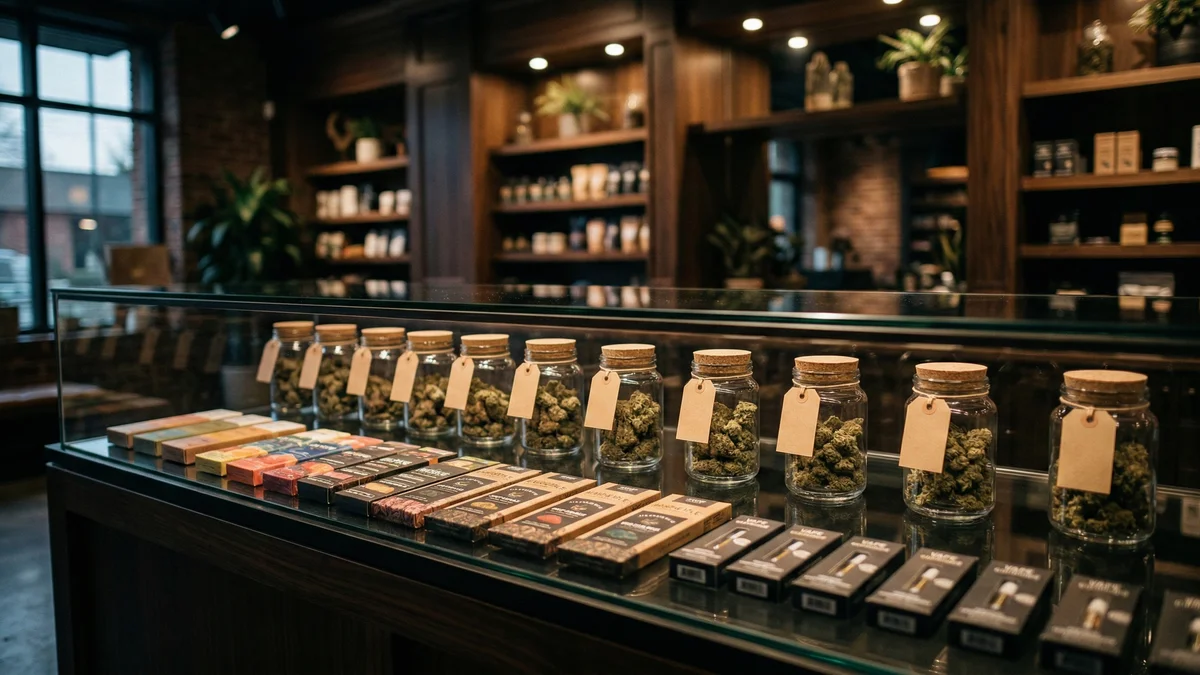
The Raleigh-Durham-Chapel Hill area has a strong network of dispensaries carrying lab-tested THCa flower, concentrates, and edibles.
In Raleigh: Sherlocks Glass & Dispensary on Hillsborough Street carries a wide selection of THCa flower and concentrates with full COAs available, they're rated 4.9 stars from more than 880 reviews. Modern Apotheca offers free delivery across the Raleigh area. Browse all Raleigh dispensaries.
In Durham: Bull City Dispensary at 102 E Main St downtown focuses on THCa flower, Delta-9, and CBD and takes orders online. See all Durham dispensaries.
Across the Triangle: Use our full dispensary directory to search by city, product type, or features like delivery and late-night hours.
NC Enforcement: The Gray Area
While THCa is legal, enforcement actions across North Carolina highlight the confusion that persists:
In April 2024, "Operation Vapor Trail" targeted about 100 vape shops, 71 of them in Onslow and New Hanover counties. At one shop alone, officers seized more than $20,000 in products. Store owners later sued the sheriff and officers, alleging their products were legal hemp with valid COAs. The core dispute: how THC content was measured and whether the products qualified as legal hemp (Port City Daily, 2024).
In June 2024, an NC A&T student was cited for misdemeanor marijuana possession after purchasing 2 grams of hemp from a store in Greenville. The product was legally purchased hemp, but officers couldn't distinguish it from marijuana, and the charge was later dismissed (The Assembly NC).
The NC State Bureau of Investigation flagged the problem in 2019, warning that law enforcement cannot distinguish between hemp and marijuana. The NC Supreme Court heard arguments in September 2025 on whether marijuana odor can still support probable cause for a search. In May 2026, in State v. Dobson and State v. Rowdy, it held that odor remains one factor in the totality of the circumstances, without deciding whether odor alone is enough, and in August 2026 it dismissed a third case, State v. Scheine (UNC SOG, 2026).
These cases underscore why buying from established dispensaries matters. A receipt and COA from an established retailer is your best protection if your hemp products are ever questioned.
Age Requirements
North Carolina currently has no state law setting a minimum age to purchase THCa or other hemp-derived THC products. Governor Stein identified this as a core issue when establishing the Advisory Council in June 2025, stating that "today all across North Carolina, there are unregulated intoxicating THC products available for purchase: just walk into any vape shop" (Governor's Office, 2025).
Most reputable dispensaries in the Triangle voluntarily enforce a 21+ policy. That's store policy, not state law. When a shop checks your ID, it's a good sign you're buying from a responsible seller.
HB 328 and a separate age bill, SB 328, would each make 21 the legal age, but neither has passed. HB 607, which also had a 21+ rule, stalled in 2025.
Frequently Asked Questions
Is THCa the same as marijuana?
Functionally, yes, when heated. Raw THCa is non-psychoactive, but smoking or vaping THCa flower converts it to Delta-9 THC through decarboxylation, producing effects identical to traditional cannabis. Legally, THCa flower is classified as hemp (not marijuana) because compliance testing measures only delta-9 THC content before decarboxylation. That distinction is what makes it legal under current NC and federal law, and what P.L. 119-37 eliminates starting December 2026.
How long will THCa remain legal in NC?
Under NC state law (SB 455), THCa has no expiration date today, but that could change: HB 328, if the House adopts it, would remove THCa flower from NC's hemp definition on November 12, 2026. Federally, P.L. 119-37 redefines hemp using total THC, and that part takes effect December 11, 2026. After that date, THCa flower and most THCa products won't meet the new federal definition of hemp. The Advisory Council's April 2026 interim report recommended a regulated adult cannabis market, but no legislation has followed.
Can you order THCa online and have it shipped to NC?
Currently yes, until December 11, 2026: since THCa is legal under both federal and state law today, online sales and shipping to NC addresses are permitted. However, buying online means you can't inspect COAs in person or verify product quality before purchase. We recommend buying from local Triangle dispensaries where you can ask questions and see lab results firsthand.
Is THCa safe?
The FDA has not approved any THCa products for any use. The only FDA-approved cannabis-derived drug is Epidiolex (CBD) for specific epilepsy syndromes (FDA). That said, THCa flower is a natural plant product with a safety profile comparable to traditional cannabis. The primary risks come from contaminants, pesticides, heavy metals, and microbial issues, which is why third-party lab testing and COAs are essential. Buy from reputable retailers with verifiable lab results.
What's the difference between THCa and CBD?
CBD (cannabidiol) is non-psychoactive and stays non-psychoactive regardless of how you consume it. THCa is non-psychoactive in raw form but converts to psychoactive Delta-9 THC when heated. CBD products are widely available and face less regulatory scrutiny. THCa products, because they effectively deliver THC, face the same legal and regulatory pressures as other intoxicating hemp products.
The Bottom Line
THCa is legal in North Carolina right now, protected by both the 2018 Farm Bill and NC Session Law 2022-32. But the December 2026 federal ban specifically targets THCa, the new "total THC" definition was designed to close exactly this loophole. With HB 328 awaiting a House vote that could come before December 18, 2026, and the federal change landing December 11, the next few months will determine what NC's hemp market looks like going forward. Dispensary owners can find actionable steps in our guide on how NC dispensaries can prepare for P.L. 119-37.
If you're buying THCa in the Triangle, buy smart: stick to reputable dispensaries with lab-tested products, always ask for COAs, and stay informed as the laws evolve.
Ready to find a dispensary? Browse our full directory of verified Triangle dispensaries to find tested THCa products near you.
This article is for informational purposes only and does not constitute legal advice. Cannabis laws change frequently at both the state and federal level. Consult a licensed attorney for advice on your specific situation. Last updated October 10, 2026.