P.L. 119-37 Countdown: How NC Dispensaries Should Prepare for the 2026 Deadline

This article is for informational purposes only and does not constitute legal, medical, or product advice. Consult a qualified professional for guidance specific to your situation.
Ninety-five percent of the hemp products on your shelves right now will lose federal hemp status on December 11, 2026. That's not speculation. It's the estimate from the U.S. Hemp Roundtable after Congress passed P.L. 119-37 in November 2025.
Most of the law takes effect December 11, 2026. One narrow piece, covering products made with cannabinoids a Cannabis sativa plant cannot naturally produce, takes effect earlier, on November 12, 2026 (Section 2019, enrolled text). There's no grace period and no grandfather clause for existing inventory. Products that don't comply with the new definition are treated as marijuana, a Schedule I controlled substance.
Here's what makes North Carolina especially vulnerable: the state has no dedicated hemp retail licensing framework. No regulatory body. No state-level safety net. Minnesota built a regulated retail framework. NC hasn't. If the federal floor drops out, you're largely on your own.
This guide is your operational playbook. Seven steps and a month-by-month timeline to get your Triangle dispensary ready for December 11, 2026, with one earlier checkpoint on November 12. Not the legal analysis (we've published a comprehensive breakdown of the law). This is the operational reality of what you need to do between now and the deadline.
P.L. 119-37 caps total THC at 0.4mg per container starting December 11, 2026, which the U.S. Hemp Roundtable estimates will eliminate 95% of current hemp products and put 300,000+ jobs at risk nationwide (Frier Levitt). NC dispensary owners need to finish auditing inventory, pivoting to CBD/CBN/CBG products, and rebuilding before December 11, and clear any product made with cannabinoids the plant cannot naturally produce before November 12. Below: the step-by-step playbook.
Update, October 10, 2026: The delay is law, and nothing since has changed it. The President signed H.R. 6500 on September 2, 2026, and it became Public Law 119-103, after the Senate passed it 90-6 on August 8 and the House agreed to the Senate's version 370-48 on September 1. Its Section 2019 splits the P.L. 119-37 hemp rewrite across two dates. On November 12, 2026, one narrow piece takes effect: intermediate and final products containing cannabinoids that a Cannabis sativa L. plant cannot naturally produce. Everything else waits until December 11, 2026 (Section 2019, enrolled text). That remainder is the part that reaches the shelf: the 0.3 percent total-THC test that counts THCa, the exclusion for cannabinoids the plant can make but that were synthesized outside it (which is where delta-8 made from CBD falls), and the 0.4mg total-THC-per-container cap that reaches nearly every gummy, tincture, and vape. December 11 is also the day the stopgap funding law runs out, so Congress could still move the date in its next funding bill; as of this update it has not. Our NC hemp bill tracker follows what happens next, and our December 11 report counts what the change reaches across Triangle shops.
What Exactly Does P.L. 119-37 Change?
Section 781 of P.L. 119-37, signed November 12, 2025, rewrites the federal definition of hemp in three ways that matter for your business (Congressional Research Service).
Here is the short version, with the date each piece takes effect:
| What changes | The new rule | Takes effect |
|---|---|---|
| What counts as THC | Total THC (Delta-9, THCa, Delta-8, Delta-10 and compounds with "THC-like effects") replaces Delta-9 alone | December 11, 2026 |
| Raw plant material | (THCa × 0.877) + all Delta variants at or below 0.3% dry weight | December 11, 2026 |
| Finished products | No more than 0.4mg total THC per container, not per serving | December 11, 2026 |
| Cannabinoids the plant cannot naturally produce | Lose federal hemp status | November 12, 2026 |
| Anything over the limits | Treated as marijuana, a Schedule I controlled substance | On the dates above |
Total THC replaces Delta-9 THC. The 2018 Farm Bill measured only Delta-9 THC in raw plant material. The new law counts everything: Delta-9, THCa, Delta-8, Delta-10, and any compound the FDA classifies as having "THC-like effects." The formula for raw material: (THCa × 0.877) + all Delta variants must stay at or below 0.3% on a dry weight basis.
A 0.4mg per container cap on finished products. Not per serving. Per container. A typical hemp gummy contains 5-10mg of THC. The new federal limit for the entire bottle is 0.4mg (Frier Levitt). That's roughly 12 to 25 times lower than what's in a single gummy today.
Non-compliant products become Schedule I. Anything over these limits loses its hemp classification and falls under the Controlled Substances Act. Possession, sale, and interstate transport carry federal penalties.
For the full legal breakdown with charts and source links, read our NC hemp law update. For deeper dives on specific cannabinoids, see our guides on Delta-8 legality in NC and THCa legality in NC. What follows below is the operational translation: what these numbers mean for your daily business and what to do about them.
Which Products Survive, and Which Don't?
Under P.L. 119-37, approximately 95% of hemp-derived cannabinoid products currently on the market will become federally unlawful on December 11, 2026, according to the U.S. Hemp Roundtable. The law also implicates roughly 90% of non-intoxicating full-spectrum CBD products because they exceed the 0.4mg total THC per container threshold (Frier Levitt). Here's how each product category on your shelves will be affected.
The math is worth spelling out. THCa flower typically tests at 20-30% THCa. Convert that to total THC and you get roughly 17.5-26%, about 60 to 90 times the 0.3% limit. Delta-8 products count toward the new total THC measurement, and delta-8 made from CBD is also caught by the new exclusion for cannabinoids synthesized outside the plant. And Delta-9 edibles face the container cap: even a single 5mg gummy exceeds the 0.4mg limit by more than 12x.
So what's left? CBD isolate. Broad-spectrum CBD with verified non-detectable THC. Minor cannabinoids like CBN and CBG. Topicals formulated below the threshold. Mushroom products and glass accessories aren't cannabinoid products at all and aren't affected.
That might sound like a thin lineup. But for shops that start repositioning now, it's a workable business. More on that in Step 3.
Step 1: Audit Your Current Inventory
Before you can plan a transition, you need to know exactly what you're transitioning from. The first step is pulling every product SKU and checking it against the new 0.4mg total-THC-per-container threshold.
The key number is total THC per container, not per serving and not Delta-9 alone. That means you need certificates of analysis (COAs) that report full cannabinoid panels. If your supplier's COA only shows Delta-9 THC, it's no longer adequate. You need THCa, Delta-8, Delta-10, and total THC calculated using the (THCa × 0.877) + Delta variants formula. For a walkthrough of what to look for, see our guide to reading COAs.
Sort every product into three categories:
Compliant. Total THC per container is under 0.4mg and raw material tests under 0.3% total THC. These stay.
Reformulatable. The product type is viable but the current formulation fails. Think full-spectrum CBD that's slightly over the limit. Your supplier may offer lower-THC versions.
Must-exit. The product is inherently non-compliant. THCa flower, Delta-8 concentrates, high-dose gummies. These need to be sold through before December 11 or returned to your supplier, and anything made with cannabinoids the plant cannot naturally produce has to go before November 12.
Start this audit now. It becomes the foundation for every decision that follows. If you don't know what's on your shelves at a molecular level, you can't plan the transition.
Step 2: Renegotiate Supplier Contracts
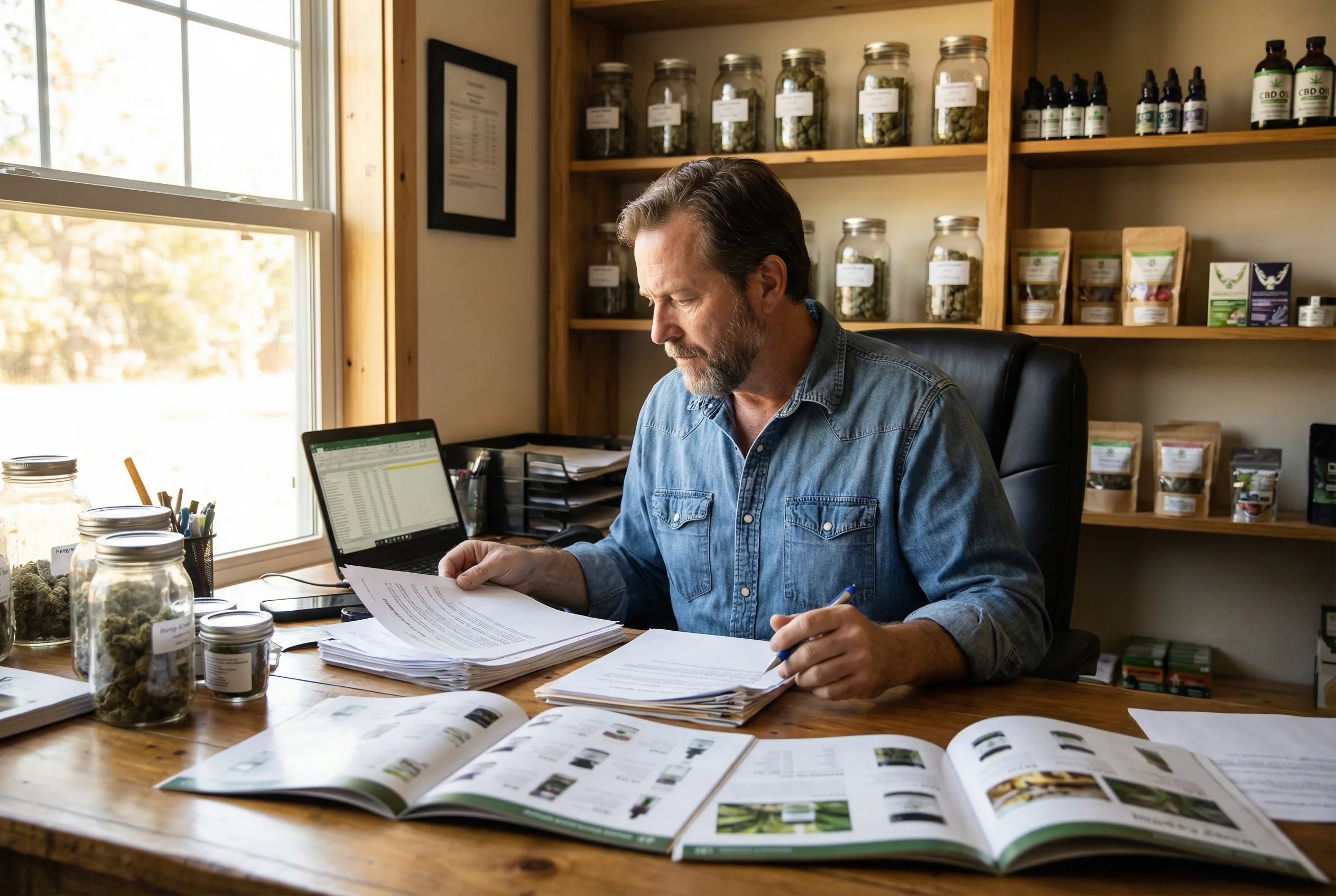
Your suppliers are making their own decisions right now, and those decisions affect what you can stock in December. Have these conversations before they're finalized without you.
Review every active supplier contract for change-of-law provisions. Womble Bond Dickinson advises having existing contracts professionally reviewed to spot potential breaches and lead renegotiations (Womble Bond Dickinson). If yours don't, start the conversation anyway. Suppliers who want to keep your business post-transition will work with you.
Set concrete deadlines:
- Last-order dates for non-compliant products. When is the final day you'll place an order for inventory that won't survive the transition?
- Return terms. Can you return unopened, unexpired inventory that becomes non-compliant? Negotiate this now, not in the final weeks before the deadline.
- New product samples. Ask suppliers about their compliant product lines. Many are already developing low-THC and THC-free formulations.
One thing to avoid: don't bulk-order non-compliant products at steep discounts planning to "sell through" before the deadline. Payment processors may restrict higher-risk hemp categories and insurers may reassess coverage for intoxicating products as the deadline nears (National Law Review). An inventory dump gone wrong could cost you more than the products are worth.
Step 3: Reformulate and Diversify Your Product Line
On December 18, 2025, President Trump signed an executive order directing officials to work with Congress to update the hemp definition so Americans can "benefit from access to appropriate full-spectrum CBD products" (White House). That's the strongest regulatory signal about where this market is heading. But don't wait for Congress to act. Start building your post-deadline product mix now.
The categories worth investing in right now:
CBD products (isolate and broad-spectrum). This is the broadest compliant market. Tinctures, capsules, topicals, and pet products all survive if they test below the total THC threshold. Margins are lower than THCa flower, but the customer base is established. The executive order's emphasis on CBD access signals this category has regulatory support going forward. For product guidance, check our CBD oil guide.
CBN and CBG wellness products. CBN for sleep and CBG for focus are genuine growth categories. They test below THC thresholds and align with the wellness trend driving new customers to dispensaries nationwide.
Functional mushrooms. Adaptogenic and nootropic mushroom products aren't cannabinoid products at all. They're completely unaffected by hemp regulation, they're popular, and they're a natural fit for dispensary shelves.
Accessories and glass. Not glamorous, but 100% regulation-proof. Pipes, papers, storage, and lifestyle products give you baseline revenue that no law can touch.
Think of this as rebuilding your menu, not closing your restaurant. Your customers aren't going away. Their needs aren't going away. You're changing what you serve.
Step 4: Update Labeling, Testing, and Compliance
Section 781 does not mandate label wording. But from December 11, 2026, whether a product counts as hemp turns on total THC per container, so a label or COA that reports only Delta-9 THC no longer shows whether the product qualifies. Switching every label and COA to total THC per container before December 11 is strongly advisable.
NC doesn't have formal dispensary inspections, but documenting total THC for every product protects you in two ways: it shows each product meets the federal definition, and it prepares you for state rules if HB 328 or a later bill passes.
What needs to change:
- Product labels. Should show total THC per container (not per serving, not Delta-9 only)
- COA requirements. Demand full-panel testing from suppliers: THCa, Delta-8, Delta-10, total THC calculated
- Record-keeping. Maintain a compliance file for every product on your shelves: COA, label copy, supplier agreement, date verified
- Staff training. Your budtenders need to explain the difference between Delta-9 THC and total THC to customers asking why their favorite products are disappearing
Start with the products that survive your Step 1 audit. Get their labels and documentation right first, then work through your phase-out timeline.
Step 5: Build Your Financial Runway

North Carolina's hemp industry supports approximately 9,000 jobs and generates up to $1.1 billion in annual sales (Port City Daily). Nationally, the U.S. Hemp Roundtable estimates $1.5 billion in aggregate state tax revenue is at risk (Frier Levitt). Those are the big numbers. What matters to you is your store's profit-and-loss statement over the next 12 months.
Revenue will drop during the transition. THCa flower and Delta-8 products carry higher margins than CBD. If your shop does $30,000 per month and 60-70% of revenue comes from THC products, a rough, illustrative model is $12,000-15,000 per month in the first quarter after transition (our estimate, not a published benchmark). It will recover as your new product mix finds its footing, but you need enough cash to survive the dip.
Build a 6-12 month reserve based on post-transition revenue projections, not current numbers. Factor in these costs:
- Lab testing. Roughly $200-500 per product for total THC panels (an illustrative range; get quotes from your lab)
- Label redesign and reprinting across your entire compliant product line
- Staff retraining on new products, legal changes, and customer communication
- Marketing for new product categories (customers need to know what you carry now)
- Revenue gap during the transition period itself
Banking remains a challenge. Many institutions still won't open accounts for hemp businesses, and payment processors may tighten further as the deadline approaches. If you don't have a stable banking relationship, securing one should be a top priority right now. Our guide on opening a hemp dispensary in NC covers banking options in more detail.
Step 6: Watch the Legislative Landscape
North Carolina has no dedicated hemp retail licensing framework. That's worth repeating because it's the single biggest structural risk for NC dispensary owners. Ohio enacted a categorical ban on intoxicating hemp products in December 2025. Minnesota built a regulated retail structure with state oversight. NC hasn't done either (Frier Levitt).
Here's what's in play at both levels:
NC HB 328 is the live state bill. Its conference report would adopt a total-THC hemp definition and a 0.4mg per container cap on November 12, 2026, plus an age-21 rule, with no licensing and no fees. The Senate adopted it 37-6 on July 2, 2026; it sits in House Rules and can still get a House vote in the reconvened sessions that run through December 18, 2026 (HB 328 on ncleg.gov).
North Carolina status, October 10, 2026: HB 328, the state hemp crackdown, passed the Senate in July but still awaits a House vote, which can come in the reconvened sessions between October 26 and December 18. Today North Carolina sets no minimum age for hemp products, though many shops card at 21. Details in our NC hemp bill tracker.
The Governor's Advisory Council on Cannabis recommended legalizing marijuana for adults 21+ in its April 2026 interim report, proposing one regulated market for marijuana and intoxicating hemp. The final framework is due December 31, 2026, but any resulting legislation would still need months to move through the General Assembly.
P.L. 119-103 (signed September 2, 2026) already moved most of the federal rule from November 12 to December 11, 2026 (Section 2019, enrolled text). December 11 is also the day that stopgap funding law runs out, so Congress could move the date again in its next funding bill. As of October 10, 2026, it has not, and the White House reportedly committed to no further extensions (Foley Hoag).
The Hemp Planting Predictability Act (H.R. 7024) would delay the new hemp definition by two years, to November 12, 2028. Introduced January 13, 2026 by Rep. Jim Baird (R-IN) and referred to the House Agriculture Committee (Congress.gov). It hasn't passed.
The bottom line: don't plan around a delay or a rescue from Raleigh. Plan for December 11, 2026, clear non-plant cannabinoids by November 12, and treat any legislative relief as a bonus. The dispensaries that survive will be the ones that prepared for the worst case, not the ones that bet on politicians.
Your Month-by-Month Countdown to December 11, 2026

This countdown was first written in April 2026. If you are reading it in October, treat the April through September steps as a catch-up list and work through them now, in order. Here's what to prioritize each month.
April: Audit and Assess Complete your product-by-product inventory audit (Step 1). Categorize every SKU as compliant, reformulatable, or must-exit. Request total THC COAs from every supplier.
May: Supplier Conversations Contact all suppliers about their compliant product lines. Set last-order dates for non-compliant inventory. Negotiate return terms for unopened stock. Start sampling CBD, CBN, and CBG products.
June: Reformulation and Ordering Place first orders for new compliant products. Begin phase-out pricing on slow-moving non-compliant inventory. Research functional mushroom and wellness product suppliers.
July: Labels and Training Update all in-store and online labels to show total THC per container. Retrain staff on new product lines and the legal changes behind them. Update your website and product menus.
August: Marketing Pivot Launch customer-facing marketing for new product categories. Update social media, in-store signage, and email communications. Start educating your customer base on what's changing and why. For the channel-by-channel playbook (GBP, SMS, email, content, loyalty) NC operators can actually use given federal ad-platform bans, see our 2026 NC hemp dispensary marketing guide.
September: Phase-Out Acceleration New orders for non-compliant products should be at zero. Run clearance promotions on remaining THC inventory. Finalize contracts with compliant suppliers.
October: Final Compliance Check Confirm that every product you plan to carry after December 11 meets the new standard, and flag anything made with cannabinoids the plant cannot naturally produce, which has an earlier deadline. Conduct a staff refresher on P.L. 119-37 basics. Prepare customer FAQ sheets and in-store signage explaining the two dates.
By November 11: Clear the Narrow Group Pull products made with cannabinoids a Cannabis sativa plant cannot naturally produce. They lose federal hemp status on November 12. The FDA has not yet published its list of naturally produced cannabinoids, so lean on your suppliers' COAs and ask them in writing.
December 1-10: Go Live Pull any remaining non-compliant products by December 10. Your shelves should be compliant on December 11, when the total-THC test and the 0.4mg per container cap take effect. Execute your customer communication plan, and watch the December funding bill for any last-minute change.
Frequently Asked Questions
Will CBD products still be legal after December 2026?
Yes, with conditions. CBD isolate and broad-spectrum CBD with verified non-detectable THC remain compliant under P.L. 119-37. Full-spectrum CBD is the gray area: roughly 90% of current products exceed the 0.4mg total THC per container cap (Frier Levitt). Products that test below the threshold are fine. Those above it need reformulation.
Can NC state law protect dispensaries from the federal ban?
Potentially, but unpredictably. NC SB 455 (Session Law 2022-32) doesn't criminalize hemp-derived THC products at the state level, and the UNC School of Government confirmed in January 2026 that "state law in this area has not changed" (UNC SOG). That could change if the House adopts HB 328, which would write a similar total-THC standard into state law on November 12, 2026. And federal illegality creates real problems for banking, insurance, shipping, and payment processing regardless of what NC law says.
Could the December 11 deadline move again?
It already moved once. P.L. 119-103, signed September 2, 2026, moved most of the rule from November 12 to December 11, 2026 (Section 2019, enrolled text), and December 11 is also the day that stopgap funding expires, so the next funding bill could change it again. The Hemp Planting Predictability Act (H.R. 7024) would push the definition to November 2028 (Congress.gov). As of October 10, 2026, neither a further delay nor H.R. 7024 has passed. Don't plan around one. If a delay happens, you'll be ahead of schedule instead of scrambling.
What should I do with non-compliant inventory I can't sell by the deadline?
Start phased reductions now. Negotiate return terms with suppliers for unopened products. Avoid aggressive clearance practices that regulators may scrutinize. For remaining stock after December 11 (or November 12 for non-plant cannabinoids), consult a hemp attorney about disposal and destruction requirements in your jurisdiction.
How much will the transition cost my business?
Our rough, illustrative estimate is $10,000-50,000 depending on your operation's size and current product mix. Key line items: lab testing at $200-500 per product for total THC panels, label redesign, staff retraining, marketing for new product categories, and the revenue gap during transition. Build this into your financial runway planning (Step 5).
If you haven't started, start with the Step 1 inventory audit this week.
P.L. 119-37 isn't a surprise. It was signed November 12, 2025. The dates are set in law unless Congress acts again. The products affected are clear. The only question is which dispensaries will adapt and which won't.
Your customers still need dispensaries in the Triangle that carry quality, compliant products. Whether your shop is one of them depends on what you do between now and December 11.
Already listed on Raleigh Dispensaries? Make sure your product categories and business information are current as you transition your product mix. Not listed yet? Get listed today to reach customers searching for compliant hemp products in the Triangle.