How to Market a Hemp Dispensary in NC: A 2026 Playbook

This article is for informational purposes only and does not constitute legal, medical, or product advice. Consult a qualified professional for guidance specific to your situation.
The biggest digital marketing platforms in America won't sell you an ad for what most NC hemp shops actually sell. Google, Meta, and TikTok all block paid promotion of THC products, including Delta-8, Delta-9, and THCa. The CBD carve-outs that do exist come with certification gates, written approvals, and location limits that keep most NC retailers out in practice.
That leaves NC hemp dispensary owners in a strange spot. The product is federally legal. No state retail license is required today. But every major paid channel treats the category like Schedule I. Independent shops scrambling for foot traffic can't just hand a credit card to Google Search and start driving customers.
This is also why the NC hemp market looks so different from California or Michigan. National guides write for adult-use states with track-and-trace systems and licensed retail. North Carolina is a hemp-only market with no retail license required at the state level, and its main pending state bill (HB 328) has passed the Senate as a compromise but still awaits a House vote. A playbook copied from Denver doesn't translate. This one is built for the rules NC operators actually work under.
NC hemp dispensaries can't run Google, Meta, TikTok, or YouTube ads for THC products in 2026. Google allows only topical hemp CBD ads, and only for LegitScript-certified advertisers in approved locations (Google Ads policy). Meta allows CBD ads (0.3% THC or less) only with LegitScript certification and Meta's written authorization, targeting US adults 18+, and bans every THC product (Meta ad standards). The five owned channels that actually move foot traffic: a complete Google Business Profile (87% of consumers use Google to find local businesses, per Statista data cited by BloggingWizard), SMS (text messages see roughly 98% open rates per Springbig), cannabis-industry email (18 to 22% open rate per The Cannabis Marketing Agency), educational content marketing, and loyalty programs (members spend 3.5x more annually per Flowhub). NC HB 328, the state hemp crackdown, passed the Senate as a conference report in July 2026 and still awaits a House vote, so build your marketing to the stricter standard it would set.
Why Paid Ads Don't Work for NC Hemp Dispensaries
In 2026, the four largest U.S. ad platforms (Google, Meta, TikTok, and YouTube) all prohibit paid promotion of hemp-derived THC products to North Carolina audiences. Google's policy says "Ads for topical, hemp-derived cannabidiol (CBD) products with THC content of 0.3% or less are allowed," but only for advertisers who get LegitScript certification and target the locations Google permits; its policy names California, Colorado, and Puerto Rico as the approved targets for FDA-approved pharmaceutical CBD (Google Ads recreational drugs policy). YouTube ads run through Google Ads, so the same rules apply there. Meta allows ads for CBD products with no more than 0.3% THC, topical or not, but only with LegitScript certification and Meta's prior written authorization, targeting people 18 and older in the United States; it bans any THC product or "cannabis products containing related psychoactive components" (Meta ad standards: CBD and related products). TikTok lists "ingestible hemp" as not allowed and permits topical CBD cosmetics only in some markets, through a TikTok sales representative rather than self-serve (TikTok healthcare and pharmaceuticals ad policy). X (formerly Twitter) opened cannabis ads in 2023, but only to advertisers licensed by the appropriate authorities and pre-authorized by X, and even they "may not promote or offer the sale of Cannabis"; the one sales exception is topical hemp-derived CBD at 0.3% THC or less (Kelley Drye summary of the X policy, 2023). An NC hemp shop holds no cannabis license, so X's THC path isn't open to it.
The constraints aren't going to ease for US hemp retailers in 2026. Google's 2025 and 2026 cannabis policy updates created and then expanded a Search pilot for licensed cannabis businesses in Canada only; nothing in them opens a path for US hemp shops (Google Ads policy update, March 2026). Meta's authorization process for compliant CBD brands adds a written-approval step on top of LegitScript certification. P.L. 119-37 takes full effect December 11, 2026 and won't help ad-platform policy either, because its total-THC definition makes more hemp products federally illegal, not fewer. The realistic 2026 posture for an NC operator: assume zero paid ads on the major platforms, and design the marketing program around that.
A footnote on the regulatory side. P.L. 119-37 (signed November 2025) doesn't change ad-platform rules directly, but it changes which products you're allowed to sell starting December 11, 2026. That ripples through every marketing decision. For the operational implications, read our P.L. 119-37 dispensary preparation guide.
What Each Major Platform Allows for NC Hemp Retailers
The full picture is easier to digest as a side-by-side. Every NC hemp operator should know the policy posture of each major ad surface before allocating a marketing budget. The matrix below maps the six platforms NC retailers actually consider against the three product categories and the approval gate (LegitScript, manual review, or no path available) for each.
| Platform | Topical CBD | Ingestible CBD | THCa, Δ-8, Δ-9 | Approval gate |
|---|---|---|---|---|
| Google Ads | Allowed, approved locations only | Not allowed | Banned | LegitScript certification |
| Meta (FB/IG) | Allowed with authorization | Allowed with authorization | Banned | LegitScript + Meta written authorization, US, 18+ |
| TikTok | Some markets, sales rep only | Banned | Banned | TikTok sales representative |
| YouTube Ads | Same as Google Ads | Not allowed | Banned | Runs under Google Ads policy |
| X (Twitter) | Allowed | Not allowed | No sale ads; licensed cannabis firms only | Licensed + pre-authorized, 21+ targeting |
| Reddit Ads | Case-by-case | Banned | Banned | Manual review, age-gated subs |
The takeaway isn't that hemp is unmarketable. It's that the channels you'd default to with a normal retail business aren't available. NC hemp dispensaries that grow do it through channels they own outright: their listing on Google Business Profile, their SMS subscriber list, their email list, their search rankings, and their loyalty members. Platforms don't get to revoke any of those overnight.
Google Business Profile Is the Single Biggest Free Channel
About 87% of consumers use Google to find local businesses, according to Statista data collected in BloggingWizard's 2026 GBP statistics roundup. The same roundup cites Localo research finding that 75% of businesses in the top three local positions have a completed business description, and Whitespark's survey ranking the primary GBP category as the number one local ranking factor. Around 60% of cannabis consumers begin their shopping journey with online search, mostly mobile queries like "dispensary near me" (WebJoint, 2025). For an NC hemp shop with no paid-ad option, the GBP is where you fight (and win) the local-pack battle.
What makes GBP unusual among free channels is how directly it converts. The local pack sits above the organic results for most "near me" searches in 2026, occupying the first screen on mobile and the top fold on desktop. A complete GBP doesn't just rank you higher in the pack; it also gives the user enough information (hours, photos, rating, directions, call button) to make a decision without clicking through to your site. For a hemp shop where the conversion is a physical visit, that's exactly the friction profile you want.
Five things to get right on the profile:
- Category. Choose "Cannabis store" as the primary category. "Tobacco shop," "Vitamin & supplements store," and "Holistic medicine practitioner" are tempting but cost you visibility on the searches that matter.
- Photos. Upload at least 10 exterior, interior, and product photos. Refresh monthly. Profiles with current photos earn more clicks than text-only listings.
- Q&A. Answer your own most-asked questions on the profile. Treat it as a mini-FAQ page Google can read.
- Posts. Publish a weekly Post (offer, event, product highlight). These show up in your Knowledge Panel and signal an active business to Google's local algorithm.
- Reviews. Ask every happy customer at checkout. Reply to every review (positive and negative) within 48 hours. Review velocity and response rate are well-documented local SEO ranking factors.
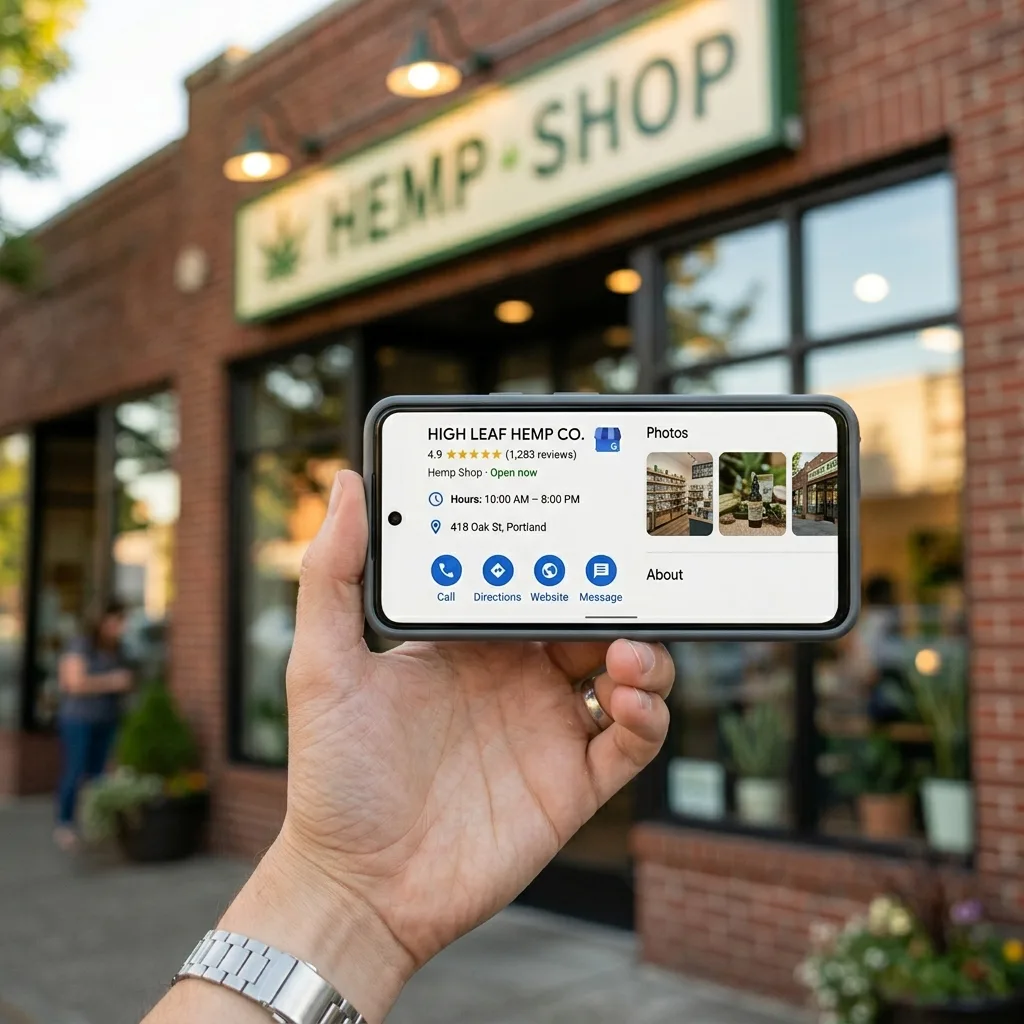
Here's a benchmark to anchor against. In our directory of 82 Triangle hemp dispensaries, the 80 listings with Google ratings average a 4.87-star rating across more than 23,800 cumulative reviews (raleighdispensaries.com directory, October 2026), with a median of about 145 reviews per shop. If your profile is materially below that average, the problem usually isn't your product, it's that you're not asking. A simple counter-card prompt ("Loved your visit? A quick Google review takes 30 seconds and helps us grow") tends to flip the curve within a quarter.
The most overlooked GBP move? Geo-tagged photos. Embed location metadata in image files before uploading. Google reads it, and it strengthens your relevance for "dispensary near [neighborhood]" searches. Most Triangle hemp shops don't bother. Add it to your monthly photo upload routine and you'll separate yourself from the pack within two or three months.
SMS Is the Highest-ROI Channel for Repeat Visits
Text messages see roughly 98% open rates, with 93% opened within the first three minutes, according to cannabis loyalty and messaging vendor Springbig; that is a general SMS figure, not one measured only on dispensary lists. Time-sensitive promotions sent over MMS (a multimedia message with an image attachment) drive an additional 15 to 25% lift in same-day foot traffic compared to plain SMS (Media Jel, 2025). For repeat-visit revenue, no other free or low-cost channel comes close.
Two practical guardrails. First, frequency. Two to four messages per month is the sweet spot for hemp retailers. Past that, opt-out rates spike. Second, TCPA compliance. You need documented express written consent before the first send, a clear opt-out keyword on every message, and identification of the business in the message body. NC has no extra hemp-specific SMS restrictions as of May 2026, but federal TCPA penalties run $500 to $1,500 per violating message, and class actions over noncompliant cannabis SMS aren't rare. Document consent.
The high-leverage moments to send:
- Product drops. New strain or limited-edition gummy arrives. MMS with the product photo, time-windowed promo.
- Holiday weekends. 4/20, 7/10, Memorial Day, Black Friday. Send the offer 48 hours ahead.
- Birthday rewards. Triggered. Highest conversion message you'll send all year.
- Re-engagement. Subscriber hasn't opened in 60 days? One MMS with a meaningful discount before they churn.
Cannabis-friendly SMS tools include Springbig, Alpine IQ, and SimpleTexting. General-purpose platforms are riskier: Klaviyo's acceptable use policy, for example, prohibits any SMS or MMS content related to CBD, cannabis, or THC on US and Canadian short-code and toll-free numbers (Klaviyo acceptable use policy). Read the acceptable-use policy of any tool before signing.
Email Is the Workhorse for Education and Retention
Cannabis dispensary email programs typically land in the 18 to 22% open-rate range with 2.3 to 4.1% click-through and 1.5 to 2.8% conversion (The Cannabis Marketing Agency, 2025). That's well within general retail benchmarks, and the operators who beat the top of that range are usually the ones segmenting aggressively (new vs. repeat, flower vs. edible buyers, last-30-day vs. lapsed) instead of broadcasting the same message to everyone. Email won't beat SMS on speed or open rate, but it's where you do the things you can't do in 160 characters: storytelling, education, and longer-form merchandising.

The hemp-shop email program that pays for itself runs on five flows:
- Welcome series (3 emails). What you sell, what's legal in NC, how to read a COA. Lead with our COA guide as the educational anchor. Welcome flows typically outperform broadcast email by a wide margin because new subscribers are at peak engagement.
- Lab-result transparency drops. When you take new inventory, send the COA. Customers who get this twice will tell their friends.
- Monthly menu newsletter. What's in stock, what's new, what's leaving. Keep it short and scannable.
- Abandoned cart (if you sell online). Triggered 1 hour and 24 hours after cart abandonment. Standard ecommerce playbook, but most NC hemp shops haven't built it yet.
- Win-back. No purchase in 90 days, send a single, well-targeted offer. Then drop them off the active list. Stale subscribers tank deliverability.
Cannabis-friendly platforms include Springbig, Alpine IQ, and Sender. Mailchimp accepts hemp accounts with content restrictions, and SimpleTexting works for hybrid SMS plus email. Klaviyo's acceptable use policy bans CBD and cannabis content in SMS and reserves the right to restrict "illegal or controlled substances" based on its downstream providers' rules (Klaviyo acceptable use policy), so an account built around THC products sits on shaky ground there. Pick a platform built for this category from day one.
Segmentation is what separates the operators landing at the top of the 18 to 22% open-rate range from those at the bottom. Even basic segments (new vs. repeat, flower vs. edible buyers, last-30-day shoppers vs. lapsed) lift performance versus one-size-fits-all sends. Your POS or loyalty tool is the segmentation engine; the email tool just executes.
Content Marketing Is the One Channel Where You Can Outrank Anyone
Organic search is the one acquisition channel that keeps working after the content is paid for, and with paid search closed to THC products it is the main way a new customer finds you before they find your Google Business Profile. The demand is real and specific to North Carolina. In DataForSEO's US keyword data, "is thca legal in nc" averages about 880 Google searches a month and "dispensary raleigh nc" about 590, and the pages ranking for the NC legal questions average only one or two referring domains, a sign that few sites have competed for them (DataForSEO Labs, September 2026 data). For independent NC hemp shops without national-chain budgets, organic content is the only channel where you can credibly outrank larger competitors on local intent.
What you write matters more than how often. Local-plus-educational beats either alone. Pages that answer NC-specific questions ("Is THCa legal in North Carolina?", "How do I read a hemp COA?", "Best dispensaries in [your city]?") rank because national hemp brands don't bother writing them, and most local hemp shops don't either. The competitive vacuum is wide.
Three rules that separate dispensary content that ranks from content that doesn't:
- Schema markup. LocalBusiness for the shop, Product for inventory pages, FAQPage for FAQ sections, BlogPosting for articles. Google rewards rich-result eligibility. Skip schema and you're competing with one hand tied.
- Internal linking. Every article should link to your product category pages, your city page, and at least two related articles. Reciprocal links inside your domain compound over time.
- Original photography. Stock images of generic hemp flower don't convince E-E-A-T evaluators that you sell hemp flower. Shoot your own shelves, your own customers (with permission), your own COAs.
The compounding effect is the part that makes this channel different from any other. A consistent monthly publishing cadence and clean on-page optimization don't just rank one post; they pull related queries up over time, increase the number of pages eligible for AI Overview citation, and lower CAC by raising the share of new customers who find you without ever clicking a paid listing. That's a result a national chain would pay six figures for in paid acquisition. The cost? A consistent blog and well-built local pages.
Loyalty Programs Pay for Themselves
Cannabis loyalty program members spend 3.5x more annually than one-time buyers, visit 40% more often, and are 5x more likely to try new products, according to data from cannabis POS and loyalty vendor Flowhub (Flowhub cannabis loyalty data, 2025). Flowhub's own example calculation puts the average non-member cannabis customer at roughly $120 in annual spend versus around $600 for an active loyalty member. For NC hemp dispensaries without paid-channel access, retention is the highest-leverage growth lever available.
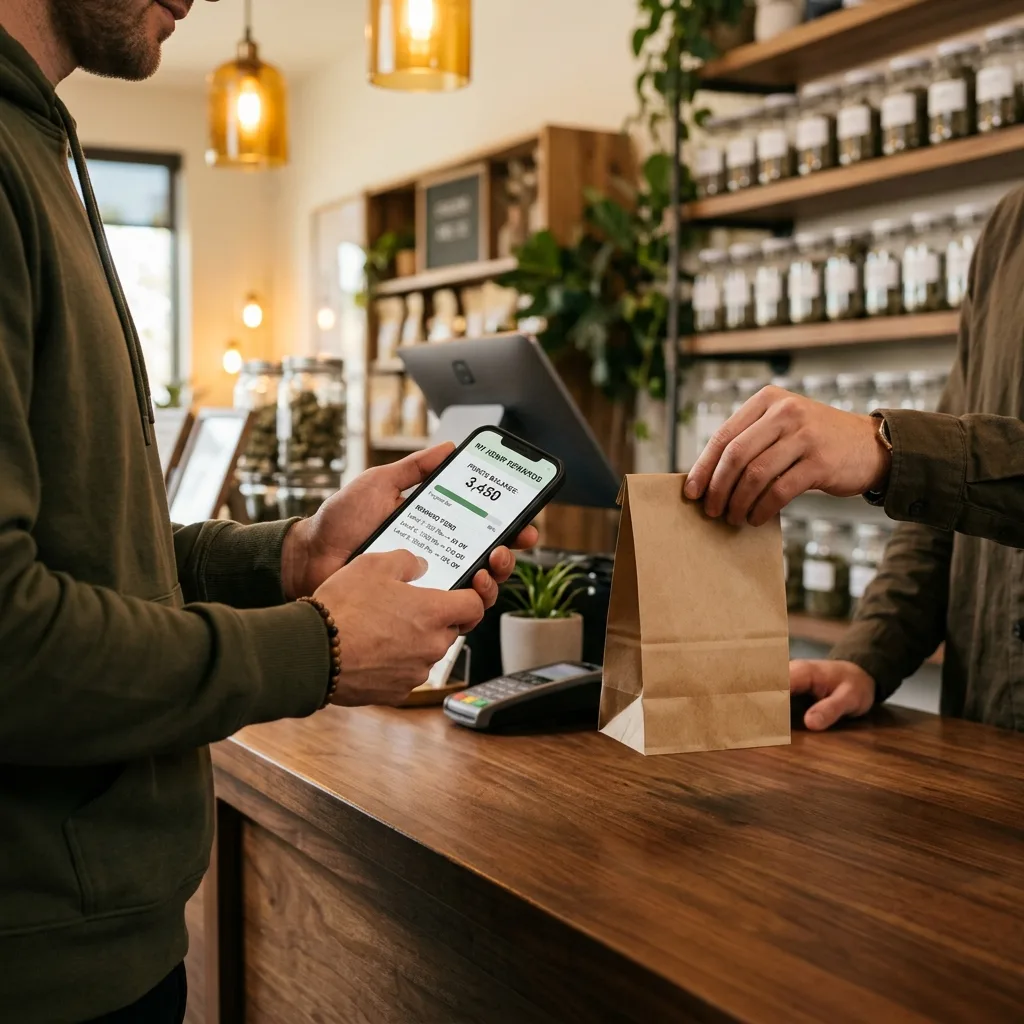
The practical takeaway is personalization. In a market with dozens of shops selling similar THCa flower and gummies, the customers you've already converted are still shopping around. A simple "based on your last purchase, you might like..." in your email or SMS sequence gives a member a reason to come back to you instead of the shop down the road, and your loyalty data is what makes that message possible.
What a baseline NC hemp loyalty program should include:
- Points per dollar. Most shops settle on 1 point per $1, with rewards starting around 100 points. Keep the math obvious.
- Tiered status. Bronze / Silver / Gold tiers with escalating perks (early access, birthday gift, exclusive product drops). Status is a behavioral lever, not just a label.
- Birthday reward. Send a single, generous offer in the customer's birthday week. This is also a TCPA-clean SMS opportunity if the customer opted in.
- Member-only drops. When you get a limited-quantity product, sell it to loyalty members first for 24 hours. Drives signups and creates scarcity.
- Referral mechanic. $10 credit when a friend joins and spends. Trackable, repeatable, low effort.
Cannabis-specific loyalty tools include Springbig (the category leader), Alpine IQ, Sticky Cards (digital punch-card style), and several POS-bundled programs. If you're already on a hemp-friendly POS like Treez or Dutchie, the loyalty add-on is often the path of least resistance.
The reason this category compounds: most shoppers in a dense market like the Triangle split their visits across more than one shop. Loyalty programs are how you move from one of the shops they visit to the default. The marginal lift on each customer translates directly to revenue, and unlike paid acquisition, the gain compounds month after month.
Local Directories and Listings Still Matter
Weedmaps and Leafly remain the two largest cannabis-specific directories serving NC searchers. A comparison from cannabis marketing agency Marijuana SEO put Weedmaps basic listings at around $300 per month as of 2018, with Leafly pricing geo-specific and ranging from roughly $600 to $4,000 per month, and it warns that these prices "are constantly changing" (Marijuana SEO). Get a current quote before you budget. Even with platform restrictions, listings still move customers, and most NC hemp shops underuse them.

A practical hierarchy:
- Free first. Google Business Profile, Yelp, Bing Places, Apple Maps. Get all four claimed and consistent before paying for anything.
- Cannabis-specific directories. Weedmaps and Leafly basic listings. Match the level of investment to your market density. If you're the only hemp shop in your zip code, basic plans are often enough.
- Regional directories. Triangle-area searchers also use regional and city-focused lists that don't appear on every national radar.
Full disclosure: we run raleighdispensaries.com, the Triangle's only hemp-specific dispensary directory. Our Get Listed page shows where it fits alongside Weedmaps and Leafly. National directories give you reach; a Triangle-specific directory gives you local intent. Most growing operators use both. We're not trying to be Weedmaps. We're trying to be the page someone in Cary searches when they want a Cary dispensary, and the page that AI assistants reference when answering "where can I buy hemp in Raleigh?"
Whichever directories you pick, the most important thing is NAP consistency: identical name, address, and phone number across every listing. Google triangulates trust from cross-source consistency. One letter difference in your address across two listings is a measurable ranking drag.
What the Pending HB 328 Means for NC Hemp Marketing
NC HB 328 has had a long road (HB 328 status). The House passed it 112-0 in April 2025, the Senate rewrote and passed it 35-7 in June 2025, and on April 21, 2026 the House voted 95-18 not to concur with the Senate version. That vote sent the bill to a conference committee rather than ending it: conferees were appointed on June 23 and 24, 2026, and the Senate adopted their compromise 37-6 on July 2, 2026. The compromise still needs a House vote.
North Carolina status, October 10, 2026: North Carolina has not passed its own hemp law. HB 328, the state crackdown that would count THCa toward the THC limit, cap finished products at 0.4mg total THC per container, and make 21 the legal purchase age, cleared the Senate as a conference report 37-6 on July 2, 2026. The House has not voted on it: the report sits in House Rules, and Speaker Destin Hall said in August that a vote would not come before November. Under the adjournment resolution the House can still take it up in the reconvened sessions of October 26 to 28, November 16 to 19, or November 30 to December 18, and SB 328, a 21+ age bill, is also still eligible for a final Senate vote. Until one of them passes, North Carolina sets no minimum age for hemp products, though most Triangle shops card at 21 as store policy (HB 328 on ncleg.gov). Our NC hemp bill tracker has the vote-by-vote detail.
Here is that path at a glance.
The compromise is not the bill operators were bracing for in 2025. Unlike the Senate's 2025 version, which built a retail licensing system, the conference report creates no licensing at all and no advertising rules. What it would do is change what you can sell and to whom: it rewrites the state hemp definition to count total THC, including THCa, treats finished products above 0.4mg total THC per container as controlled substances under state law, and makes selling to anyone under 21 a misdemeanor with civil penalties for the business (conference report text).
What it does NOT change: the federal layer. P.L. 119-37 still takes full effect December 11, 2026 and reshapes which hemp products are federally legal. The Governor's Advisory Council on Cannabis is still due to issue final recommendations by December 31, 2026. And the FDA continues to assert that ingestible CBD isn't a lawful food additive regardless of what any state does.
The marketing implications:
- Don't plan on a long runway. The House can take HB 328 up in the reconvened sessions through December 18, 2026, and the federal date arrives December 11 either way. Use the time to build owned channels (GBP, SMS, email, loyalty, content) now rather than after the rules change.
- Build to a stricter standard anyway. Card everyone at 21 today, even though no state law requires it yet; it is what HB 328 and SB 328 would require. Drop minor-appealing packaging and product names, and keep health claims out of every channel. Operators who clean these up now are ready for any regime; operators who wait pay legal fees and lost time.
- The federal layer is the binding constraint in 2026. Whether or not the House acts, P.L. 119-37 decides what is on the shelf after December 11. The dispensary-marketing program that survives is the one already pivoting toward CBD, CBN, CBG, topicals, and accessories. For the full operational playbook, see our P.L. 119-37 dispensary preparation guide.
For the broader NC regulatory picture, our NC hemp law update covers HB 328 and the federal context. Marketing programs built around channels you own (GBP, SMS, email, loyalty, organic search) survive both regulatory shifts and platform policy updates. Platforms can revoke ad accounts. Bills can pass or fail. Directories can re-tier pricing. What can't be taken away: a complete Google Business Profile, an opted-in SMS list, an opted-in email list, a published blog that ranks, and an engaged loyalty roster.
If you operate a hemp shop in the Triangle and want to be listed in our directory, our Get Listed page walks through the tiers. If you're earlier in the journey, our how to open a hemp dispensary in NC guide covers the licensing and operational basics before the marketing layer kicks in.
Frequently Asked Questions
Can NC hemp dispensaries advertise on Google?
Only topical hemp-derived CBD ads (0.3% THC or less) are eligible, and only for advertisers who obtain LegitScript certification and target the locations Google permits (Google Ads policy). Google's recreational drugs policy prohibits ads for substances that alter mental state for recreation, so Delta-8, Delta-9, THCa, and other psychoactive hemp products are out, and the policy's CBD allowance covers topicals only. YouTube ads follow the same Google Ads rules. NC retailers effectively cannot run Google Search ads for their core inventory in 2026.
Can NC hemp dispensaries advertise on Facebook or Instagram?
Only for CBD. Meta's current policy allows ads for CBD products with no more than 0.3% THC, with LegitScript certification and Meta's prior written authorization, targeting people 18 and older in the United States, and with no health claims (Meta ad standards). Products containing THC or related psychoactive cannabinoids (including Delta-8 and THCa) are prohibited, and so are ads that promote the sale of paraphernalia such as bongs and vaporizers.
What is the highest-ROI marketing channel for an NC hemp shop?
For most shops, a complete Google Business Profile comes first: it is free, and 87% of consumers use Google to find local businesses (Statista data via BloggingWizard). SMS follows for repeat visits, since text messages see roughly 98% open rates (Springbig). Email carries retention and education, and organic content marketing builds the search visibility that paid ads can't buy for THC products.
Do I need a license to sell hemp in North Carolina in 2026?
No. North Carolina has no state license for hemp retailers or manufacturers. The NC Department of Agriculture says the state "no longer possesses the regulatory authority" to license or regulate hemp producers and processors, and growers hold USDA licenses instead (NCDA&CS hemp page). Licensing bills that would have created a new Chapter 18D (HB 607 and SB 265) stalled in committee in 2025. The live state bill, HB 328, passed the Senate as a conference report in July 2026 without any licensing; it would add a 21+ age rule and a total-THC standard if the House adopts it (HB 328 status). You still need ordinary business registrations, including an NCDOR sales tax registration.
What's the most common dispensary marketing mistake?
Paying for Weedmaps or Leafly enhanced listings before optimizing the free Google Business Profile. Directory listings can run hundreds or thousands of dollars a month (Marijuana SEO), while the profile costs nothing and sits in front of the 87% of consumers who use Google to find local businesses. Fix the free channel first, then layer paid directories. The second-most-common mistake is sending more than four SMS messages per month and watching opt-out rates spike.