NC Hemp Ban and Law Update: What Changes December 11, 2026
This article is for informational purposes only and does not constitute legal, medical, or product advice. Consult a qualified professional for guidance specific to your situation.
North Carolina's hemp industry is heading into the most turbulent year in its history. The biggest state-level effort to restrict it stalled in the spring, came roaring back in July, and now waits on a single House vote, while the federal hemp ban, now scheduled mostly for December, is still very much alive.
If you buy hemp products from dispensaries in Raleigh or anywhere in the Triangle, this directly affects you. If you are starting from the simpler question of whether weed is legal in North Carolina, read that first and come back here for the legislative detail. Here's what's happening, what it means, and what you should do.
Hemp-derived THC products are still legal in North Carolina today under SB 455 and the 2018 Farm Bill. Federally, P.L. 119-37 redefines hemp using total THC with a 0.4mg per container cap, which would remove most intoxicating hemp products from the market; under Section 2019 of P.L. 119-103, most of it takes effect December 11, 2026, with a narrow slice on November 12 (Section 2019, enrolled text). On April 30, 2026 the U.S. House passed its 2026 Farm Bill (H.R. 7567) without delaying that date (Marijuana Moment). At the state level, NC HB 328 is not dead: after the House voted 95-18 not to concur on April 21, 2026, a conference committee wrote a narrower compromise that the Senate adopted 37-6 on July 2. It sits in House Rules (re-referred July 30) and can still be adopted in the reconvened sessions through December 18, 2026 (NC General Assembly). North Carolina's hemp industry supports roughly 9,000 jobs and generates up to $1.1 billion in annual sales (Port City Daily). Wondering whether to buy ahead of the deadline? See our guide on whether to stock up before the federal rule lands.
Update, October 10, 2026: The delay is law, and nothing since has changed it. The President signed H.R. 6500 on September 2, 2026, and it became Public Law 119-103, after the Senate passed it 90-6 on August 8 and the House agreed to the Senate's version 370-48 on September 1. Its Section 2019 splits the P.L. 119-37 hemp rewrite across two dates. On November 12, 2026, one narrow piece takes effect: intermediate and final products containing cannabinoids that a Cannabis sativa L. plant cannot naturally produce. Everything else waits until December 11, 2026 (Section 2019, enrolled text). That remainder is the part that reaches the shelf: the 0.3 percent total-THC test that counts THCa, the exclusion for cannabinoids the plant can make but that were synthesized outside it (which is where delta-8 made from CBD falls), and the 0.4mg total-THC-per-container cap that reaches nearly every gummy, tincture, and vape. December 11 is also the day the stopgap funding law runs out, so Congress could still move the date in its next funding bill; as of this update it has not. Our NC hemp bill tracker follows what happens next, and our December 11 report counts what the change reaches across Triangle shops.
North Carolina status, October 10, 2026: North Carolina has not passed its own hemp law. HB 328, the state crackdown that would count THCa toward the THC limit, cap finished products at 0.4mg total THC per container, and make 21 the legal purchase age, cleared the Senate as a conference report 37-6 on July 2, 2026. The House has not voted on it: the report sits in House Rules, and Speaker Destin Hall said in August that a vote would not come before November. Under the adjournment resolution the House can still take it up in the reconvened sessions of October 26 to 28, November 16 to 19, or November 30 to December 18, and SB 328, a 21+ age bill, is also still eligible for a final Senate vote. Until one of them passes, North Carolina sets no minimum age for hemp products, though many Triangle shops card at 21 as store policy (HB 328 on ncleg.gov). Our NC hemp bill tracker has the vote-by-vote detail.
The Current Legal Landscape: Still Legal, For Now
As of October 10, 2026, all hemp-derived cannabinoid products remain legal in North Carolina. This includes THCa flower, Delta-8, Delta-9 gummies, HHC, CBD products, and everything else currently sold at Triangle dispensaries.
Two laws created this framework:
The 2018 Farm Bill removed hemp from the federal Controlled Substances Act and defined it as Cannabis sativa L. with a Delta-9 THC concentration of no more than 0.3% on a dry weight basis. Because it measured only Delta-9 THC, not total THC, products containing THCa, Delta-8, and other cannabinoids slipped through.
NC Session Law 2022-32 (SB 455) aligned North Carolina's state law with the federal framework. As enacted in 2022, it amended G.S. 90-94 to exclude "tetrahydrocannabinols found in hemp or hemp products" from the NC Controlled Substances Act. Today that exclusion, G.S. 90-94(b)(2), covers tetrahydrocannabinols "found in a product with a delta-9 tetrahydrocannabinol concentration of not more than three-tenths of one percent (0.3%) on a dry weight basis" (G.S. 90-94). For a deeper dive on this law, read our guides on Delta-8 legality in NC and THCa legality in NC.
The UNC School of Government confirmed in January 2026 that "state law in this area has not changed and all the hemp products discussed above remain legal as a matter of state law" (UNC SOG).
But that's about to change, from two directions at once.
Threat #1: The Federal Ban (P.L. 119-37)
On November 12, 2025, Section 781 of the Continuing Appropriations Act (P.L. 119-37) was signed into law. It fundamentally rewrites how hemp is defined at the federal level (Arnold & Porter). It was written to take effect 365 days after enactment, on November 12, 2026, but Section 2019 of P.L. 119-103 now holds almost all of it to December 11, 2026 (Section 2019, enrolled text).
Here's what changes:
THC measurement shifts from Delta-9 to total THC. The old law measured only Delta-9 THC in raw plant material. The new law counts "total tetrahydrocannabinols (including tetrahydrocannabinolic acid)," so THCa counts, and the container cap also counts any other cannabinoids with similar effects (P.L. 119-37, Section 781).
A 0.4mg per container cap on finished products. For context, a single hemp gummy currently contains 10-25mg of THC. The new federal limit is 0.4mg for the entire container, not per serving, per container. That's roughly 25-60x lower than what's in a single gummy today.
Products that don't comply are treated as marijuana. Any hemp-derived product exceeding these limits would lose its federal hemp classification, which leaves it treated as marijuana, a Schedule I controlled substance under the Controlled Substances Act (Regulatory Oversight).
The FDA must publish guidance. Within 90 days of enactment (by approximately February 2026), the FDA was required to publish lists of naturally occurring cannabinoids, THC-class cannabinoids, and cannabinoids with THC-like effects. The Congressional Research Service reported that as of September 28, 2026 the FDA still had not published those lists, which leaves real uncertainty about exactly how some cannabinoids (such as HHC and THCP) will be classified when the rule takes effect (Congressional Research Service, IF13136).
A two-year lifeline is still stalled, but a one-month one has now passed Congress. Rep. Jim Baird (R-IN) introduced the Hemp Planting Predictability Act (H.R. 7024), which would extend the effective date from November 2026 to November 2028, giving the industry three years instead of one (Congress.gov). A bipartisan Senate companion (S. 3686) was introduced in January 2026. Neither has passed (H.R. 7024 was last referred to a House subcommittee on May 20, 2026), and the vehicle everyone watched for a delay left the station without one: on April 30, 2026, the U.S. House passed its 2026 Farm Bill (H.R. 7567, the Farm, Food, and National Security Act of 2026) by a 224-200 vote with no language delaying the hemp deadline, after Baird's delay amendment was ruled "not germane" in committee (Marijuana Moment). The Farm Bill was never where the delay landed. It arrived instead on a stopgap funding bill, H.R. 6500, which passed the Senate 90-6 on August 8, 2026, after which the House agreed to the Senate's version 370-48 on September 1, 2026. The President signed it on September 2, 2026, making it Public Law 119-103 (govinfo bill status). Its Section 2019 does not postpone the whole redefinition. It narrows what applies on November 12, 2026 to cannabinoids the plant cannot naturally make and pushes the rest, including the 0.4mg per container cap, to December 11, 2026. Our NC hemp bill tracker tracks it vote by vote.
Important nuance for NC: NC's own hemp statute is unchanged unless the General Assembly acts. If HB 328 is never adopted, North Carolina law would still define hemp by delta-9 THC alone after the federal change, creating a potential federal-state conflict similar to marijuana legalization in other states: products could be illegal federally but not under NC state law. How enforcement plays out remains unclear. If HB 328 is adopted, the conflict largely disappears, because the state would adopt its own total-THC standard.
Key Dates: The 2026 Timeline
What Happened to NC HB 328: Stalled, Revived, and Still Pending
While the federal clock ticks, North Carolina's legislature spent most of 2025 and 2026 trying to write its own hemp rules. The lead bill is HB 328, "Regulate Hemp-Derived Consumables," and it is still pending.
HB 328 passed the NC House 112-0 on April 16, 2025, and the Senate 35-7 on June 19, 2025, but the two chambers passed substantially different versions. The Senate rewrote the bill into a far more restrictive licensing regime. On April 21, 2026, the House voted 95-18 not to concur in the Senate version. That vote did not kill the bill: it sent it to a conference committee. Conferees were appointed by the House on June 23 and the Senate on June 24, 2026, and on July 2, 2026 the Senate adopted the conference report 37-6. On July 30 the report was re-referred to House Rules, where it remains (NC General Assembly).
The conference report is much narrower than the Senate version. It rewrites NC's hemp definition around total THC (delta-9 plus 87.7% of THCa plus delta-7, delta-8 and delta-10), excludes synthetic or chemically converted cannabinoids, and puts finished consumable products over 0.4mg of total THC per container into Schedule VI, all effective November 12, 2026. It makes sale to or possession by anyone under 21 a Class 2 misdemeanor (written to start July 15, 2026), bans synthetic kratom and kratom sales to anyone under 21, and creates no licensing system (conference committee text). Speaker Destin Hall said on August 4 that the House would not take it up in that session window, and WUNC reported lawmakers likely would not act "until November at the earliest" (WUNC). The House can still adopt it in the reconvened sessions of October 26 to 28, November 16 to 19, or November 30 to December 18, 2026; if it does not, the bill dies when the session adjourns (Resolution 2026-6). Our HB 328 breakdown covers the compromise in detail.
History: What the Senate's 2025 Version Would Have Done
The Senate's 2025 version is no longer the live text, but it shows how far the Senate was willing to go, and it is the clearest signal of what a future licensing bill could look like. Here's what that version of HB 328 would have done:
Cannabinoid Bans
The Senate version broadly defined "prohibited hemp-derived consumable products" as those containing any hemp-derived cannabinoid other than Delta-9 THC intended for ingestion or inhalation. If enacted, it would have outlawed:
- THCa flower and all THCa products
- Delta-8 THC in all forms
- HHC (hexahydrocannabinol)
- Many forms of CBD in consumable products
- All synthetic cannabinoids
Only Delta-9 THC products under 0.3% would have remained legal, and only through licensed retailers.
THC Serving Limits
| Product Type | Max Per Serving | Max Per Package |
|---|---|---|
| Solid ingestibles (gummies) | 10mg Delta-9 | 100mg |
| Liquid products (beverages) | 10mg per container | 10mg |
| Inhalable products (vapes) | 3mg | Not specified |
Licensing Fees
- Manufacturing: $25,000 initial fee, $10,000 annual renewal
- Distribution: $5,000 initial fee, $1,500 annual renewal
- Retail (per location): $500 initial fee, $500 annual renewal
For comparison, NC HB 607, a competing bill, proposed lower fees: $15,000 for manufacturers (reduced to $1,000 if gross income is under $100,000) and $250 per retail location (WUNC).
Enforcement and Penalties
- The ALE Division (Alcohol Law Enforcement) would have regulated the industry
- Sale to anyone under 21: Class 2 misdemeanor
- Possession under 21: Class 2 misdemeanor
- Possession of prohibited cannabinoids (THCa, Delta-8, etc.): Class A1 misdemeanor
- Business violations: $500 first offense, escalating to license revocation
- All products required to include COAs with QR codes, child-resistant packaging, and batch tracking
Kratom Clause
Kratom rode along with the hemp fight. The live conference report does not schedule kratom; its Section 5 would make it a Class 2 misdemeanor to sell or possess synthetic kratom products, or to sell kratom products to anyone under 21 or possess them under 21 (conference committee text). Until the House adopts it, kratom remains unregulated by state statute in NC.
Other NC Hemp Bills to Watch
HB 328 isn't the only bill in play. The 2025-2026 session has produced at least six hemp-related bills:
SB 328 is the narrowest of the bunch. It focuses solely on making it a Class 2 misdemeanor to sell hemp products to anyone under 21 or for anyone under 21 to possess them. It passed the Senate 42-0 on May 1, 2025 and the House, as amended, 106-1 on June 25, 2025, and has sat in Senate Rules awaiting a concurrence vote since June 26, 2025 (NC General Assembly). Because it was returned for concurrence before August 6, 2026, it is still eligible for that vote in the reconvened sessions through December 18. HB 607, SB 265, HB 680 and SB 535 never left committee and cannot be taken up before the session ends.
HB 680 (the "Protect Children from Cannabis Act") takes a different approach, routing hemp regulation through the ABC Commission rather than ALE. Its findings cite data showing that emergency department visit rates for THC ingestion among children 17 and under rose more than 600 percent by 2023 (HB 680 text).
SB 59 (Age 21) Advanced in June 2026, Then Ran Out of Road
While HB 328 sat between chambers, one narrower measure briefly came back to life. Senate Bill 59, "Age 21 Hemp-Derived Consumables/Kratom," passed the NC Senate 44-0 on March 12, 2025 and then sat in the House for more than a year. On June 10, 2026, a House committee substitute sponsored by Rep. Jimmy Dixon (R-Duplin) was reported favorably out of the House Agriculture and Environment Committee and re-referred to the House Rules Committee (NC General Assembly).
Unlike HB 328, SB 59 does not ban any product. It restricts the sale and possession of hemp-derived consumables, and (for the first time in an NC bill) kratom, to adults 21 and older. "We've got the good sense to put an age limit on these types of products," Dixon said. "That is the lowest hanging fruit" (Carolina Journal). For most Triangle shoppers the practical change would have been small, since nearly every dispensary already cards at 21 as store policy; SB 59 would simply have made that a statewide legal requirement. It never reached the House floor, and because it was not in conference or awaiting concurrence by August 6, 2026, it cannot be taken up in the reconvened sessions (Resolution 2026-6). Of the age-only bills, SB 328 is the one still eligible this year.
The bottom line as of October 10, 2026: HB 328 came back. Its conference report passed the Senate 37-6 on July 2, 2026, and it carries both an age-21 rule (written to start July 15, so it would take effect on enactment) and the total-THC 0.4mg-per-container standard (effective November 12), pending a House vote that has not happened. The report went to House Rules on July 30, 2026, and Speaker Hall signaled no action before November. The narrower SB 59 age-only bill has been overtaken by this compromise. Even so, the restriction that actually removes products from the shelf now lands on two dates rather than one: November 12, 2026 through HB 328 if the House adopts it as written, and December 11, 2026 through the federal standard. See our dedicated HB 328 breakdown for the details.
The Governor's Advisory Council on Cannabis

Governor Josh Stein added another piece to the puzzle on June 3, 2025, when he signed Executive Order No. 16 establishing the North Carolina Advisory Council on Cannabis (Governor's Office).
The executive order allows up to 30 members, and the current NCDHHS roster lists 27 members plus two co-chairs: Dr. Lawrence Greenblatt (State Health Director) and Matt Scott (District Attorney, Robeson County). Members include law enforcement officials, hemp farmers, medical professionals, tribal leaders, legislators, and the CEO of Great Smoky Cannabis Company from the Eastern Band of Cherokee (NCDHHS).
Two key deadlines:
- March 15, 2026: Preliminary recommendations due (the interim report was released in early April 2026)
- December 31, 2026: Final recommendations due
The council has been meeting actively, at least bi-monthly since July 2025. Their scope includes youth protection, impaired driving, medical marijuana access, potency limits, retail restrictions, taxation, and even expunging past marijuana convictions.
The April 2026 recommendation. In the council's interim report, released in April 2026, its co-chairs recommended a regulated adult-use market in which adults could legally buy cannabis through state-licensed retail outlets; WRAL reported the proposal would set the age at 21 (NORML; covered here). That recommendation didn't translate into legislation before the regular session adjourned on August 6, 2026: no marijuana-legalization bill advanced, and the only hemp bill that moved was the HB 328 crackdown. But the council's final recommendations are still due December 31, 2026, and the council's posture suggests the 2027 long session will see at least one major cannabis bill, whether that's medical-only, full adult-use, or a successor to HB 328 focused on hemp restriction.
What's at Stake: NC's Hemp Economy
North Carolina has built one of the largest hemp industries in the Southeast. The numbers tell the story:
Nationally, Whitney Economics' 2023 report estimated that the hemp-derived cannabinoid industry employs about 328,000 workers who earn $13 billion in wages, with total demand above $28 billion and a total economic impact above $79 billion (Whitney Economics).
For the Triangle specifically, the impact is felt in the dozens of dispensaries across Raleigh, Durham, Chapel Hill, Cary, and surrounding communities. These shops employ local staff, pay commercial rent, and contribute to the area's tax base. Whether they survive 2026 depends entirely on what happens in Raleigh and Washington.
What Raleigh Consumers Should Do Right Now
1. Stock up strategically, but don't panic. Products remain fully legal today, and most keep their federal hemp status until December 11, 2026. Federal enforcement against individual consumers has historically been nonexistent. If you're weighing whether to buy ahead, our guide on whether you should stock up before the federal rule lands walks through which products keep, which don't, and how to think about the math.
2. Buy from reputable dispensaries. Lab-tested products from established Triangle shops like Sherlocks Glass & Dispensary and Oak City Hemp in Durham will always be safer than gas station products, regardless of what the law says. Browse our full dispensary directory to find verified shops near you.
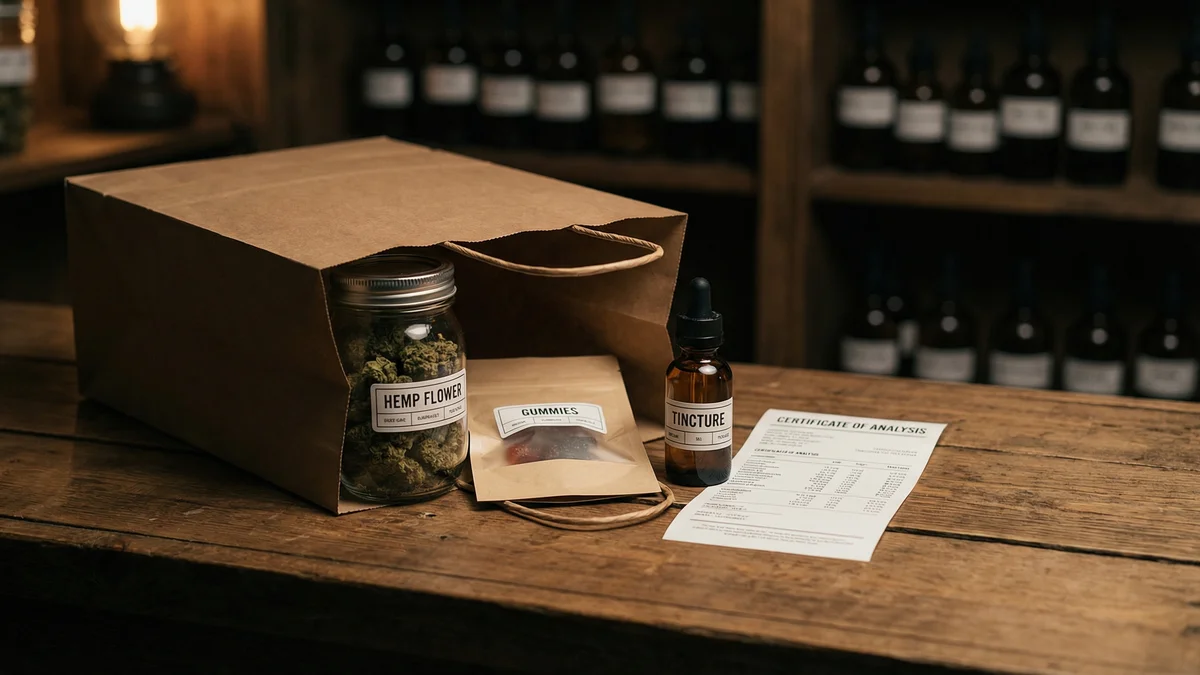
3. Ask for COAs. Certificates of Analysis from third-party labs are your best quality assurance. They verify cannabinoid content, screen for heavy metals and pesticides, and confirm what you're actually consuming. Read our guide on how to read a COA.
4. Understand what you're buying. Learn the differences between Delta-8, Delta-9, and THCa so you know which products might be affected by future legislation. HB 328's conference report would count THCa toward NC's THC limit and exclude chemically converted cannabinoids such as most Delta-8 starting November 12, 2026, but only if the House adopts it; until then, all three remain legal in NC.
5. Watch the Advisory Council's December 31 final recommendations. The council's co-chairs recommended a regulated adult-use cannabis market in April 2026, and its final recommendations are due in December. Those, plus any successor bill to HB 328, will shape what comes next. We'll update this article as new information becomes available.
6. Support your local dispensary. These businesses are navigating enormous uncertainty. If you value having access to legal hemp products in the Triangle, patronize shops that invest in compliance, testing, and quality. Check out our guides to the best dispensaries in Raleigh and best dispensaries in Durham.
Frequently Asked Questions
Are hemp products still legal in North Carolina in 2026?
Yes. As of October 10, 2026, all hemp-derived cannabinoid products remain legal in NC under Session Law 2022-32 (SB 455) and the 2018 Farm Bill. This includes THCa flower, Delta-8, Delta-9 gummies, edibles, vapes, and CBD products. No state or federal ban has taken effect yet. HB 328, once written off as dead, returned through a conference committee and passed the Senate 37-6 on July 2, 2026; if the House adopts it by December 18, its 21+ age limit takes effect on enactment (its July 15 start date has passed) and its total-THC 0.4mg-per-container cap on November 12.
When does the federal hemp ban take effect?
P.L. 119-37 takes full effect on December 11, 2026, after Section 2019 moved most of it back from the one-year mark. After that date, any hemp product exceeding 0.3% total THC or 0.4mg total THC per container would be federally classified as a Schedule I controlled substance. The Hemp Planting Predictability Act (H.R. 7024) proposes extending this deadline to November 2028, but it has not passed. A narrower delay did pass and is now law: H.R. 6500 cleared the Senate 90-6 on August 8, 2026, the House agreed to the Senate's version 370-48 on September 1, 2026, and the President signed it on September 2, 2026 as Public Law 119-103 (govinfo bill status). It moves the 0.3 percent total-THC test and the 0.4mg per container cap to December 11, 2026 while leaving a narrow slice on November 12. Plan around November 12 for cannabinoids the plant cannot naturally make and December 11 for everything else, delta-8 made from CBD included. Our NC hemp bill tracker has the live status.
What does HB 328 mean for THCa flower now that it's back?
HB 328 targets THCa flower. The July 2026 conference report rewrites NC's hemp definition so that 87.7% of THCa counts toward the 0.3% THC limit starting November 12, 2026, a test typical high-THCa flower fails, and it separately caps finished consumable products at 0.4mg of total THC per container (conference committee text). THCa flower is fully legal in NC today. It would lose that status under state law on November 12 if the House adopts the report and it becomes law. THCa operators should plan for that date as well as the federal December 11 date.
Will I need to be 21 to buy hemp products in NC?
Probably soon. Every major hemp bill in the 2025-2026 NC legislature included a 21+ age requirement. The measure now closest to law is the HB 328 conference report, which the Senate adopted 37-6 on July 2, 2026 and which would set a statewide 21+ limit on hemp consumables and kratom, written to a July 15, 2026 start date that has now passed without the bill becoming law (NC General Assembly). NC currently has no state-level age requirement (the 21+ rule at most dispensaries is store policy), but HB 328 would make it mandatory. The House sent it to its Rules committee on July 30, 2026 without a floor vote; it can still act in the reconvened sessions through December 18. SB 328, an age-only bill, is also still eligible for a final Senate concurrence vote.
How does the federal ban affect North Carolina specifically?
The federal ban creates a complicated situation. NC's SB 455 still makes hemp products legal under state law, nothing in P.L. 119-37 forces states to adopt the federal definition, and NC's statute is unchanged unless the General Assembly acts. This means products could theoretically be legal under NC law but illegal under federal law, similar to recreational marijuana in states like Colorado or California. Federal enforcement against individual consumers has been extremely rare, but businesses face more risk.
What happens to dispensaries if these laws pass?
It depends on which law. If the House adopts the HB 328 conference report, NC shops would face an age-21 rule on enactment and a state total-THC standard with a 0.4mg per container cap on finished products from November 12, 2026, but no state license or fee: the conference report dropped the Senate's 2025 licensing plan (conference committee text). Selling to someone under 21 would carry civil penalties of $2,500 to $25,000, or $10,000 to $50,000 when the product sold is over the cap. The federal P.L. 119-37 standard takes full effect December 11, 2026 regardless. Adding to the picture, the co-chairs of Governor Stein's Advisory Council on Cannabis recommended a regulated adult-use market in April 2026, which could open a new licensing pathway for existing hemp retailers if lawmakers ever act on it. For a detailed look at how dispensaries should prepare for P.L. 119-37, see our B2B preparation guide. For the marketing side (which channels work for NC hemp retailers given federal ad-platform bans), see our 2026 NC dispensary marketing playbook.
This article was last updated on October 10, 2026 to correct the status of HB 328 (revived in conference, adopted by the Senate July 2, pending in House Rules), add the reconvened-session windows under Resolution 2026-6, reflect P.L. 119-103's split federal dates, and correct the House Farm Bill vote date (April 30, 2026). Hemp law in NC continues to evolve rapidly. We'll update this page as new legislation moves, the Advisory Council releases its December 2026 final recommendations, or the federal timeline changes. Bookmark this page or browse our blog for the latest.
Have questions about finding hemp products in the Triangle? Browse our dispensary directory to find verified shops in Raleigh, Durham, Chapel Hill, Cary, and more.