CBD Oil Guide for NC: Types, Dosing & What to Buy
This article is for informational purposes only and does not constitute legal, medical, or product advice. Consult a qualified professional for guidance specific to your situation.
CBD oil is the most widely available hemp product in North Carolina and the easiest entry point for new consumers. Unlike THCa flower or Delta-8, CBD is non-intoxicating, it won't get you high. But the market is flooded with low-quality products, confusing labels, and unsubstantiated health claims that make it hard to know what you're actually buying.
This guide covers the three types of CBD, what the clinical research actually shows, how to dose, which medications interact with CBD, and how to find quality products at Triangle dispensaries.
CBD oil comes in three types, full-spectrum (contains up to 0.3% THC), broad-spectrum (THC removed), and isolate (99%+ pure CBD). Oral bioavailability is only 6–14%, so sublingual dosing under the tongue is more effective (PMC, 2024). Start at 10–25mg daily and adjust. A 2024 study found 74% of CBD products deviate from label claims by more than 10% (Frontiers in Pharmacology, 2024), always buy from retailers with third-party COAs.
The Three Types of CBD
Not all CBD products are the same. The type determines what else is in the product besides CBD, and that matters for effects, drug test risk, and legal status.
Which type should you choose?
- Full-spectrum if you want maximum potential benefit and aren't drug tested. The "entourage effect" theory suggests cannabinoids work better together, though human clinical evidence is still mixed.
- Broad-spectrum if you want some entourage benefits without THC. Good middle ground, but verify the COA, 26% of products don't match their stated type (Frontiers in Pharmacology, 2024).
- Isolate if you're drug tested or want precise CBD dosing without other compounds. See our drug testing guide for why this matters.
Bioavailability: Why How You Take CBD Matters
Most people swallow CBD oil, but here's the problem: oral CBD has only 6–14% bioavailability. That means if you swallow a 50mg dose, your body absorbs just 3–7mg (PMC, 2024).
Practical tips to improve absorption:
- Hold sublingual oil under your tongue for 60–90 seconds before swallowing. The mucous membranes under your tongue bypass first-pass liver metabolism, potentially doubling absorption.
- Take CBD oil with food, especially fatty food. CBD is fat-soluble. Epidiolex studies showed food increased absorption 4–5x compared to fasting.
- Nano-emulsion products (marketed as "water-soluble CBD") use smaller particle sizes to improve bioavailability. Some beverages using this technology claim 10–30 minute onset times compared to 30–90 minutes for standard oil.
How to Dose CBD
There are no FDA-approved dosing guidelines for over-the-counter CBD products. Clinical studies have used doses ranging from 10mg to 1,500mg daily, with an emerging pattern: CBD appears to follow an inverted U-shaped dose-response, where intermediate doses (around 300mg) may work better than both lower and higher doses for some conditions (PMC, 2024).
For most consumers, the practical approach is:
Start low: 10–25mg per day, taken in 1–2 doses
Increase gradually: Add 5–10mg every 3–5 days until you notice effects
Track your response: Keep a simple log of dose, time, and how you feel
Reading CBD labels
The most important numbers on a CBD product label:
- Total CBD per bottle (e.g., 1,000mg), this is the total for the entire product
- CBD per serving (e.g., 33mg per 1mL dropper), this is what you're taking per dose
- CBD per mL or per unit, the concentration that determines value
- Type (full-spectrum, broad-spectrum, isolate), confirmed by COA, not just the label
Cost benchmarks: CBD oil typically costs $0.05–$0.20 per mg. A 30mL tincture with 1,000mg CBD at $60 = $0.06/mg, that's a fair price. Anything over $0.20/mg is premium pricing. For more on evaluating product quality, see our COA reading guide.
What Does the Research Actually Show?
CBD has real clinical evidence for some uses, limited evidence for others, and no evidence for many claims made by brands. Here's what the peer-reviewed research says as of 2026:
Anxiety: Most promising
A 2024 meta-analysis of 8 studies (316 participants) found a substantial effect size (Hedges' g = -0.92) for CBD reducing anxiety symptoms (PubMed, 2024). A separate RCT (n=178) using nanodispersible CBD found significant reductions in both GAD-7 and HAM-A anxiety scores compared to placebo (ScienceDirect, 2024).
However, a systematic review of 15 RCTs found that 60% of studies showed single-dose CBD did NOT reduce anxiety, suggesting that consistent, multi-day dosing may be more effective than one-time use (PMC, 2024).
Pain: Promising but limited
A 2024 systematic review of 40 studies (11 human clinical trials) found that 7 of 11 human trials showed positive pain-reducing effects (PMC, 2024). Topical CBD for osteoarthritis and neuropathic pain shows the most consistent results. However, the most authoritative 2025 AHRQ Living Systematic Review found that oral CBD alone "may not be associated with improved pain" versus placebo (NCBI, 2025), combination CBD+THC products showed better outcomes.
For a deeper dive, see our CBD for pain relief guide.
Sleep: Mixed
A clinical trial of 150mg CBD nightly showed results similar to placebo on most sleep outcomes, but CBD did improve objective sleep efficiency after 2 weeks and produced greater well-being scores (JCSM, 2024). Combination products containing CBD, CBN, and THC showed clearer benefits (PMC, 2025).
The only FDA-approved CBD
Epidiolex is the only FDA-approved CBD product in the United States. It treats seizures associated with Lennox-Gastaut syndrome, Dravet syndrome, and tuberous sclerosis complex in patients 1+ years old. No other CBD product is FDA-approved for any medical condition (FDA, 2025).
Drug Interactions: What to Watch For
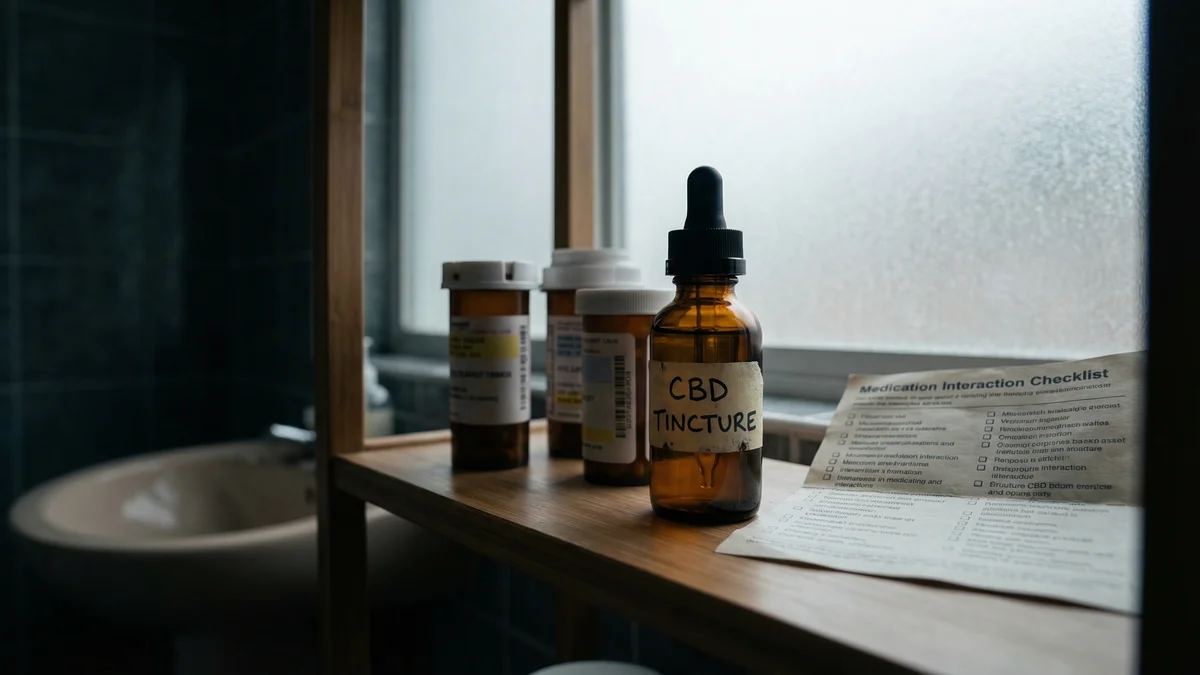
This is the most under-discussed aspect of CBD. CBD inhibits several liver enzymes (CYP3A4, CYP2C9, CYP2C19, CYP2D6) that metabolize many common medications. A 2024 systematic review of 603 patients found that 58% of documented drug interaction cases involved unexpected medication serum levels (Frontiers in Pharmacology, 2024).
Documented increases in medication levels when combined with CBD:
- Omeprazole (acid reflux): levels increased 207%
- Losartan (blood pressure): levels increased 77%
- Midazolam (sedation): levels increased 56%
(Clinical Pharmacology & Therapeutics, 2023)
High-risk medications to watch:
- Blood thinners (warfarin), documented case of INR >10 (expected 2–3) causing bleeding (PMC, 2018)
- Anti-seizure drugs (valproate, clobazam)
- Immunosuppressants (tacrolimus, sirolimus), 46% of transplant patients taking CBD/THC suffered adverse events related to medication toxicity
- Sedatives and benzodiazepines
- Some antidepressants (SSRIs metabolized by CYP2D6)
If you take any prescription medication, talk to your doctor or pharmacist before starting CBD. This isn't a disclaimer, it's based on clinical evidence of real interactions.
The Label Accuracy Problem
A 2024 analysis of 202 CBD products found that 74% deviated from their label claims by more than 10% (Frontiers in Pharmacology, 2024):
- 46% were over-labeled (contained less CBD than claimed, you're not getting what you paid for)
- 28% were under-labeled (contained more CBD than claimed)
- 26% failed to match their stated product type (labeled "broad-spectrum" but contained THC, or vice versa)
- 22% contained heavy metals (lead most prevalent)
- 90% had residual solvents detected
- 15% had pesticides
A separate 2025 analysis found that 70% of CBD gummy products had concentrations significantly different from labels (NORML, 2025).
This is why buying from dispensaries that verify COAs matters. See our COA reading guide for exactly what to look for.
Where to Buy CBD Oil in the Triangle
Every dispensary in the Triangle directory carries CBD products. For CBD-specific shopping:
- Trek CBD in Raleigh, Education-focused CBD specialty shop, ideal for first-time buyers
- Emerald Medicine Company in Durham, Wellness-focused approach with knowledgeable staff
- The Hemp Store in Chapel Hill, The Triangle's first dispensary, strong CBD selection, woman-owned
- Modern Apotheca in Raleigh, Free delivery, good CBD tincture selection
- Carolina Hemp Hut in Durham, NC's largest shop with the widest selection
For shops in your area, browse by city: Raleigh, Durham, Chapel Hill, Cary.
The December 2026 Federal Question
P.L. 119-37 (signed November 2025) redefines hemp based on total THC, effective December 11, 2026. For CBD products specifically:
- CBD isolate products: Likely unaffected (zero THC)
- Broad-spectrum CBD: Likely unaffected if truly THC-free
- Full-spectrum CBD: Products with more than 0.4mg THC per container become federally restricted. Most full-spectrum tinctures currently on the market would exceed this threshold.
For the full legal context, see our guides on hemp vs. marijuana in NC and THCa legality.
Frequently Asked Questions
Will CBD oil show up on a drug test?
It depends on the type. CBD isolate has virtually no drug test risk. Full-spectrum CBD can cause positive results, a JAMA Psychiatry study found that 50% of participants using full-spectrum hemp extract tested positive for THC metabolites after 4 weeks (JAMA, 2020). For more detail, see our drug testing guide.
How much CBD should I take?
Start with 10–25mg daily. Increase by 5–10mg every 3–5 days until you notice effects. Most consumer products deliver 10–50mg per serving. Clinical studies used 25–300mg for anxiety and 50–150mg for pain. A safety review recommends a max of 160mg daily for healthy adults without medical supervision.
Is CBD legal in North Carolina?
Yes. CBD derived from hemp (≤0.3% Delta-9 THC) is legal under both the 2018 Farm Bill and NC Session Law 2022-32 (SB 455). No prescription, medical card, or special license is required. NC has no state-level age requirement, though most shops enforce 21+.
Can CBD interact with my medications?
Yes, this is a real concern. CBD inhibits liver enzymes (CYP3A4, CYP2C9, CYP2C19) that metabolize many prescription drugs. It can increase levels of blood thinners, anti-seizure meds, blood pressure drugs, and sedatives. If you take any prescription medication, consult your doctor or pharmacist before starting CBD.
What's the difference between hemp CBD and marijuana CBD?
Chemically, nothing. CBD is CBD regardless of the source plant. The legal difference is that hemp-derived CBD comes from plants with ≤0.3% Delta-9 THC, making it federally legal. Marijuana-derived CBD comes from plants exceeding that threshold and is illegal in NC.
Ready to try CBD? Browse the Triangle dispensary directory to find a shop near you, or read our guide on what to look for in a quality dispensary. For first-time buyers, our first-time dispensary guide walks through exactly what to expect.
This article is for informational purposes only. It does not constitute medical, legal, or product endorsement advice. CBD is not FDA-approved for any condition other than specific seizure disorders (Epidiolex). Consult a healthcare provider before starting CBD, especially if you take prescription medications. Information is current as of February 2026.