North Carolina Recommends Legalizing Marijuana: What It Means for Hemp Dispensaries

This article is for informational purposes only and does not constitute legal, medical, or product advice. Consult a qualified professional for guidance specific to your situation.
North Carolina just took its most significant step toward marijuana legalization in state history. In early April 2026, Governor Josh Stein's Advisory Council on Cannabis released an interim report in which its co-chairs recommend an adult-use market: adults could legally buy, possess, and use cannabis through state-licensed retail outlets (NCDHHS interim report). WRAL reported the proposal would set the age at 21 (WRAL, 2026).
The recommendation doesn't make anything legal yet. The Republican-led General Assembly still has to act, and neither House Speaker Destin Hall nor Senate leader Phil Berger has publicly supported adult-use legalization. In July, Hall went further: "I know our caucus has no interest in doing any sort of marijuana, medicinal or otherwise" (WRAL). Still, a council of law enforcement officials, health experts, bipartisan lawmakers, and agricultural stakeholders (27 members plus two co-chairs on the current roster) has handed the legislature a starting framework for regulation.
For the 80+ hemp dispensaries in our Triangle directory, this raises a very specific question: what happens to their businesses if North Carolina moves from unregulated hemp sales to a licensed marijuana market?
This article is for informational purposes only and does not constitute legal advice.
Federal update: Three weeks after Stein's council issued its interim report, the Justice Department moved state-licensed medical marijuana and FDA-approved marijuana products to Schedule III in a final order announced April 23, 2026 and effective April 28. In the same week, Senate Leader Phil Berger told reporters his chamber would revisit medical marijuana (WRAL). See our breakdown of the Schedule III order in NC context for what changed federally and what didn't change in North Carolina.
Governor Stein's Advisory Council on Cannabis released an interim report in April 2026 in which its co-chairs recommend a regulated adult-use market with licensed retail sales (NCDHHS interim report). The council backs "molecule-based" regulation that would unify the current hemp and marijuana frameworks around total THC. NC's hemp industry supports nearly 9,000 jobs and generates $759 million to $1.1 billion annually (Port City Daily, citing a 2023 Whitney Economics study). The legislature adjourned its regular session on August 6, 2026 without acting, and House Speaker Destin Hall has said his caucus has no interest in legalizing marijuana.
Update, October 10, 2026: The federal hemp deadline referenced below has shifted. H.R. 6500 became Public Law 119-103 on September 2, 2026, and its Section 2019 delays most of the new hemp definition, including the 0.4mg per container THC cap and the total-THC test that counts THCa, to December 11, 2026. A narrow piece covering cannabinoids the plant cannot naturally produce still begins November 12, 2026. Still current as of this update. Track it in our NC hemp bill tracker.
What Did the Advisory Council Recommend?
In the council's interim report, the co-chairs' preliminary recommendation is "an adult-use regulatory model with built-in protections for medical consumers," under which "adults would be permitted to legally purchase, possess, and use cannabis through state-licensed retail outlets" (NCDHHS interim report; NC Governor, 2026). It's the first time a state-appointed body in North Carolina has formally backed a legal adult market. The report notes that the council's vote to issue it should not be read as every member organization's "blanket endorsement" of each recommendation.
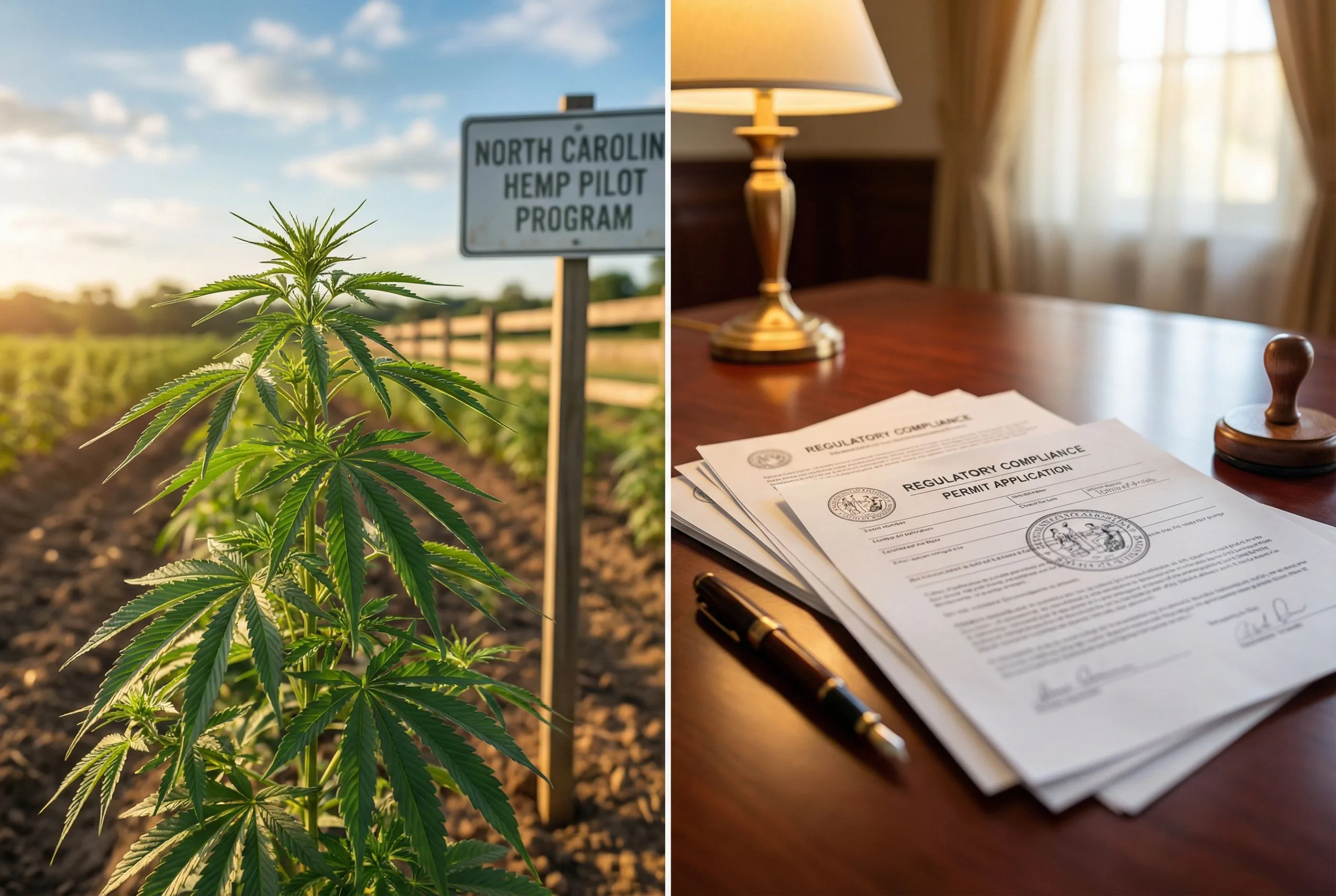
Governor Stein established the council through Executive Order No. 16 on June 3, 2025 (Executive Order). The order allows up to 30 members; the current NCDHHS roster lists 27 members plus two co-chairs, State Health Director Dr. Lawrence Greenblatt and District Attorney Matt Scott of Robeson County (NCDHHS). The panel spans the State Highway Patrol, county sheriffs, and police chiefs. It includes medical professionals, bipartisan state legislators (including Republican Sen. Bill Rabon, who sponsored the Compassionate Care Act), agricultural interests, tribal representatives from the Catawba Indian Nation, and tax policy experts from the Center for New Revenue.
The most notable recommendation is what the council calls a "molecule-based" regulatory approach. Instead of maintaining separate legal frameworks for hemp and marijuana (the current system), the council argues that regulation should focus on the THC molecule itself. As the interim report puts it: "The plant source is irrelevant and should not drive different treatment when the intoxicating compound is the same" (Marijuana Moment, 2026).
What the interim report actually recommends, and what it leaves for later:
- A unified, THC-based framework that regulates products by total THC and intoxicating potential instead of running separate hemp and marijuana systems
- An adult-use market with protections for medical consumers, recommended by the co-chairs
- Medical-grade safeguards, which the report lists as low-THC product options, comprehensive testing standards, expanded product warnings, recall authority, and access to qualified medical consultation
- Expungement as a topic for further study: the report says the council's next phase will discuss "pathways to advance justice, including potential expungement of prior convictions," without making a recommendation yet
The report does not recommend a specific regulatory agency, social equity program, or home cultivation; those details are left for the final report. Three Phase 1 subcommittees (Consumer Safety and Youth Protection, Prevention and Treatment, Market Structure) did the early work, and three new ones (Regulatory Structure, Enforcement and Criminal Justice Reform, Revenue and Federal Compliance) are working on Phase 2 (NCDHHS interim report). The council's final report is due December 31, 2026.
Why Now? NC's Billion-Dollar "Wild West"
North Carolina has one of the largest illicit marijuana markets in the country, with an estimated $3 billion spent on illegal marijuana in 2022, "ranking second in the nation," according to the council's interim report (NCDHHS interim report). Meanwhile, the state's legal hemp industry has grown to an estimated $759 million to $1.1 billion in annual sales with 858 licensed growers and nearly 9,000 jobs, but no comprehensive regulatory framework (Port City Daily, citing Whitney Economics, 2023).
Governor Stein put it bluntly: "Our state's unregulated cannabis market today is the Wild West and is crying for order" (NC Governor, 2026).
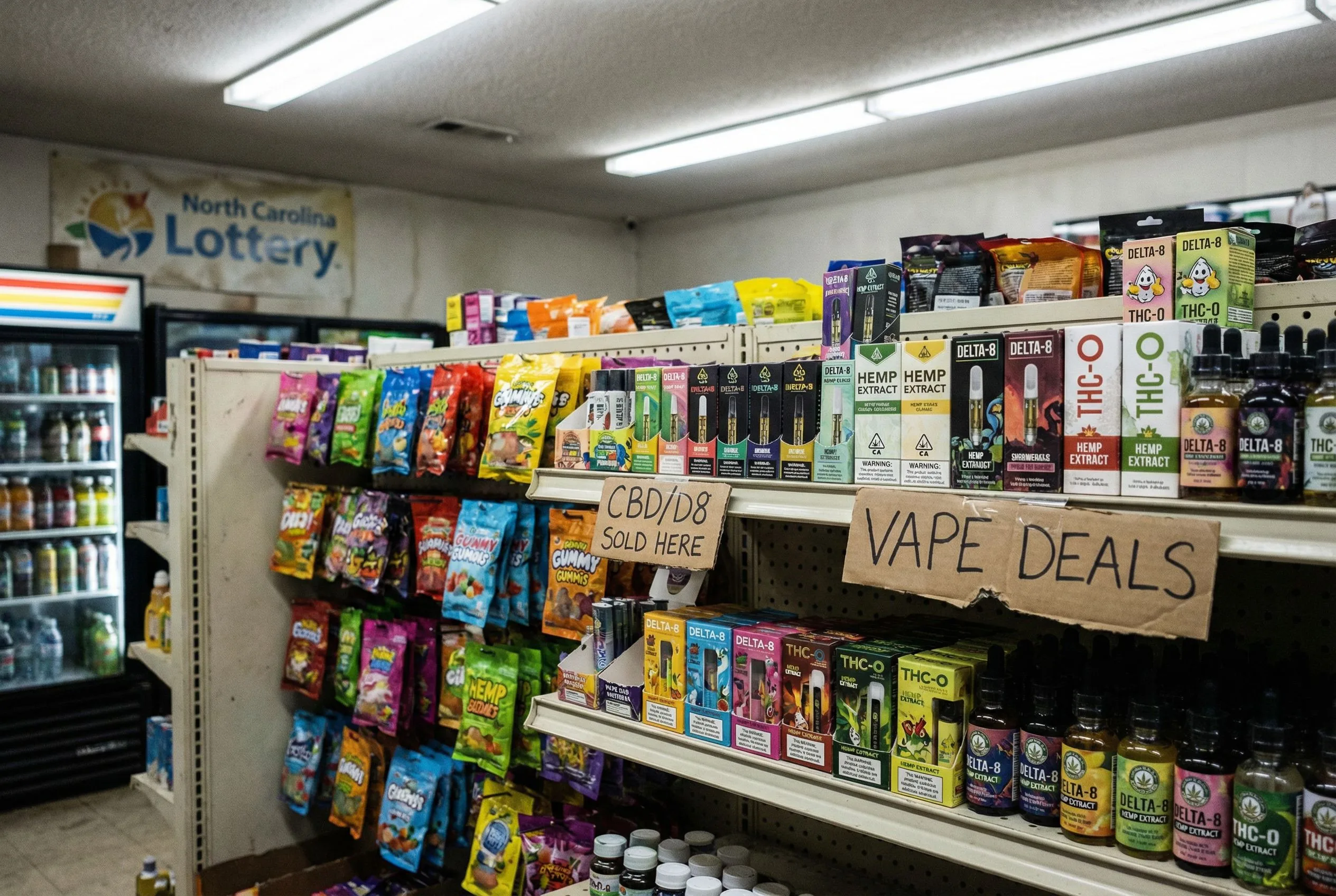
He's not wrong. Walk into certain gas stations in the Triangle and you'll find THC gummies, vapes, and delta-8 products sitting next to the candy bars. No age verification at the door. No third-party lab testing required. No consistent labeling standards. That's a far cry from the legitimate dispensaries in our directory, which invest in proper testing and responsible retail practices.
The safety data backs up the concern, though the best recent example comes from another state. When the Milwaukee Journal Sentinel had 30 unregulated hemp products from Milwaukee-area retailers tested in early 2026, over one-third contained mold and pesticides. Half contained lab-produced synthetic cannabinoids like HHC and THCP. One sample tested positive for methylene chloride, a solvent used in paint stripper. At least one product had a forged certificate of analysis (NORML, 2026).
This is the irony of NC's current system. Legitimate shops compete on an uneven playing field with gas stations and convenience stores that face no oversight. The council's argument is straightforward: regulation creates a safer market, generates tax revenue, and brings legitimate businesses out of a legal gray area. For more on what separates reputable retailers from unregulated sellers, see our guide on what to look for in an NC dispensary.
What Cannabis Bills Are Already on the Table?
Two significant cannabis bills were filed in the 2025-2026 NC General Assembly, though neither gained enough Republican support to advance, and neither can be taken up in the limited reconvened sessions left in 2026. The most ambitious, HB 413, would legalize recreational marijuana with a 30% excise tax (NC General Assembly, 2025).
The Marijuana Legalization and Reinvestment Act (HB 413), filed March 17, 2025 by Rep. Jordan Lopez (D-Mecklenburg), would:
- Legalize possession of up to 2 ounces of cannabis and 15 grams of concentrate
- Allow 6 plants for personal use
- Impose a 30% excise tax plus an optional 2% local tax
- Create a Community Reinvestment and Repair Fund for impacted communities
- Establish automatic expungement of past cannabis convictions
- Target effective date: January 1, 2028
A companion bill, S350 (Marijuana Justice and Reinvestment Act), was filed in the Senate by seven Democratic senators.
How much revenue could NC expect? The council's interim report cites a range of $33 million to $552 million annually, based on other states' results. Here's what the top-earning states collected in 2024, according to the Marijuana Policy Project:
The Compassionate Care Act tells a cautionary story about legislative obstacles. As SB 711, sponsored by Republican Sen. Bill Rabon, the medical marijuana bill passed the NC Senate 36-7 in June 2022. Its successor, SB 3, passed the Senate 36-10 on March 1, 2023. The House never voted on either (NC General Assembly, SB 711; SB 3). A new version (HB 1011) was filed in 2025 but has sat in House Rules since April 2025 (NC General Assembly).
North Carolina is one of only 10 states, plus three U.S. territories, with neither a regulated adult-use market nor a medical marijuana program, according to the council's interim report. Its only medical carve-out is a narrow exemption for hemp extract used to treat intractable epilepsy (G.S. 90-94.1). Twenty-four states plus D.C. have legalized recreational use (NCSL, 2026). For a full breakdown of NC's current cannabis laws, including possession penalties and the hemp vs. marijuana legal distinction, check our legal guides.
The P.L. 119-37 Collision Course
The federal government just set a deadline that makes state-level action more urgent than ever. P.L. 119-37, signed November 12, 2025, redefines hemp to include total THC and caps finished products at 0.4mg per container. Under Section 2019 of P.L. 119-103, it takes full effect December 11, 2026, with a narrow piece starting November 12 (Section 2019, enrolled text).
What makes this a collision course with legalization? Consider the timeline:
- April 2026: Advisory council's interim report recommends an adult-use market; short legislative session begins
- August 6, 2026: Regular session adjourns with no cannabis legalization bill advanced
- December 11, 2026: P.L. 119-37 takes effect, banning roughly 95% of current hemp products
- December 31, 2026: Council's final regulatory framework due
- January 1, 2028: HB 413's proposed legalization effective date
See the gap? Even if the legislature passed HB 413 tomorrow, legal retail sales wouldn't start until 2028. Meanwhile, P.L. 119-37 hits in December 2026. That creates a potential gap of roughly 13 months where most hemp-derived THC products are federally illegal, marijuana remains state-illegal, and NC has no licensed cannabis market at all.
The U.S. Hemp Roundtable estimates P.L. 119-37 will eliminate 95% of existing hemp-derived cannabinoid products nationwide, threatening 300,000 jobs and $1.5 billion in state tax revenue. The industry is valued at roughly $28.4 billion (US News, 2025). NC's share of that impact: nearly 9,000 jobs and up to $1.1 billion in annual sales, by Port City Daily's count.
For a detailed breakdown of P.L. 119-37's impact on specific products, read our comprehensive law update and dispensary preparation guide.
What Would This Mean for NC's Hemp Dispensaries?
If legalization passes, the council envisions a "molecule-based" regulatory system that wouldn't distinguish between hemp-derived and marijuana-derived THC (NCDHHS, 2026). That means NC's existing hemp dispensaries could potentially transition into licensed cannabis retailers rather than being shut out of a new market.
This is the most important detail for the Triangle's 80+ hemp shops. Here's how the three most likely scenarios play out:
Scenario 1: Legislature acts before December 2026. This is unlikely given the tight timeline, but if NC passed emergency hemp regulations or a legalization framework before P.L. 119-37 takes effect, existing dispensaries could continue operating under a state licensing system. States like Minnesota and Ohio have built their own frameworks to maintain legal markets even under changing federal law.
Scenario 2: P.L. 119-37 hits, legislature acts later. More realistic. Hemp dispensaries would need to pivot to P.L. 119-37-compliant products (CBD isolate, CBN, CBG, mushroom products, accessories) for months or potentially years while waiting for a state cannabis market to launch. Our P.L. 119-37 preparation guide covers this in detail.
Scenario 3: Legislature does nothing. Also possible. NC's hemp dispensaries would face the P.L. 119-37 product ban with no state safety net, no licensing pathway, and no legal cannabis market. This is the worst-case scenario for the industry's nearly 9,000 workers and 858 licensed growers.
The council's "molecule-based" approach is encouraging for existing shops. It suggests the regulatory framework would build on the existing hemp infrastructure rather than starting from scratch with a marijuana-only licensing system. Dispensaries that already maintain proper testing, labeling, and age verification would have a head start. For owners thinking through the transition, our guide on how to open a dispensary in NC covers compliance and licensing expectations.
Can the Legislature Actually Pass This?
Ninety-five percent of North Carolina voters support changing the state's cannabis laws: 62% favor full adult-use legalization, 32% support medical-only reform, and just 5% want to keep the current prohibition (MPP, 2024 poll). A separate Meredith College poll of 703 likely voters in February 2025 found 71% support legalizing medical cannabis, with majority support among Republicans, Democrats, and unaffiliated voters (ABC11, 2025).
But public support hasn't translated to legislative action yet. The core obstacle remains: the Republican-controlled General Assembly. Neither House Speaker Destin Hall nor Senate President Pro Tem Phil Berger has publicly endorsed legalization, and Hall said in July that his caucus has "no interest in doing any sort of marijuana, medicinal or otherwise" (WRAL). The Compassionate Care Act proved that even bipartisan, medical-only legislation can die without a House vote.
Still, there are reasons for cautious optimism.
The regional shift is accelerating. Virginia's legislature passed retail sales bills (HB 642 and SB 542) in 2026, and Gov. Abigail Spanberger vetoed them on May 19, 2026 (NORML). She then reached a compromise with lawmakers, written into the state budget that became law in late June, that allows up to 350 licensed shops with retail sales beginning July 1, 2027 (WBTV/AP, 2026). When NC's northern neighbor opens legal stores, that creates competitive pressure. Why should North Carolina residents drive to Virginia while NC's own billion-dollar industry withers?
The Cherokee precedent normalized it. The Eastern Band of Cherokee Indians began adult-use sales to members of federally recognized tribes on July 4, 2024, and opened sales to all adults 21 and older on September 7, 2024, the first general adult-use cannabis sales in the Southeast, with nearly 1,000 people lined up that day (NORML; BPR, 2024). Recreational cannabis sales are already happening on North Carolina soil.
The revenue numbers speak for themselves. States have collected a combined $24.7 billion or more in cannabis tax revenue since 2014, with more than $4.4 billion in 2024 alone, a single-year record (MPP, 2025). For a legislature that's always looking for revenue, those numbers carry weight.
P.L. 119-37 creates urgency. If the legislature does nothing, nearly 9,000 NC jobs and a billion-dollar industry face federal disruption in December 2026. Acting on cannabis regulation isn't just about legalizing marijuana. It's about protecting an existing economic engine.
The 2026 short session didn't produce a legalization vote, committee hearing, or medical bill. The regular session adjourned on August 6, 2026, and the reconvened sessions left this year can consider only a narrow list of items, which includes the HB 328 hemp crackdown but not HB 413 or HB 1011 (Resolution 2026-6). The council's final report in December 2026 will give the legislature a detailed blueprint for the 2027 long session, the next realistic window.
What Should Consumers and Dispensary Owners Watch For?
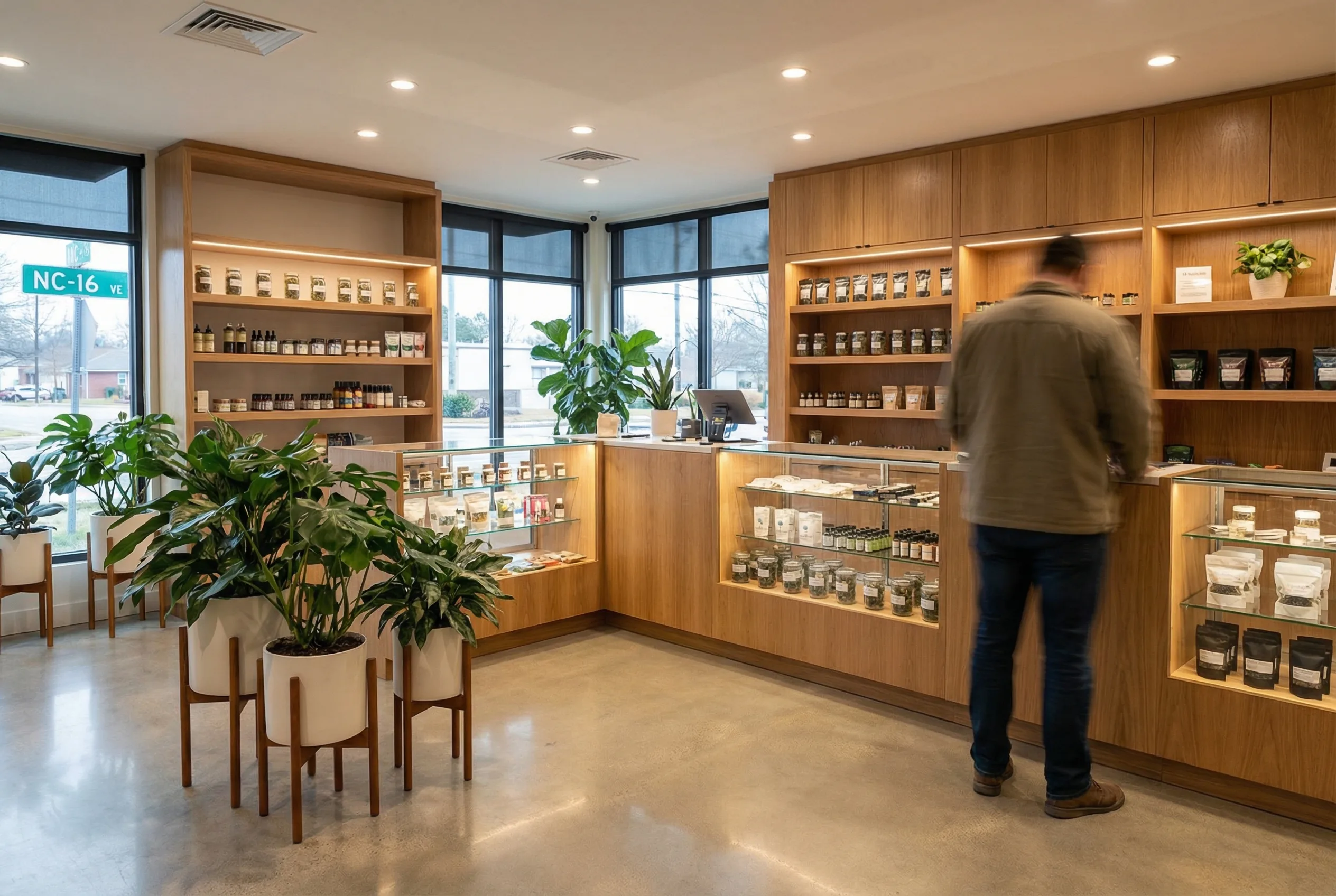
For consumers shopping at Triangle dispensaries:
Nothing changes today. Hemp-derived THC products remain legal in North Carolina right now. You can still buy THCa flower, delta-8, edibles, and other products at established hemp retailers across the Triangle. (North Carolina does not license hemp shops.)
But here's what to keep on your radar:
- The December 2026 deadline is real. If P.L. 119-37 takes effect without congressional or state intervention, most THC products will become unavailable. Read our buying guide for tips on finding quality products now.
- Follow the reconvened sessions. The General Assembly can still vote on the HB 328 hemp crackdown between October 26 and December 18, 2026; legalization bills will have to wait for the 2027 long session. Our NC hemp bill tracker follows each vote.
- Support your local shops. Legitimate dispensaries are the businesses most likely to transition into a licensed market. Buying from tested, reputable retailers strengthens the industry's case for regulation over prohibition.
For dispensary owners:
- Read the council's full interim report. The document is available from NCDHHS. Understanding the proposed regulatory framework helps you position your business for whatever comes next.
- Don't wait on P.L. 119-37 preparation. December 11, 2026 is about two months away. Our preparation guide covers inventory audits, product pivots to compliant categories, and compliance planning.
- Engage with the process. The council's final report is due December 31, 2026. Public input during this period can shape the licensing framework.
- Document your compliance track record. If legalization passes, early movers with established testing, labeling, and age verification practices will have an advantage during the licensing process.
Frequently Asked Questions
Is marijuana legal in North Carolina right now?
No. Marijuana remains illegal in NC for both recreational and medical use. However, hemp-derived THC products (THCa flower, delta-8, delta-9 gummies) are currently legal under the 2018 Farm Bill and NC Session Law 2022-32. The advisory council's recommendation doesn't change current law. Only the General Assembly can do that. For the full breakdown, see our guide on whether weed is legal in North Carolina.
What is the NC Advisory Council on Cannabis?
A panel of up to 30 members (27 members plus two co-chairs on the current roster) established by Governor Josh Stein through Executive Order No. 16 on June 3, 2025 (NC Governor). Co-chaired by State Health Director Dr. Lawrence Greenblatt and District Attorney Matt Scott, the council includes law enforcement, health professionals, bipartisan legislators, agricultural representatives, and tribal interests. In its April 2026 interim report, the co-chairs recommend an adult-use market with licensed retail and protections for medical consumers.
How would legalization affect existing hemp dispensaries?
The council's "molecule-based" approach suggests existing hemp retailers could transition into licensed cannabis businesses rather than being replaced by a separate marijuana-only system. Dispensaries with established compliance records (third-party testing, age verification, proper labeling) would likely have an advantage in a licensing process. The details will depend on the final regulatory framework, due December 31, 2026.
Does the Marijuana Legalization and Reinvestment Act (HB 413) have enough votes?
Not currently. HB 413 was filed by Democratic legislators, and the Republican-led General Assembly controls both chambers. The bill has sat in the House Rules Committee since March 18, 2025 (NC General Assembly) and cannot be taken up in the reconvened sessions left in 2026. Even the bipartisan medical cannabis bill (the Compassionate Care Act, SB 3) died without a House vote despite passing the Senate 36-10 in 2023.
How does P.L. 119-37 affect NC's legalization timeline?
P.L. 119-37 adds urgency by threatening to eliminate 95% of hemp products by December 11, 2026. Even if HB 413 passed immediately, legal retail wouldn't start until January 2028, creating a potential gap of roughly 13 months. This pressure could push the legislature toward interim protections or expedited action. For product-specific impacts, see our NC hemp law update.