THC vs CBD: Effects, Benefits & How to Choose in NC (2026)
This article is for informational purposes only and does not constitute legal, medical, or product advice. Consult a qualified professional for guidance specific to your situation.
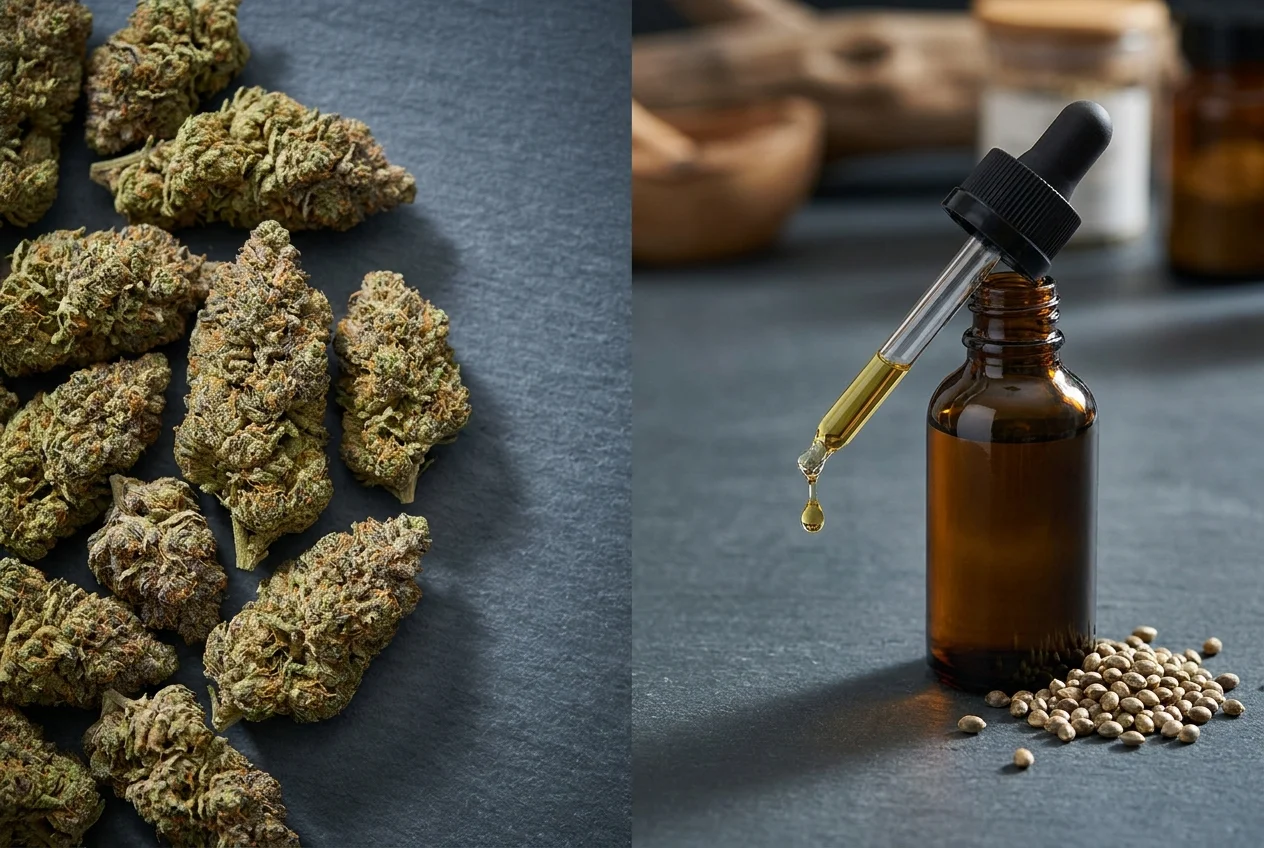
In North Carolina, the "THC vs CBD" question isn't what Healthline and WebMD think it is. Every THC product on a NC dispensary shelf today is hemp-derived and sold in the same stores that sell CBD, under the 2018 Farm Bill and NC Senate Bill 455 (NCGA, 2022). You're not choosing between a dispensary and a health food store, you're choosing between two cannabinoids on the same counter.
That changes on December 11, 2026. Public Law 119-37 excludes any finished hemp product containing more than 0.4mg of combined total THC per container (P.L. 119-37, Section 781, 2025), which will pull most current THC products off NC shelves while leaving CBD isolate and THC-free broad-spectrum products largely untouched. Understanding what each compound actually does (and which one fits your need) matters more now than it has in years.
THC intoxicates, CBD doesn't. In NC both are sold at the same hemp dispensaries under the 2018 Farm Bill. CBD has stronger clinical evidence for anxiety and seizure disorders, THC has stronger evidence for pain and sleep, and in one large cancer-pain trial a THC:CBD blend beat placebo while THC alone did not. Oral CBD bioavailability is roughly 6–14% (MDPI Pharmaceuticals, 2024) and oral THC roughly 4–20% (NIH review, 2007). P.L. 119-37 caps finished hemp products at 0.4mg total THC per container starting December 11, 2026.
What's the Difference Between THC and CBD?
THC intoxicates, CBD doesn't. That's the only difference that matters to most buyers, and it's the single cleanest answer you'll get. About a third of American adults have tried CBD and 64% say they are familiar with it, according to survey data compiled by SingleCare (its own 2020 survey and a 2019 Gallup poll), which makes it the more mainstream of the two. THC familiarity is catching up fast as hemp-derived products spread across state lines.
Under the hood, both compounds share the same molecular formula (C21H30O2) and differ only in how a few atoms are arranged. That small structural difference changes how they bind to your endocannabinoid system. THC fits cleanly into the CB1 receptor in your brain and triggers the intoxicating high. CBD barely touches CB1 at all, which is why it doesn't produce a high even at doses of several hundred milligrams.
Both CBD and the hemp-derived forms of THC (delta-8, delta-9, and THCa) are federally legal today under the 2018 Farm Bill's 0.3% delta-9 dry-weight threshold. That's the framework every NC hemp shop operates under, and it's the framework P.L. 119-37 rewrites on December 11, 2026.
Which Is Better for Pain, Anxiety, and Sleep?
Clinical evidence is stronger for CBD on anxiety and seizure disorders, stronger for THC on pain and sleep, and strongest for combinations on complex symptoms like cancer pain. In a 177-patient randomized trial, 43% of cancer pain patients on a THC:CBD extract reached at least a 30% pain reduction, versus 21% on placebo and 23% on a THC-only extract, which did no better than placebo (Johnson et al., Journal of Pain and Symptom Management, 2010). That's one trial's evidence for combining the two compounds rather than picking a side.
For seizures, CBD has the cleanest medical record of any cannabinoid. In one Lennox-Gastaut trial on the FDA label for the CBD drug Epidiolex, the 20 mg/kg/day dose produced a 41% median reduction in total seizure frequency, versus 14% on placebo (Epidiolex label, DailyMed). That's why CBD has been FDA-approved as a prescription medicine since 2018 while THC, in its natural plant form, still hasn't.
For anxiety, the evidence runs toward CBD. For chronic pain and insomnia, it runs toward THC and THC:CBD blends. A 2025 Sleep Medicine Reviews meta-analysis of six randomized trials (1,077 patients) found that cannabinoids improved self-reported sleep quality compared with placebo, but the benefit came from non-CBD formulations such as THC and CBN products; CBD-only treatments showed no significant effect (Sleep Medicine Reviews, 2025). That matters if you're shopping for sleep specifically.
In SingleCare's 2020 survey, 64% of American CBD consumers said they use it for pain and 49% for anxiety (SingleCare). Those two use cases drive most first-time purchases. For the specifics on each, our CBD for pain relief guide, cannabis for sleep guide, and cannabis for anxiety guide walk through the clinical research in detail.
What we hear from shops: In our conversations with staff at Triangle hemp dispensaries, they describe CBD-curious visitors as mostly first-timers in their 30s, 40s, and 50s shopping for a specific problem (sleep, pain, anxiety), and THC-curious visitors as returning customers comparing potency and format. The entry point and the repeat-visit pattern split cleanly between the two compounds.
How Do You Actually Feel Each One?
THC produces a psychoactive high within minutes when inhaled and typically 1 to 3 hours after it is swallowed (The Permanente Journal, 2024). CBD produces a non-intoxicating effect that users often describe as "slightly less anxious" or "a little calmer" rather than a noticeable shift in consciousness. A first-time user who takes 25 mg of CBD and expects the sensation of a low-dose edible is almost always disappointed. CBD isn't a gentler high, it's a different thing entirely.
Bioavailability (how much of the compound actually reaches your bloodstream) varies sharply by route. Oral CBD bioavailability is roughly 6 to 14%, and holding it under the tongue has not shown a reliable advantage: the same review notes that the profile with oral mucosal delivery "tends to be similar" to swallowing it (MDPI Pharmaceuticals, 2024). Oral THC sits at roughly 4 to 20%, while smoked THC was reported anywhere from 2 to 56% (NIH review, 2007); inhaled THC hits and clears fast. Topicals are designed to act locally on skin, muscle and joint tissue rather than through the bloodstream.
Tolerance is another axis where the two compounds split. In a lab study using high, escalating oral THC doses (up to 210 mg a day), tolerance to the subjective effects appeared within 11 to 16 days (NIH PMC3584989), which helps explain why experienced consumers need larger doses than newcomers to feel the same effect. CBD does not produce a high, so there is no comparable intoxication tolerance to build.
Are Both THC and CBD Legal in North Carolina?
Yes, both are currently legal in NC when sold as hemp-derived products under the 2018 Farm Bill. That's the framework every shop in our dispensary directory operates under, and it's the framework that changes on December 11, 2026. After that date, P.L. 119-37 redefines hemp using total THC (not just delta-9) and excludes any finished hemp product with more than 0.4mg of combined total THC per container (P.L. 119-37, Section 781, 2025; dates per P.L. 119-103, Section 2019).
The practical impact is asymmetric. Most current THC products (5 mg delta-9 gummies, 25 mg delta-8 chocolates, higher-potency THCa flower) will fall outside the new definition and come off shelves or be reformulated to fit under 0.4mg of total THC per container. CBD isolate and broad-spectrum products with no detectable THC are largely unaffected, but most full-spectrum CBD exceeds the 0.4mg per container cap. For a detailed breakdown of how the rule works, see our NC hemp law update and P.L. 119-37 dispensary preparation guide.
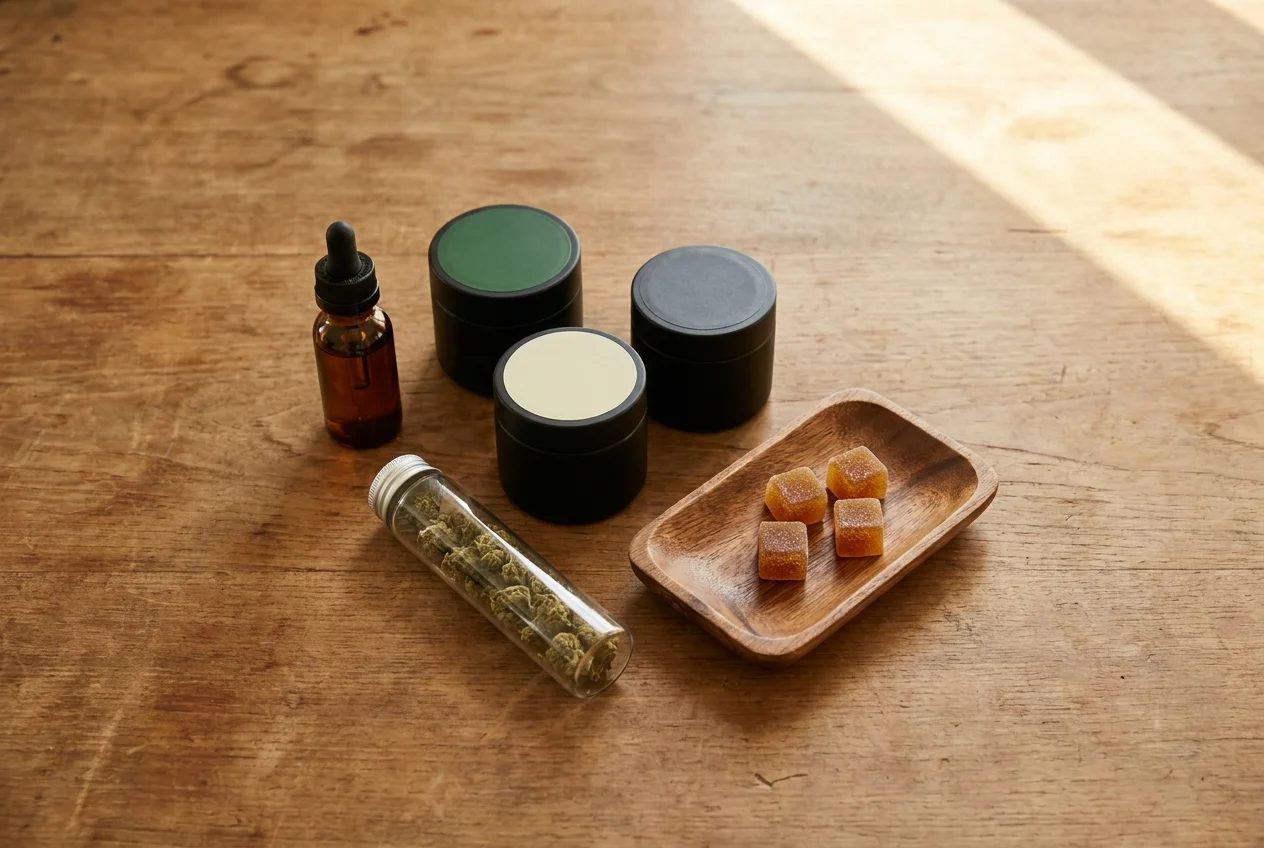
Until December 11, 2026, buying both CBD and hemp-derived THC at an NC hemp dispensary is legal. North Carolina does not license hemp retailers and sets no minimum age for hemp products today, though many Triangle shops card at 21 as store policy. No medical card, no prescription, no diagnosis required. The hemp versus marijuana explainer covers why this works the way it does.
North Carolina status, October 10, 2026: HB 328, the state hemp crackdown, passed the Senate in July but still awaits a House vote, which can come in the reconvened sessions between October 26 and December 18. Today North Carolina sets no minimum age for hemp products, though many shops card at 21. Details in our NC hemp bill tracker.
Will CBD or THC Show Up on a Drug Test?
Pure CBD isolate won't trigger a drug test, but full-spectrum CBD products legally contain up to 0.3% delta-9 THC and can accumulate enough to cause a positive result with daily high-dose use. Regular use of any THC product, including delta-8, delta-9, and THCa, can produce a positive result on a standard 50 ng/mL urine screen, the federal workplace cutoff (49 CFR 40.85). If passing a test is non-negotiable, CBD isolate is the only safe answer, and even then product label accuracy is a real concern.
74% of commercial CBD products deviate from their labeled potency by 10% or more, and 33% are mislabeled outright (Frontiers in Pharmacology, 2024). That means a "CBD isolate" product with no lab report may actually contain trace THC the manufacturer didn't test for. Dispensary-grade products with a current certificate of analysis (COA) are the safer path, and our guide on how to read a COA walks through exactly what to verify.
Topical CBD shows the same problem. A separate study of 89 topical products found most labels missed the mark:
Only 24% of topical CBD products tested by Johns Hopkins researchers were accurately labeled; 58% contained more CBD than the label said and 18% contained less (JAMA Network Open, 2022). That's why buying from an established NC shop that provides a current COA matters more than the price tag. Mislabeling turns up across retail channels, not just in one kind of store.
For workers in drug-tested industries (trucking, healthcare, construction, federal contracting), our hemp and drug testing guide covers SAMHSA cutoffs and detection windows. On the legal side, the Fourth Circuit's 2024 Anderson v. Diamondback decision sided with an employer that fired a worker over a positive THC test, because she could not show her products were compliant hemp (Parker Poe, 2024).
Can You Take CBD and THC Together? What's the Entourage Effect?
Yes, and clinical evidence now supports combining them for specific outcomes. The "entourage effect" (the idea that cannabis compounds work better together than in isolation) was a marketing concept for years, but a 2024 Johns Hopkins trial produced some of the first clinical evidence for it. When D-limonene, a common cannabis terpene, was combined with delta-9 THC, anxiety side effects were measurably reduced compared to THC alone (Spindle et al., Drug and Alcohol Dependence, 2024).
A THC:CBD blend beat placebo for pain in the cancer trial cited earlier, where THC alone did not, and blends appeal to users who want mild intoxication without the anxiety THC alone can produce in new consumers. A CBD-heavy ratio such as 2:1 CBD:THC is a common starting point for newcomers. Whether CBD reliably softens THC's effects is still debated in the research, so start low either way. Our delta-8 vs delta-9 vs THCa comparison covers how the different forms of THC shop alongside CBD.
One critical caveat: CBD inhibits the CYP3A4 liver enzyme, and roughly 60% of clinically prescribed medications are metabolized through that same pathway (PMC8298645, 2021). If you take warfarin, seizure medications, immunosuppressants, or most heart medications, talk to your doctor before combining CBD with them. The interaction risk is real and well-documented in clinical case reports.
How to Choose and Buy Safely in NC
Choose by the problem you're trying to solve, not by the compound that sounds more familiar. A simple decision tree for first-time customers comes down to five questions:
- Do you need to pass a drug test? CBD isolate only. No full-spectrum, no THC.
- Is pain your primary issue? THC or a THC:CBD blend (2:1 or 1:1).
- Is anxiety your primary issue or are you new to hemp? Start with CBD. Add low-dose THC only if CBD alone isn't enough after 2 to 3 weeks.
- Want minimal intoxication but localized pain relief? Topical THC or CBD. No systemic effect, no drug test risk.
- Insomnia? Low-dose (2 to 5 mg) THC edible 60 minutes before bed, or a 2:1 CBD:THC gummy. CBD alone did not improve sleep in the 2025 meta-analysis cited above.
At a NC dispensary, five questions are worth asking every time:
- "Can I see the COA for this product?" Every legitimate product has one. If they can't show it, leave.
- "Is the THC total or per serving?" This matters as P.L. 119-37 phases in.
- "Is this full-spectrum, broad-spectrum, or isolate?" Full-spectrum has trace THC, broad-spectrum has zero THC but other cannabinoids, isolate is pure CBD.
- "How does this compare to [reference product]?" A good budtender can frame potency and effect against something you've tried.
- "Does this interact with any medications?" Shows you've done the homework and flags the CYP3A4 concern.
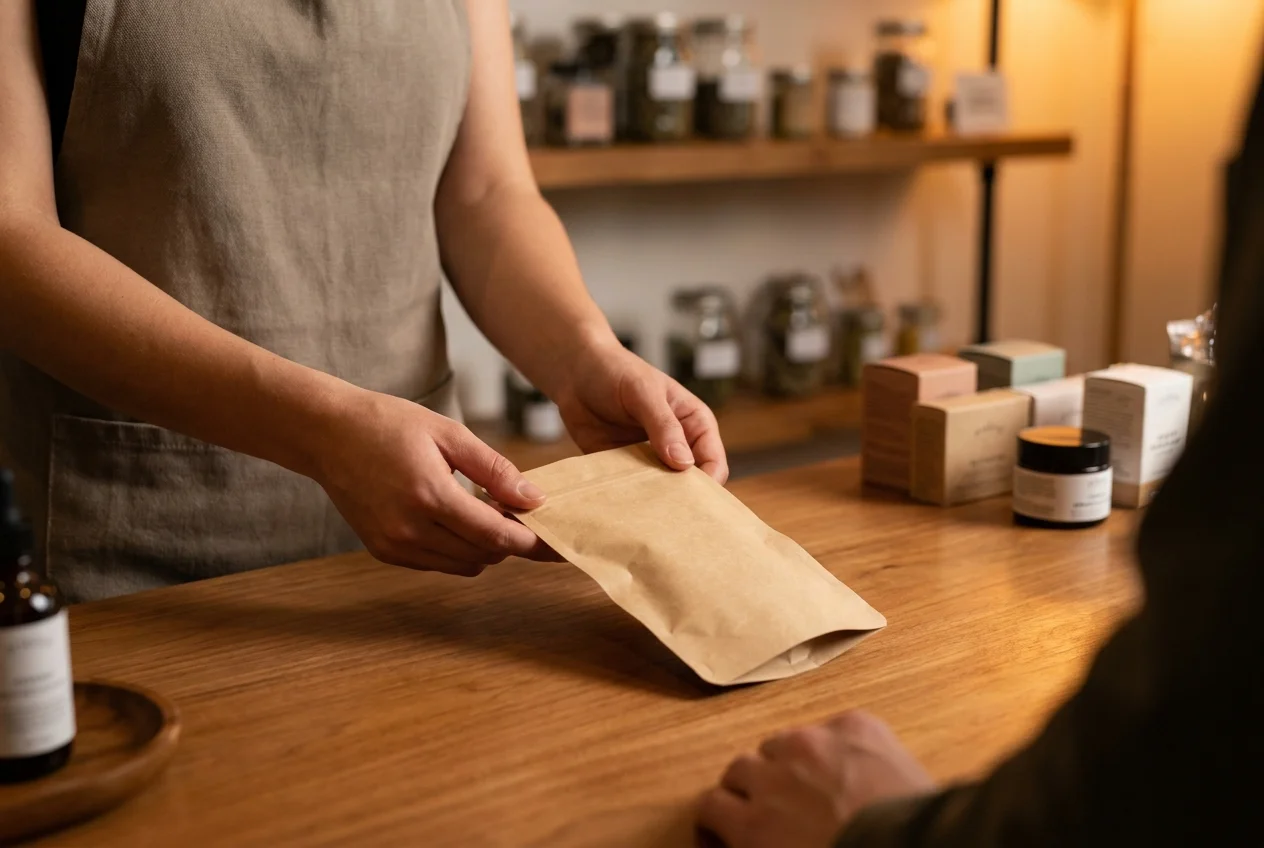
For shopping itself, our first-time dispensary guide and what to look for at a NC dispensary cover the on-the-ground experience. Product pages for CBD, edibles, THCa flower, and delta-9 list the NC shops that carry each category.
Frequently Asked Questions
Which is stronger, THC or CBD?
THC is stronger in subjective intoxicating effect. CBD is stronger for specific medical indications, most notably refractory childhood epilepsy, where FDA-approved Epidiolex cut total seizure frequency by a median 41% (versus 14% on placebo) in one Lennox-Gastaut trial (Epidiolex label, DailyMed). Strength isn't a single axis, it depends on what outcome you're measuring.
Can CBD get you high?
No. Pure CBD is non-intoxicating even at doses of several hundred milligrams. Full-spectrum CBD products legally contain up to 0.3% delta-9 THC and can produce mild effects in sensitive users at very high daily doses, but they won't produce a THC-style high. If any intoxication matters to you, switch to CBD isolate or broad-spectrum.
Will CBD show up on a drug test?
Pure CBD isolate won't, but full-spectrum CBD can. 74% of commercial CBD products deviate from their labeled potency by 10% or more (Frontiers in Pharmacology, 2024), which means a "CBD isolate" from a non-dispensary source may contain trace THC. Daily full-spectrum use can accumulate enough to trigger a positive. Our hemp drug test guide has the detection windows.
Can you take CBD and THC together?
Yes. Some trials, notably in cancer pain, found a THC:CBD blend worked better than THC alone (Johnson et al., 2010), and a 2024 Johns Hopkins trial produced some of the first clinical evidence of the "entourage effect," with D-limonene reducing THC-induced anxiety (Spindle et al., 2024). A CBD-heavy ratio such as 2:1 CBD:THC is a cautious place to start if you're new.
Is THC legal in North Carolina?
Yes, as of October 2026. Hemp-derived delta-8, delta-9, and THCa are all legal in NC, with no state minimum age today, under the 2018 Farm Bill and NC SB 455 (NCGA, 2022). That framework ends when P.L. 119-37 caps finished hemp products at 0.4mg of total THC per container (P.L. 119-37, Section 781, 2025). That cap moved from November 12 to December 11, 2026.
The Bottom Line
THC and CBD answer different questions, and in NC you can buy both at the same hemp dispensary until December 11, 2026.
- Pick CBD for: anxiety, epilepsy, drug-tested jobs, first-time hemp use, indirect sleep support, everyday wellness.
- Pick THC for: moderate-to-severe pain, insomnia, appetite stimulation, experienced consumers.
- Pick a THC:CBD combination for: cancer pain, complex symptom clusters, newcomers who want a low-anxiety THC experience.
- Always verify the COA, always buy from an established dispensary that posts lab results, and always disclose CBD use to your doctor if you take prescription medications.
The weeks before December 11, 2026 are the clearest window to try the current generation of NC hemp THC products legally. Browse the full Triangle dispensary directory to find a shop nearby, read the NC buying guide before your first visit, and pair with CBD oil or edibles if you want a deeper dive into a specific product category.