Cannabis for Sleep: Best Hemp Products for Insomnia in NC
This article is for informational purposes only and does not constitute legal, medical, or product advice. Consult a qualified professional for guidance specific to your situation.
One in three North Carolina adults doesn't get enough sleep. That's over 2.5 million people in the state reaching for something to help them through the night (America's Health Rankings, 2022). And increasingly, they're reaching for hemp.
Traditional sleep aids come with real downsides. Benzodiazepines carry real dependency risks, and in one Canadian study of 146 medical cannabis patients, 45.2% stopped their benzodiazepine (an association, not proof cannabis caused it) (Cannabis and Cannabinoid Research, 2019). Meanwhile, hemp-derived products are legal in NC today and available at more than 80 Triangle-area dispensaries. But the marketing claims outpace the science by a wide margin.
This guide cuts through the noise. We'll cover what clinical trials actually show about each cannabinoid for sleep, honest dosing guidance, and where to buy locally.
A small 2025 pilot trial (20 adults) found a THC + CBN + CBD + terpene softgel improved insomnia scores (Health Science Reports, 2025), while a 2024 trial of 150 mg CBD alone performed similarly to placebo (JCSM, 2024). The evidence is early, but it leans toward products containing CBN or low-dose THC rather than CBD isolate. Edibles offer the longest duration (6-8 hours), making them ideal for staying asleep. NC hemp-derived products with no more than 0.3% delta-9 THC are legal today, but federal rules tighten on December 11, 2026, and you should always check the COA. Browse Triangle dispensaries →
How Bad Is the Sleep Problem in North Carolina?
34.1% of NC adults report sleeping less than 7 hours per night, slightly better than the U.S. value of 35.5% and 18th best among states (America's Health Rankings / CDC BRFSS, 2022). Even the best states, such as Minnesota (29.6%) and Colorado (30.3%), are near 30%, so short sleep is common everywhere.
The numbers at the national level are just as stark. Globally, 16.2% of adults have insomnia disorder, affecting an estimated 852 million people (Sleep Medicine Reviews, 2025). In the US, the CDC reports that 14.5% of adults have trouble falling asleep most days, and 17.8% have trouble staying asleep. Women are hit harder on sleep maintenance specifically: 20.7% report difficulty staying asleep, compared to 14.7% of men (CDC NCHS, 2022).
So what are people doing about it? Turning to cannabis. 22 million US adults (9%) currently use a cannabis product as a sleep aid, and another 60 million (23%) say they're likely to try one (National Sleep Foundation, 2025).
The question isn't whether people are using cannabis for sleep. They already are. The question is whether it actually works, and which products work best.
Which Cannabinoid Is Best for Sleep: CBD, CBN, THC, or Delta-8?
A 2025 meta-analysis of 6 randomized controlled trials (n=1,077) found that THC and CBN formulations improved sleep quality, while CBD alone did not reach statistical significance (Sleep Medicine Reviews, summarized by NORML, 2025). That's the headline. Now let's break down each cannabinoid.
CBD: Not the Sleep Drug You Think
Here's an inconvenient truth for CBD brands marketing "sleep gummies": the best clinical trial to date found that 150 mg of CBD nightly performed similarly to placebo on insomnia outcomes (JCSM, 2024). The RCT enrolled 30 insomnia patients and ran for 2 weeks. CBD showed slightly better objective sleep efficiency in weeks 1-2, but didn't move the needle on the Insomnia Severity Index.
Does CBD do nothing for sleep? Not exactly. CBD may help you sleep indirectly by reducing anxiety, which is a common driver of insomnia. But calling CBD a "sleep aid" isn't supported by the current clinical evidence. If you're buying CBD isolate gummies specifically for sleep, you're paying for marketing.
CBN: The "Sleepy Cannabinoid" Label Is Marketing
You'll see CBN marketed as "the sleepy cannabinoid" and sometimes described as "5x more sedating than THC." But a 2021 systematic review found zero published clinical trials testing CBN for sleep using validated questionnaires or polysomnography (Cannabis and Cannabinoid Research, Corroon 2021). The "sleepy cannabinoid" label is rooted in cannabis lore, not clinical evidence.
That said, the science is catching up. A 2023 randomized trial of about 300 adults found that 20 mg CBN reduced nighttime awakenings compared to placebo, though its effect on overall sleep quality did not reach statistical significance (Experimental and Clinical Psychopharmacology, 2023). That's promising, but it's one study so far. CBN isn't snake oil. It's just early.
THC (Delta-9 and THCa): Effective but Complicated
THC is the cannabinoid with the most consistent sleep effects. Many users report falling asleep faster, and a 2025 meta-analysis found THC-containing products improved self-rated sleep quality, but lab data is mixed. There's also a trade-off: a 2026 pilot RCT found that a single oral dose of THC/CBD reduced REM sleep by 33.9 minutes (p<0.001) and delayed REM onset by about an hour (Journal of Sleep Research, Suraev et al. 2026, n=20). The effect came from a 10 mg THC + 200 mg CBD combination, suggesting THC's REM suppression persists even alongside CBD. The same trial found the combination shortened total sleep time by about 24 minutes and did not improve self-rated sleep quality.
Short-term, that means fewer dreams. Long-term, reduced REM may affect memory consolidation and emotional processing. Tolerance develops with regular use, and when you stop, sleep is often disrupted for a while. For more on THCa specifically, see our THCa flower guide.
Delta-8: Proceed with Caution
Delta-8's evidence for sleep is thin, and what exists isn't encouraging. A 2025 conference abstract in SLEEP, based on 200 adults aged 18 to 35, found that delta-8 users had nearly 3x higher odds of poor sleep compared to non-users (SLEEP, 2025). This is a single study, and it's observational rather than a controlled trial. But it's enough to pause before choosing delta-8 specifically as a sleep aid. Read more about delta-8's legal status in NC.
Worth Watching: Combination Products
Some early evidence favors products that combine multiple cannabinoids with terpenes. A small 2025 crossover pilot (20 adults with mild insomnia, partly funded by the manufacturer) tested a supplement containing 3 mg THC + 6 mg CBN + 10 mg CBD + 90 mg terpenes and found it improved Insomnia Severity Index scores versus placebo (p=0.003) (Health Science Reports, 2025). Bergen Insomnia Scale scores also improved from baseline. It is encouraging but needs larger trials.
This fits the entourage effect hypothesis, the idea that cannabinoids and terpenes work better together than in isolation, though that has not been proven. For sleep, products with CBN or low-dose THC have more support than CBD isolate.
Do Terpenes Matter for Sleep?
Possibly, but the evidence is thin. A 2025 trial of 125 adults found a CBD (300 mg) and terpene formula marginally increased deep plus REM sleep, with larger gains, as much as 48 minutes a night, in some participants who started with the least (PubMed, 2025). The study had no CBD-only group, so it cannot show how much the terpenes added, and its authors hold equity in the sponsor.
Which terpenes matter most? Three stand out in the research:
Myrcene is the most abundant terpene in cannabis and the one most associated with sedation. In mice, high injected doses of myrcene lengthened barbiturate-induced sleep (Phytomedicine, do Vale et al. 2002); there are no human trials. Nearly half (49%) of cannabis users who use the plant for sleep specifically seek out myrcene-rich products (Exploration Medicine, 2023).
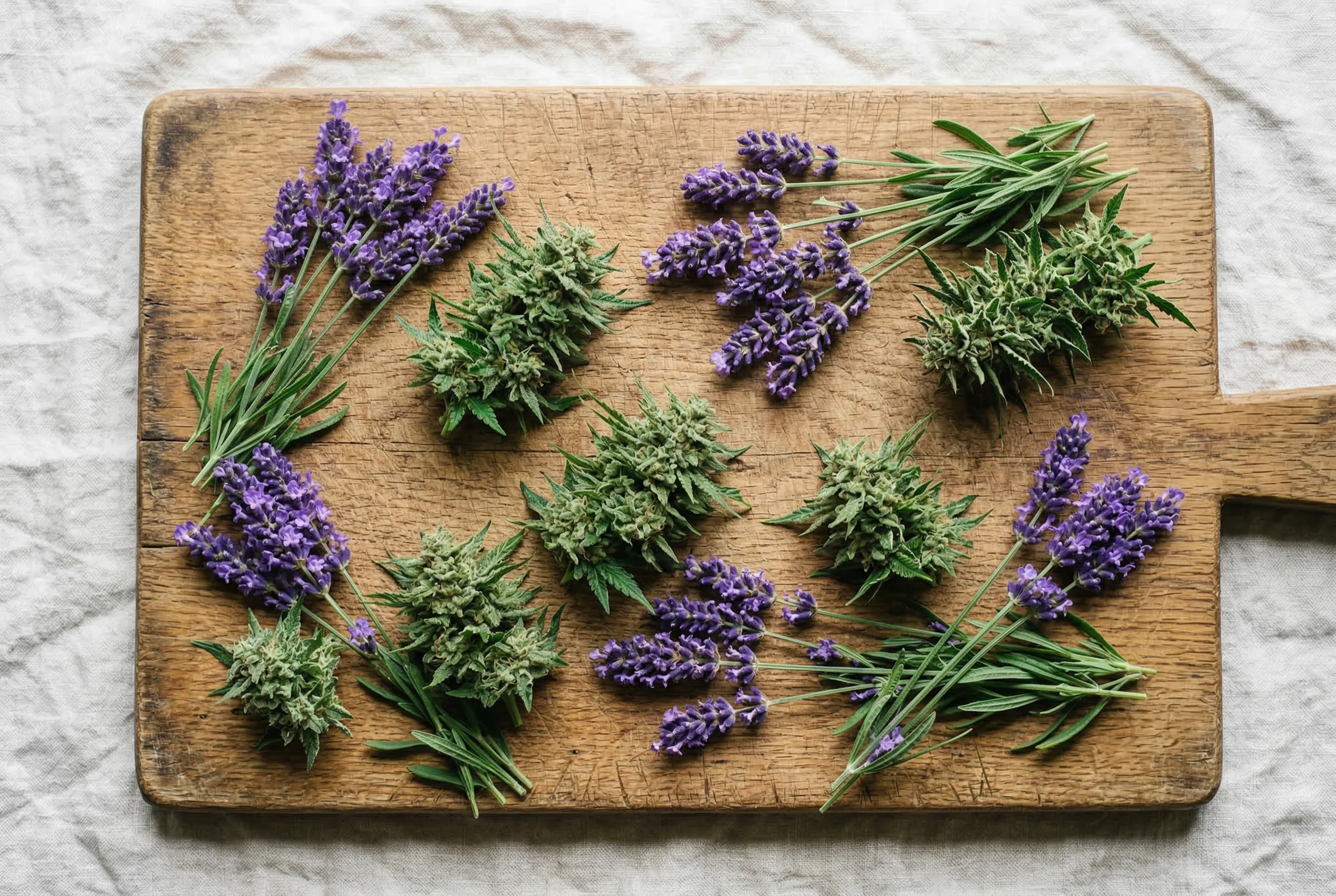
Linalool is the same terpene found in lavender. It's anxiolytic, meaning it reduces anxiety, which is a common root cause of insomnia. If your sleeplessness stems from a racing mind, linalool-rich strains may be especially helpful.
Beta-caryophyllene acts on CB2 receptors in the endocannabinoid system. It doesn't produce a high but may reduce inflammation and pain that disrupts sleep.
Want to know if a product contains these terpenes? The answer is on the lab report. See our guide on how to read a COA to decode terpene profiles. Strain labels like "indica" are unreliable guides to terpene content, so check the COA for myrcene and linalool instead.
How to Choose a Product Format for Sleep
Edibles and capsules offer the longest duration at 6-8+ hours, thanks to liver metabolism converting delta-9 THC into 11-hydroxy-THC. That makes them ideal for staying asleep through the night. But the right format depends on your specific sleep problem. Can't fall asleep? Can't stay asleep? Both? Here's how each format stacks up.
Edibles and Gummies
- Onset: 30-120 minutes
- Duration: 6-8+ hours
- Best for: Staying asleep all night
Take edibles 1-2 hours before bed to account for the slow onset. The extended duration means you're covered until morning. Sleep gummies with CBN + low-dose THC are the format with the most encouraging early data, from a small 2025 pilot. For dosing details and how edibles are metabolized, see our full edibles guide.
Tinctures (Sublingual)
- Onset: 15-45 minutes
- Duration: 4-6 hours
- Best for: Moderate duration with faster onset
Many people hold tinctures under the tongue for 60-90 seconds before swallowing, though research suggests most CBD is still absorbed by swallowing. Effects often come on somewhat faster than with gummies. Good for people who want to fall asleep without waiting an hour. Our CBD oil guide covers the three CBD types and bioavailability differences.
Flower and Vapes
- Onset: 1-5 minutes
- Duration: 1-3 hours
- Best for: Falling asleep fast
The fastest onset of any format, but effects wear off too quickly for most people to stay asleep all night. Some users combine a vape hit (for immediate onset) with an edible (for sustained effect). Check our vapes guide and THCa flower guide for product details.
Dosing Guide: How Much to Take and When
Start low. That's not just generic advice. Some of the trials with encouraging results used small doses. The 2025 combination pilot? Just 3 mg THC + 6 mg CBN + 10 mg CBD + 90 mg terpenes. More isn't always better, especially with THC, where higher doses can actually increase anxiety and make sleep worse.
A few practical notes. Tolerance develops with nightly THC use, sometimes within weeks. Some people take regular nights off to slow tolerance; there is no tested schedule. And be aware that CBD inhibits the liver enzymes CYP3A4 and CYP2C19, which can affect how your body processes other medications. If you take blood thinners, seizure medications, or other drugs metabolized by these pathways, talk to your doctor first. Our CBD oil guide has a detailed section on drug interactions.
Here's a conservative starting reference; only some rows come from trials:
| Cannabinoid | Starting Dose | Clinical Range | When to Take |
|---|---|---|---|
| CBD | 25 mg | 25-150 mg | 1 hour before bed |
| CBN | 5-10 mg | 10-20 mg | 30-60 min before bed |
| THC (delta-9) | 2.5 mg | 2.5-10 mg | 1-2 hours before bed (edible) |
| Delta-8 | 5 mg | No trial data | 1-2 hours before bed (edible) |
| Combination | Per label | ~3mg THC + 6mg CBN + 10mg CBD | 1-2 hours before bed |
Is Cannabis Better Than Melatonin or Prescription Sleep Aids?
Among people who've tried cannabis, OTC sleep aids, and prescription medications, 88.6% said cannabis left them feeling "more refreshed" the next morning. Only 1.7% said the same about prescription sleep aids (Exploration Medicine, 2023, n=526). That's a large gap, though the survey only included cannabis users from a medical cannabis app, so it likely overstates the preference.
The prescription substitution numbers are striking too. In the Canadian study of 146 patients, most of whom were treated for pain rather than sleep, 45.2% discontinued benzodiazepines after starting medical cannabis (Cannabis and Cannabinoid Research, 2019). That is an association, not proof. And 81.8% of cannabis sleep users don't currently use any OTC or prescription sleep aid at all, suggesting that for most, cannabis replaces rather than supplements traditional options.
What about melatonin specifically? CBN and melatonin both show modest evidence for reducing nighttime awakenings, but they work through completely different mechanisms. Melatonin signals your circadian clock that it's nighttime. CBN interacts with cannabinoid receptors. There's no reason you couldn't use both, though no study has tested them together.
The honest caveat: cannabis is not FDA-approved for insomnia. The evidence base, while growing, is still smaller than what exists for established treatments like cognitive behavioral therapy for insomnia (CBT-I), which remains the gold standard. If you've been struggling with sleep for months, talk to a doctor before self-medicating with any product.
Risks, Tolerance, and When to Talk to a Doctor
A THC/CBD combination suppressed REM sleep by 33.9 minutes (p<0.001, d=-1.5) in a pilot RCT of 20 participants (Journal of Sleep Research, Suraev et al. 2026). REM sleep supports memory and emotional processing. The trial tested one night, so nightly effects are unknown, but losing half an hour of REM regularly would not be trivial.
Tolerance is another real concern. With regular THC use, you can need more to achieve the same effect. When you stop, sleep is often disrupted for a while, and many people report vivid dreams (Cannabis withdrawal review, Gates et al., 2016).
Cannabis use disorder develops in roughly 1 in 10 regular users and as many as a third of daily users (Connor et al., Nature Reviews Disease Primers, 2021), which matters if you use it every night. If you're using cannabis nightly and can't sleep without it, that's worth paying attention to.
When to see a doctor:
- Insomnia persists beyond 3 months (this is chronic insomnia and may need CBT-I)
- You're using cannabis every night and doses keep increasing
- You have or suspect sleep apnea (sleep medicine groups advise against using cannabis to treat it)
- You're taking medications that interact with cannabinoids
- You're pregnant or breastfeeding
Harm reduction tips:
- Take regular nights off to slow tolerance buildup
- Use the lowest effective dose
- Consider CBD-dominant products for maintenance nights
- Don't combine cannabis with alcohol or other sedatives
- Keep a sleep diary to track whether it's actually helping
Where to Buy Hemp Sleep Products in the Triangle
Hemp-derived cannabinoid products, including CBD, CBN, delta-8, delta-9 (no more than 0.3% by dry weight), and THCa, are legal in North Carolina today under the 2018 Farm Bill and NC Session Law 2022-32 (SB 455). You don't need a prescription or medical card. For a detailed breakdown of the legal landscape, see our NC hemp law update.
The Triangle has more than 80 dispensaries carrying sleep-oriented products. Here's what to look for and what to ask:
Products to ask about:
- Full-spectrum sleep gummies with CBN + low-dose THC (most promising early evidence)
- CBD:CBN tinctures for sublingual use
- THCa flower whose COA shows myrcene and linalool
- Nano-emulsion sleep beverages (faster onset than standard edibles)
What to check before buying:
- Third-party lab testing (here's how to read a COA)
- Terpene profile listed on the packaging or COA
- Cannabinoid content matches the label claims
- No heavy metals, pesticides, or residual solvents in the lab report
Shop by city:
- Best dispensaries in Raleigh (36 shops)
- Dispensaries in Durham (11 shops)
- Dispensaries in Chapel Hill and surrounding areas
One important note: P.L. 119-37 will restrict most hemp-derived THC products, including THCa flower, delta-8, and nearly every delta-9 gummy, through a total-THC test and a 0.4mg total THC per container cap.
Update, October 10, 2026: The federal hemp deadline referenced below has shifted. H.R. 6500 became Public Law 119-103 on September 2, 2026, and its Section 2019 delays most of the new hemp definition, including the 0.4mg per container THC cap and the total-THC test that counts THCa, to December 11, 2026. A narrow piece covering cannabinoids the plant cannot naturally produce still begins November 12, 2026. Still current as of this update. Track it in our NC hemp bill tracker.
Read our full P.L. 119-37 breakdown to understand what's coming and plan accordingly.
Own a dispensary? Get listed in our directory to connect with Triangle consumers searching for sleep products.
Frequently Asked Questions
Does cannabis actually help you sleep?
It depends on the cannabinoid. A 2025 meta-analysis of 6 RCTs (n=1,077) found that THC and CBN formulations improved sleep quality, while CBD alone did not reach statistical significance (Sleep Medicine Reviews, summarized by NORML, 2025). A small pilot of a combination product with multiple cannabinoids and terpenes was encouraging. Cannabis isn't FDA-approved for insomnia, and the clinical evidence is still early.
What is the best cannabinoid for sleep?
There is no clear winner yet. A small 2025 pilot (20 adults, partly manufacturer-funded) found a formula with 3 mg THC + 6 mg CBN + 10 mg CBD + 90 mg terpenes improved insomnia scores versus placebo (p=0.003) (Health Science Reports, 2025). CBD isolate alone doesn't have strong sleep evidence. If you're buying a single-cannabinoid product, low-dose THC has the most consistent data for helping you fall asleep, but it suppresses REM sleep.
Does cannabis reduce REM sleep? Is that harmful?
Yes. A pilot RCT found that THC/CBD reduced REM sleep by 33.9 minutes in a single session (Journal of Sleep Research, Suraev et al. 2026). Short-term, this means fewer dreams. Long-term, reduced REM may affect memory consolidation and emotional processing. Taking regular nights off and keeping doses low may limit the impact, though no schedule has been tested.
How long before bed should I take cannabis for sleep?
It depends on the format. Flower or vapes: 15-30 minutes before bed. Tinctures (sublingual): 30-60 minutes. Edibles or gummies: 1-2 hours. Edibles last the longest (6-8+ hours) and are best for staying asleep all night. See our edibles guide for a deeper dive into how they're metabolized.
Will using cannabis for sleep show up on a drug test?
Any product containing THC, including THCa, delta-8, and delta-9, can trigger a positive drug test. CBD isolate is less likely to cause a positive result but isn't risk-free due to trace THC in some products. The standard SAMHSA cutoff for workplace testing is 50 ng/mL. Our hemp drug test guide covers detection windows and cutoff levels.
Are hemp sleep products legal in North Carolina?
Yes, today. Hemp-derived products with no more than 0.3% delta-9 THC by dry weight are legal under both federal law (2018 Farm Bill) and NC state law (Session Law 2022-32). You don't need a medical card. However, P.L. 119-37 will restrict most intoxicating hemp products, including most THC sleep gummies, starting December 11, 2026, and North Carolina's HB 328, which still awaits a House vote, would add similar state limits. Read our NC hemp law update for the latest developments.
The Bottom Line
- Combination products look promising. Early evidence, mostly one small pilot, favors multi-cannabinoid formulas (THC + CBN + CBD + terpenes) over CBD gummies alone.
- CBN is promising but early. Don't believe the "5x more sedating" claim. One RCT shows it helps reduce awakenings at 20 mg. That's it so far.
- Edibles are best for staying asleep. Their 6-8 hour duration covers the whole night. Take them 1-2 hours before bed.
- Terpenes are worth checking. Myrcene and linalool are linked to relaxation, mostly in animal and early research. Look for them on the COA.
- THC works but suppresses REM. It may help you fall asleep, but take nights off to limit tolerance and REM loss.
- Start low, go slow. The encouraging 2025 pilot used just 3 mg THC. More isn't always better.
- Talk to a doctor if insomnia persists beyond 3 months, if doses keep climbing, or if you take other medications.
Ready to find sleep products near you? Browse all Triangle-area dispensaries →
These statements have not been evaluated by the Food and Drug Administration. Hemp products are not intended to diagnose, treat, cure, or prevent any disease. Nothing on this site is medical advice; talk to a clinician.