Hemp Vapes Guide: THCa Cartridges, Disposables & Safety in NC
This article is for informational purposes only and does not constitute legal, medical, or product advice. Consult a qualified professional for guidance specific to your situation.
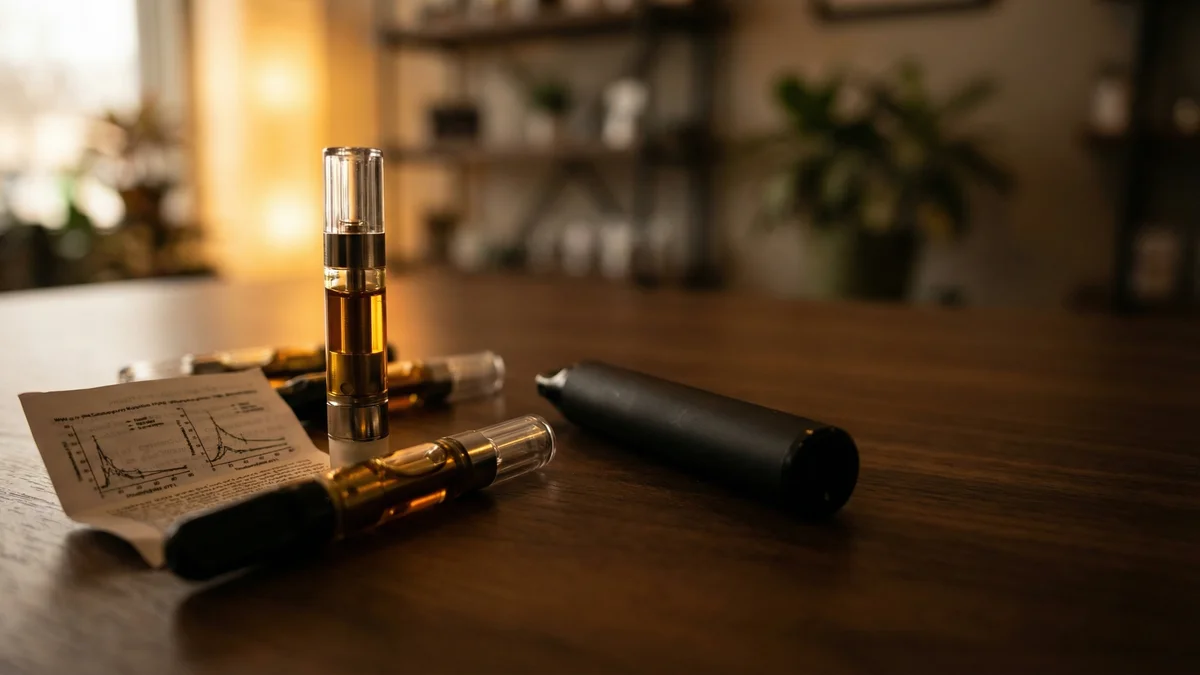
Hemp vapes are the fastest-growing product category at North Carolina dispensaries. They're convenient, discreet, and deliver effects within minutes. But they also carry unique safety risks that flower and edibles don't.
North Carolina recorded 78 EVALI cases between August 2019 and February 2020 from contaminated vaping products. Of the 16 patients interviewed about their THC products, 15 (94%) got them from informal sources. A 2025 peer-reviewed scoping review reports one study in which 21 cannabis vape e-liquid samples exceeded the 0.5 µg/g regulatory limit for lead.
This guide covers how vapes work, the different types available, what's safe, how to read a vape COA, and what happens to hemp vapes when P.L. 119-37's total-THC rules take effect on December 11, 2026.
Hemp vapes (THCa cartridges, Delta-8 disposables, CBD pods) are legal in NC under the 2018 Farm Bill, but safety varies wildly. A 2025 peer-reviewed review reports one study in which 21 cannabis vape samples exceeded the regulatory limit for lead. NC recorded 78 EVALI cases in 2019-2020, and 15 of the 16 patients interviewed about their THC products (94%) got them from informal sources. Always buy from dispensaries that provide third-party COAs, and know that P.L. 119-37 will ban most hemp vapes after December 2026.
Update, October 10, 2026: The federal deadline discussed on this page has moved, and the move is now law. H.R. 6500 became Public Law 119-103 on September 2, 2026. Its Section 2019 keeps only the narrowest piece of the new hemp definition on November 12, 2026, covering cannabinoids the plant cannot naturally make, and delays the rest to December 11, 2026, including the 0.4mg total THC per container cap that reaches most finished products (Section 2019, enrolled text). For nearly everything sold at a Triangle hemp shop, delta-8 included, December 11, 2026 is the date that matters. Nothing has changed it since September, but it falls on the same day federal funding runs out, so watch the next funding bill. See our NC hemp bill tracker for current status, and our December 11 report for how many Triangle shops sell what it reaches.
How Do Hemp Vapes Work?
Vaporizer users are 40% less likely to report respiratory symptoms like cough, phlegm, and chest tightness compared to cannabis smokers (Earleywine & Barnwell, 2007, as cited in Harm Reduction Journal, 2022). That's the core appeal of vaping over smoking: heat without combustion.
A vape heats cannabis oil or concentrate to between 315-440°F. At these temperatures, cannabinoids and terpenes vaporize into an inhalable aerosol without burning the material. No combustion means no tar, no ash, and significantly fewer harmful byproducts.
Effects hit fast. You'll feel a vape within 1-5 minutes, with peak effects around 15-30 minutes. Compare that to edibles, which take 30-90 minutes to kick in. Total duration is shorter too: 1-3 hours for vapes vs. 4-8 hours for edibles.
The tradeoff? Vapes deliver cannabinoids more efficiently than smoking. Cannabis vape concentrates can reach 95%+ THC potency compared to 17-18% in raw flower (NPR, 2025). That efficiency is a double-edged sword. Higher potency means faster tolerance buildup and a greater margin for overconsumption if you're new.
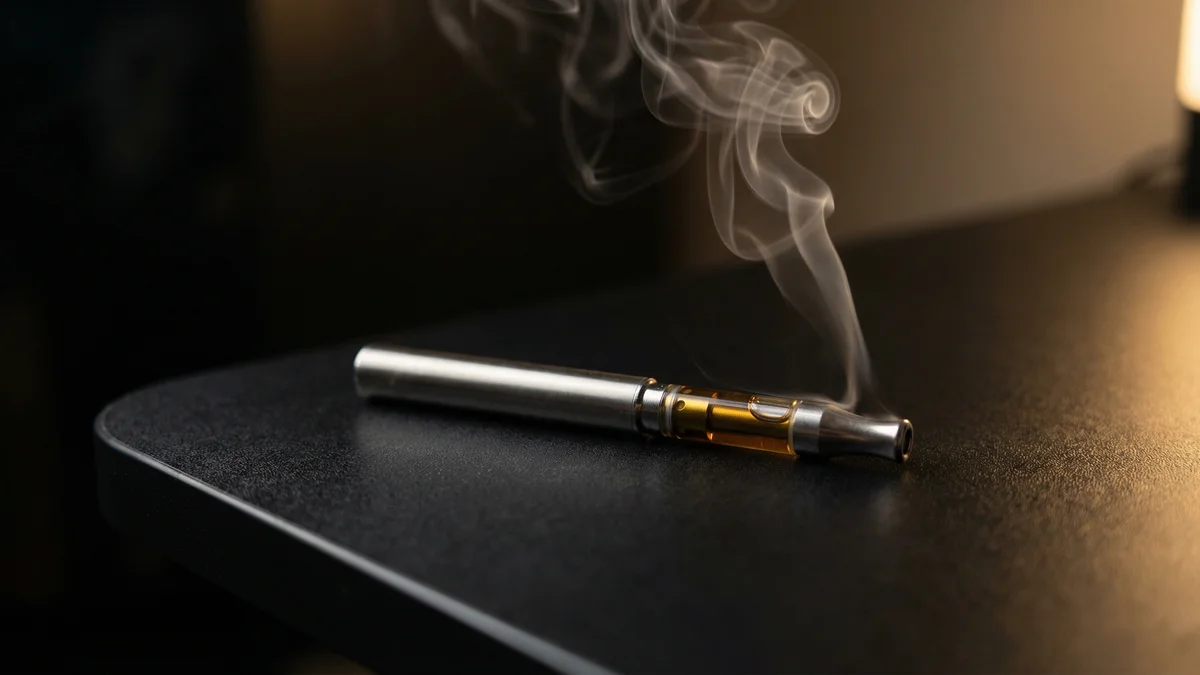
Types of Hemp Vapes: Cartridges vs. Disposables vs. Pods
Pre-filled vape cartridges made up 67.5% of global vape cartridge revenue in 2024, nicotine and cannabis combined (Grand View Research). But disposables are catching up fast, growing their market share by 92% between Q1 2022 and Q1 2024 (BDSA, 2024). Here's how each type compares.
510-Thread Cartridges
The standard format. A glass or ceramic cartridge filled with cannabis oil that screws onto any 510-thread battery. You buy the battery once ($15-30) and swap cartridges as needed.
Pros: Most cost-effective per mg, wide battery selection, adjustable voltage for flavor vs. cloud control, less waste since you reuse the battery.
Cons: Requires a compatible battery, occasional leaking at the thread connection, not as pocket-friendly as disposables.
Typical price at Triangle dispensaries: $25-50 per 1g cartridge.
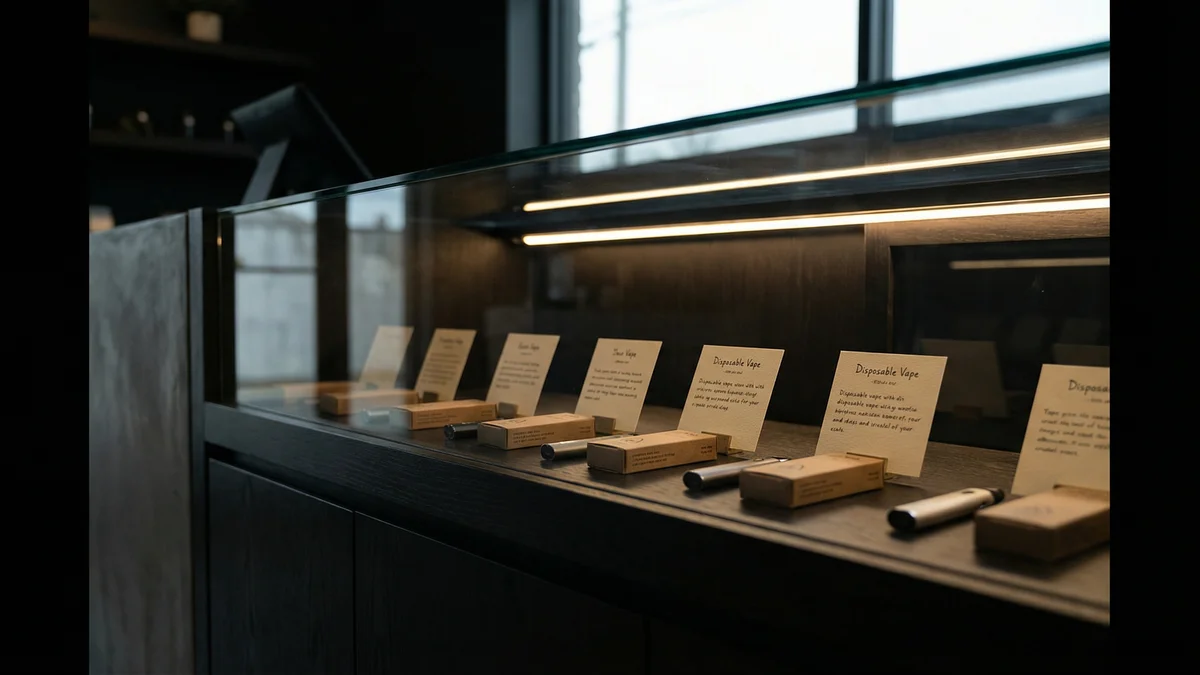
Disposable Vapes
All-in-one devices with a built-in battery and pre-filled oil. Use it until it's empty, then toss it. No charging, no setup.
Pros: Zero learning curve, compact and portable, no maintenance, consistent draw from first hit to last.
Cons: Higher cost per mg, more electronic waste, battery may die before oil runs out in cheaper models, no temperature control.
Typical price at Triangle dispensaries: $20-40 per 0.5-1g device.
Pod Systems
Proprietary pods that click into a specific device (similar to nicotine pod vapes). Less common in the hemp space but growing.
Pros: Leak-resistant magnetic connection, sleek form factor, some offer app-based temperature control.
Cons: Locked into one brand's ecosystem, fewer options, higher per-pod cost.
Live Resin vs. Distillate
This matters more than the hardware. Distillate is refined THC oil stripped of most plant compounds. It's potent but lacks the full terpene profile. Live resin is extracted from flash-frozen flower, preserving the original terpene and cannabinoid ratios. It tastes better, and many consumers report more well-rounded effects due to the entourage effect.
Live resin cartridges typically cost $5-15 more than distillate. If your budget allows, they're worth it.
What Cannabinoids Are in Hemp Vapes?
Hemp vapes aren't one-size-fits-all. The cannabinoid inside determines the experience, and some carry more risk than others.
THCa vapes contain raw tetrahydrocannabinolic acid that converts to Delta-9 THC when heated. They're the closest legal equivalent to marijuana vapes. THCa is a natural cannabinoid found in the plant, which matters for safety. See our THCa flower guide for the full chemistry breakdown.
Delta-8 vapes are the most controversial category. Delta-8 THC doesn't occur naturally in meaningful quantities. It's manufactured by converting CBD through acid isomerization, a chemical process that can leave behind harmful byproducts. Josh Swider, CEO of Infinite Chemical Analysis Labs, told NPR that about a quarter of the synthetically made THC products he sees contain a corrosive residue similar to sulfuric acid (2025). Not all Delta-8 is dangerous, but the category demands extra scrutiny. Check our Delta-8 legality guide for the full NC picture.
Delta-9 vapes with under 0.3% Delta-9 THC by dry weight are technically legal. In practice, most hemp vape concentrates exceed this threshold once you account for the concentrated form, so they're less common than THCa or Delta-8 formulations.
CBD vapes contain non-intoxicating cannabidiol. No high, no psychoactive effects. They're marketed for fast-acting anxiety or pain relief. If you're interested in CBD broadly, our CBD oil guide covers the three types (full-spectrum, broad-spectrum, isolate).
Blended formulas combine multiple cannabinoids. Common blends include THCa + CBD for a balanced effect, or Delta-8 + terpenes for a specific strain profile.
Are Hemp Vapes Safe? What NC's EVALI Outbreak Revealed
North Carolina recorded 78 EVALI cases (e-cigarette or vaping product use-associated lung injury) between August 2019 and February 2020. Of those 78 patients, 96% were hospitalized, 41% were admitted to the ICU, and 16% required mechanical ventilation. North Carolina reported zero deaths, but nationally the CDC counted 2,807 hospitalized EVALI cases or deaths, including 68 deaths (CDC, 2020).
The cause was identified: vitamin E acetate, a thickening agent added to illicit THC vape cartridges to cut costs. Researchers detected vitamin E acetate in 48 of 51 lung fluid samples from EVALI patients (NEJM, 2020). In NC specifically, 66% of tested products contained the additive.
Here's the critical detail: of the 16 NC EVALI patients interviewed about their THC products, 15 (94%) got them from informal sources, such as friends, dealers, or unlicensed websites, rather than from stores selling lab-tested products.
The Contamination Problem Goes Beyond EVALI
Even after the EVALI crisis, vape safety concerns persist. A 2025 peer-reviewed scoping review published in The Scientific World Journal reports one study in which 21 cannabis vape e-liquid samples exceeded the 0.5 µg/g regulatory limit for lead. Illegally sourced products showed lead levels 100x and nickel levels 900x above tolerance limits.
Why are heavy metals a vape-specific problem? The heating element. Cheap coils and cartridge hardware can leach lead, cadmium, nickel, and chromium into the vapor, especially at high temperatures. Flower doesn't have this problem because there's no metal heating element in a bowl or joint.
Pesticides concentrate too. When flower is processed into vape oil, contaminants don't disappear. They concentrate. A 2024 Los Angeles Times and WeedWeek investigation, using independent lab testing, found that 25 of 42 legal California cannabis products tested exceeded pesticide safety thresholds. Concentrates can carry concentrated pesticide residues, because the extraction process amplifies whatever was in the source material.
How to Read a Vape COA (What to Check Before You Buy)
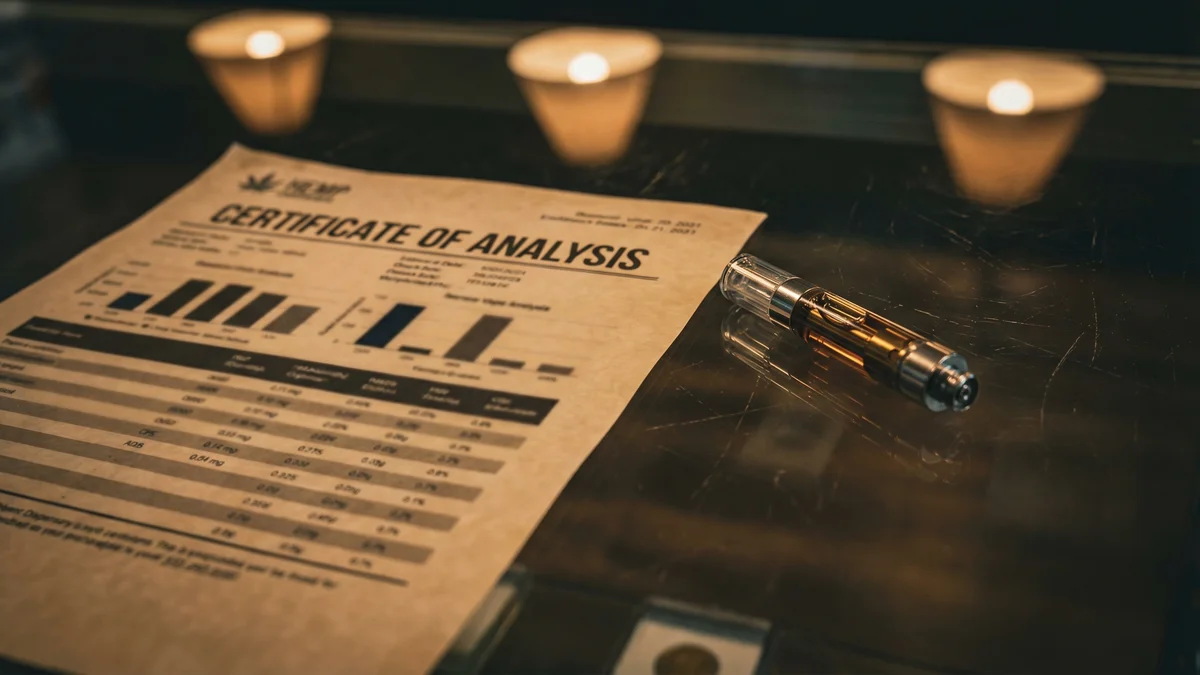
A Certificate of Analysis (COA) is your only real guarantee of vape safety. If a dispensary can't show you a COA for the specific batch you're buying, walk out. Our full COA reading guide covers the basics. Here's what's uniquely important for vapes.
5 Things to Check on a Vape COA
1. Heavy metals panel. This is non-negotiable for vapes. Look for lead (Pb), cadmium (Cd), arsenic (As), and mercury (Hg) results. All should show "ND" (not detected) or fall well below the limits. Remember: 21 e-liquid samples exceeded the lead limit in one study summarized by the 2025 scoping review.
2. Residual solvents. Vape oil extraction often uses solvents like butane, propane, or ethanol. The COA should test for residual levels. This isn't relevant for flower COAs, but it's critical for concentrates.
3. Pesticides. Given that extraction concentrates pesticides alongside cannabinoids, a clean pesticide panel matters even more for vapes than flower.
4. Potency / cannabinoid profile. Confirm the THCa, Delta-8, Delta-9, or CBD percentages match what's on the label. Significant discrepancies suggest poor quality control or misbranding.
5. Microbial contamination. Look for testing on mold, yeast, E. coli, and salmonella. Concentrates processed in unclean facilities can harbor pathogens.
Red Flags
Don't buy the product if: the COA is more than 12 months old, the batch number on the COA doesn't match the product packaging, the COA comes from an unknown lab (labs commonly seen on COAs for products sold in NC include Kaycha, ACS Laboratory, and Infinite Chemical Analysis Labs), or the dispensary refuses to show you one at all.
Want a deeper walkthrough? See our complete guide on what to look for in an NC dispensary.
Are Hemp Vapes Legal in North Carolina?
Hemp vapes containing less than 0.3% Delta-9 THC by dry weight are legal in NC under the 2018 Farm Bill and state SB 455 (Session Law 2022-32). This includes THCa vape cartridges, Delta-8 disposables, and CBD pods sold at Triangle dispensaries.
There's a catch that matters for vapes specifically: both the federal and NC definitions cover "all derivatives, extracts, cannabinoids," so the oil itself has to meet the 0.3% test. The current test counts only delta-9 THC, though, so a THCa vape can hold 80-95% THCa and still pass (N.C. Gen. Stat. 90-87).
NC has no state-level age requirement for purchasing hemp products. The 21+ policy you see at dispensaries is voluntary retailer policy, not law.
P.L. 119-37: The December 2026 Deadline
This is where it gets serious. P.L. 119-37, signed in November 2025, redefines legal hemp starting December 11, 2026. The new rules specifically target concentrates and vapes.
The law caps finished hemp products at 0.4 mg combined total THC and similar cannabinoids per container (Congressional Research Service, 2025). For context, a typical 1g THCa vape cartridge at 80% potency contains roughly 700 mg of THC potential. The new limit is 0.4 mg. That's a 99.94% reduction. Every THCa and Delta-8 vape currently sold at NC dispensaries will become federally illegal.
It gets worse for Delta-8. P.L. 119-37 also excludes cannabinoids that the plant can make but that were synthesized or manufactured outside it, regardless of concentration. Delta-8 made from CBD falls in that group, so it loses federal hemp status on December 11, 2026 along with everything else (Section 2019, enrolled text).
The U.S. Hemp Roundtable estimates P.L. 119-37 will eliminate approximately 95% of existing hemp-derived products (Frier Levitt, 2025), with projected losses of 300,000+ jobs and $1.5 billion in state tax revenue nationally. NC's hemp industry supports roughly 9,000 jobs and $759 million to $1.1 billion in annual sales.
For our detailed breakdown of P.L. 119-37 plus NC's pending state bills, see the full 2026 NC hemp law update. For how Delta-8 specifically is affected, check our Delta-8 vs. Delta-9 vs. THCa comparison.
Vape Temperature Guide: Finding Your Sweet Spot
If you're using a 510-thread battery with adjustable voltage, temperature matters. Different voltages extract different compounds and produce different experiences.
2.2-2.4V (Low): Maximum terpene preservation. Light vapor, strong flavor, smooth draw. Best for live resin cartridges where you want to taste the strain profile. Effects are milder.
2.5-2.8V (Medium): The balanced sweet spot most consumers prefer. Good flavor, visible vapor, solid effects. Start here if you're not sure.
3.0-3.3V (High): Maximum vapor production and cannabinoid delivery. Harsher on the throat, less flavor nuance, but the strongest effects per hit. Higher heat can degrade terpenes and create harsher byproducts.
Above 3.3V: Not recommended. Higher voltage can overheat the oil and create harsh byproducts, and it can wear out the cartridge's coil prematurely. If your oil turns dark brown or the hits taste burnt, your voltage is too high.
Most disposable vapes don't offer temperature control. They're typically preset to a medium range (2.5-2.8V equivalent). If temperature control matters to you, invest in a quality 510-thread battery.
Frequently Asked Questions
Are hemp vapes legal in North Carolina?
Yes. Hemp-derived vapes with less than 0.3% Delta-9 THC by dry weight are legal under the 2018 Farm Bill and NC SB 455 (Session Law 2022-32). However, P.L. 119-37 will effectively ban all THCa and Delta-8 vapes starting December 11, 2026, by capping total THC at 0.4 mg per container. See our NC hemp law update for details.
Are THCa vape cartridges safe?
When properly tested, yes. The key is buying from dispensaries that provide batch-specific COAs. Among NC EVALI patients interviewed about their THC products, 15 of 16 got them from informal sources rather than stores. Check the COA for heavy metals, residual solvents, and pesticides. Read our COA guide for a walkthrough.
What's the difference between a vape cartridge and a disposable?
A cartridge (510-thread) is a refillable-style unit that screws onto a reusable battery. You replace the cartridge when it's empty but keep the battery. A disposable is an all-in-one device you throw away after use. Cartridges are more cost-effective ($25-50/g vs. $20-40/0.5-1g for disposables). Disposables are more convenient but create more waste.
How long does a hemp vape cartridge last?
A standard 1g cartridge delivers approximately 200-300 puffs. For an average consumer taking 10-20 puffs per day, that's roughly 2-4 weeks. A 0.5g cartridge lasts half as long. Disposables in the 0.5g range typically last 150 puffs. Actual duration depends on draw length, voltage setting, and frequency of use.
Will hemp vapes show up on a drug test?
Yes. THCa vapes produce Delta-9 THC when heated, and Delta-8 vapes also metabolize into THC compounds that trigger standard drug tests. Even CBD vapes with trace THC can cause a positive result with heavy use. The SAMHSA immunoassay cutoff for THC metabolites is 50 ng/mL for urine screening. See our full guide on hemp and drug testing in NC for detection windows and your legal rights.
What happens to hemp vapes after December 2026?
P.L. 119-37 caps finished hemp products at 0.4 mg total THC per container, effective December 11, 2026. Since a typical vape cartridge contains hundreds of milligrams of THC potential, virtually all THCa and Delta-8 vapes will become federally illegal. Delta-8 faces a double ban because the law also excludes synthetically derived cannabinoids entirely. CBD vapes with no detectable THC would remain legal. NC may pass state legislation that differs from the federal framework, so watch for updates.
The Bottom Line
Hemp vapes are powerful, convenient, and legal in NC through December 2026. But convenience doesn't mean risk-free. The same concentration that makes vapes efficient also concentrates contaminants. Here's what to remember:
- Buy tested. Only purchase from dispensaries that provide batch-specific COAs. In NC's EVALI outbreak, 15 of the 16 patients interviewed about their THC products got them from informal sources.
- Check the COA. Heavy metals and residual solvents are vape-specific risks that flower doesn't share. Look for clean panels on lead, cadmium, pesticides, and solvents.
- Know what's inside. THCa is a natural cannabinoid. Delta-8 is synthetically converted, and one testing lab's CEO told NPR about a quarter of the synthetic products he sees carry a corrosive residue. Choose accordingly.
- Mind the deadline. P.L. 119-37 takes effect December 11, 2026. Most hemp vapes will become federally illegal under the new 0.4 mg THC cap.
- Start low. Vapes are among the most potent formats. If you're new, take one small hit and wait 15 minutes before taking another.
Ready to find a shop? Browse all Triangle dispensaries or check out what to look for in a quality NC dispensary before you go.
These statements have not been evaluated by the Food and Drug Administration. Hemp products are not intended to diagnose, treat, cure, or prevent any disease. Nothing on this site is medical advice; talk to a clinician.