Hemp Edibles Guide for NC: Gummies, Drinks & Dosing
This article is for informational purposes only and does not constitute legal, medical, or product advice. Consult a qualified professional for guidance specific to your situation.
Hemp edibles are the most accessible way to consume cannabinoids, no smoking, no equipment, no smell. Pop a gummy, eat a chocolate, drink a seltzer. But edibles work fundamentally differently than inhaled products, and that difference catches a lot of first-time consumers off guard.
The problem isn't that edibles are dangerous. The problem is that they're slow, long-lasting, and processed by your liver into a metabolite that's potentially several times more potent than the THC you inhaled from a joint. This is why "I didn't feel anything so I ate two more" is the most common edible mistake.
This guide covers the pharmacology behind edibles, every type available at NC dispensaries, how to dose safely, storage, and what to know about the legal landscape.
Edibles take 30–90 minutes to kick in (vs. seconds for smoking) because they're processed through your liver, which converts THC into 11-hydroxy-THC, a metabolite with nearly 100x stronger receptor binding affinity (PMC, 2007). Start at 2.5–5mg and wait a full 2 hours before taking more. Effects last 4–8 hours. Legal in NC under SB 455. Cannabis edible poisonings in children increased 1,375% from 2017–2021, keep products stored safely (AAP Pediatrics, 2023).
Why Edibles Hit Different: The Science
When you smoke or vape THC, it goes from your lungs directly to your bloodstream and brain in seconds. Peak effects happen within 5–10 minutes.
When you eat THC, it takes a completely different path:
- Stomach, THC is absorbed through the GI tract lining
- Liver, THC passes through liver (first-pass metabolism) where CYP2C9, CYP2C19, and CYP3A4 enzymes convert it into 11-hydroxy-THC (11-OH-THC)
- Bloodstream, Both THC and 11-OH-THC circulate to your brain
Here's the critical difference: 11-OH-THC has a binding affinity of Ki = 0.37 nM at the CB1 receptor, compared to Ki = 35 nM for regular Delta-9 THC, making it nearly 100x more efficient at binding (PMC, 2007). Animal studies show 11-OH-THC is 1.5–7x more potent in its effects.
This is why a 10mg edible can feel stronger than smoking flower with a much higher THC percentage. It's not a myth, it's liver chemistry.
Another key fact: only about 4–12% of oral THC reaches your bloodstream (PMC, 2022). That sounds low, but the 11-OH-THC conversion more than compensates for the lost bioavailability.
Types of Hemp Edibles in NC
Triangle dispensaries carry a growing variety of edible products:
Gummies
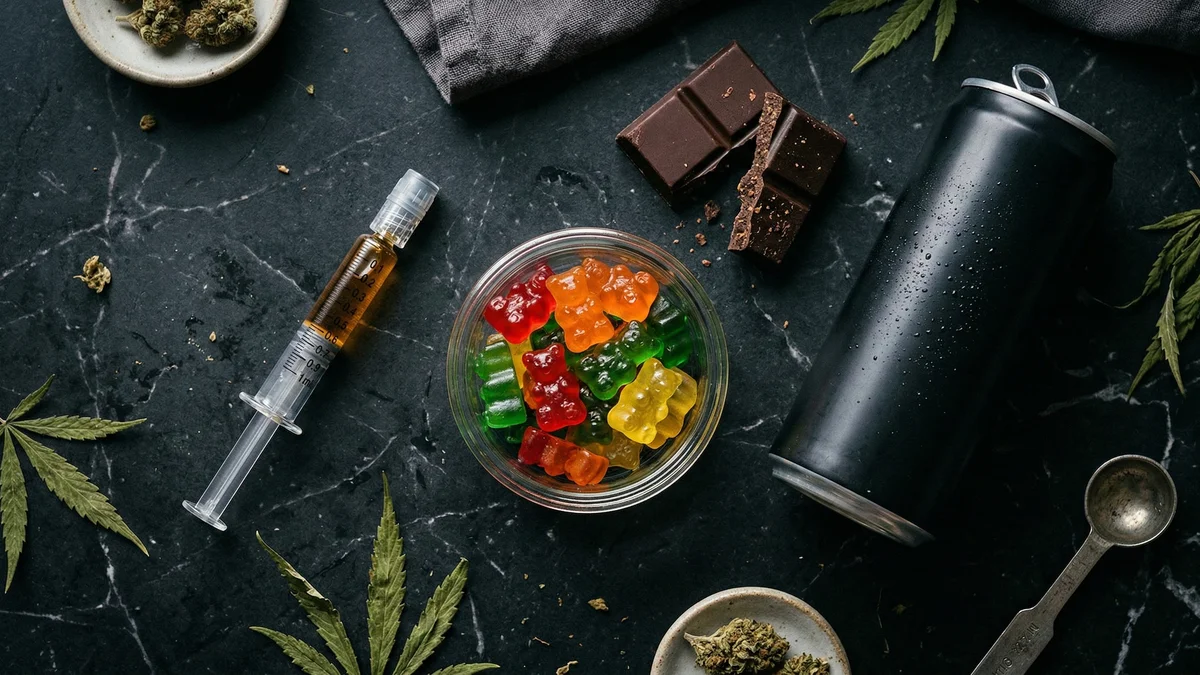
The most popular edible format. Available in Delta-9, Delta-8, THCa, and CBD formulations. Typical doses range from 5–25mg per gummy. Onset: 30–90 minutes. Duration: 4–8 hours.
Why they're popular: Precise dosing, portable, discreet, long shelf life, no special equipment needed.
Chocolates
THC-infused chocolate bars, typically scored into squares for dosing (5–10mg per square). Chocolate's fat content may improve cannabinoid absorption. Onset: 30–60 minutes. Duration: 4–6 hours.
Beverages
The fastest-growing edible category. Hemp-infused seltzers, teas, shots, and craft drinks are available at several Triangle shops including Redhead Hemp in Durham.
Nano-emulsion beverages use microscopic CBD/THC particles that absorb faster, onset in 10–30 minutes compared to 30–90 minutes for standard edibles. Duration is typically shorter at 2–4 hours.
Beverages have grown enough to deserve their own guide, and they also face a federal per-container limit that reaches them harder than any other format. See THC drinks in North Carolina for the absorption research, the milligram math, and which dates reach a can.
Baked goods and confections
Cookies, brownies, hard candies, caramels. Wake-N-Bakery in Raleigh specializes in THC-infused coffee and baked goods as a cannabis cafe concept. Onset: 60–120 minutes (baked goods are slower due to complex digestion). Duration: 6–10 hours.
Capsules and softgels
Measured-dose capsules for those who want pharmaceutical-style precision without the taste of oil. Onset and duration similar to gummies.
Tinctures (sublingual)
Technically not an edible, liquid drops held under the tongue for sublingual absorption bypass the liver partially. Faster onset (15–45 minutes) and more predictable effects than true edibles. See our CBD oil guide for more on tinctures, or our vapes guide for the fastest-onset option (1-5 minutes).
How to Dose Edibles Safely
The Golden Rule: Start Low, Go Slow
Start at 2.5–5mg. Wait a full 2 hours before taking more. The most common edible mistake is impatience. THC edibles can take up to 2 hours to peak, especially on a full stomach.
Factors that affect how edibles hit you:
- Body weight and metabolism, Faster metabolism = faster onset
- Stomach contents, Empty stomach = faster, potentially stronger effects. Full stomach = slower, more gradual
- Fat intake, CBD/THC absorb better with fatty foods
- Tolerance, Regular users need higher doses for the same effect
- Liver enzyme genetics, CYP2C9 polymorphisms affect how efficiently your liver converts THC to 11-OH-THC
Onset and Duration by Edible Type
Safety: Edibles and Children
This section matters. Cannabis edible exposures in children under 6 increased 1,375% from 2017 to 2021, with 7,043 cases reported to poison control centers during that period (AAP Pediatrics, 2023). By 2023, total cannabis poisoning reports exceeded 22,000, with children and teens representing over 75% of cases (Rutgers, 2024).
9 out of 10 child cannabis exposures in children under 5 required healthcare; 30% of hospital admissions needed ICU care (Geisinger, 2025).
The problem is obvious: gummies look like candy, chocolates look like candy bars, and beverages look like soda. Children can't tell the difference.
Storage requirements:
- Keep all edibles in original, labeled packaging, never transfer to unlabeled containers
- Store in a locked cabinet or high shelf out of children's reach
- Child-resistant packaging (which NC's proposed Chapter 18D framework would mandate) should remain intact
- Educate household members about what's in the products
- If a child ingests a hemp edible, call Poison Control at 1-800-222-1222 immediately
Storage and Shelf Life
THC degrades over time. A study by Anresco Laboratories found THC loses approximately 3–4% potency per month, adding up to 16% in year one, 26% by year two, and 41% by year four (Anresco, 2022).
Best practices:
- Cool, dark storage (60–70°F), Heat and light accelerate degradation
- Airtight containers, Oxygen exposure increases breakdown
- Avoid refrigerator moisture, Gummies can absorb moisture and change texture
- Check expiration dates, Most edibles have 6–12 month shelf lives, though potency declines gradually from day one
Edibles and Drug Tests
Every THC edible, Delta-9 gummies, Delta-8 gummies, THCa edibles, will produce the same THC-COOH metabolite that drug tests detect. Edibles may actually stay detectable longer than smoked products because your body processes them more slowly and stores THC metabolites in fat tissue.
Over 65% of THC from edibles is excreted through feces rather than urine, but the remaining 20% urinary excretion is enough to trigger positive results for days to weeks depending on usage frequency (PMC, 2022).
For full detection windows and NC employment implications, see our drug testing guide.
Legal Status of Hemp Edibles in NC
Hemp-derived edibles with ≤0.3% Delta-9 THC by dry weight are legal under the 2018 Farm Bill and NC SB 455. The "dry weight" calculation is why legal Delta-9 gummies can contain 5–15mg of THC, a 5-gram gummy at 0.3% THC = 15mg. See our Delta-9 gummies legal guide for the full math.
December 2026 change: P.L. 119-37 caps THC at 0.4mg per container, effectively banning all current Delta-9 edibles. The dry-weight math loophole that makes 15mg gummies possible disappears under the new law. For the full legal context, see our hemp vs. marijuana guide.
Frequently Asked Questions
How long do edibles take to kick in?
Standard gummies and chocolates: 30–90 minutes. Baked goods: 60–120 minutes. Nano-emulsion beverages: 10–30 minutes. Always wait a full 2 hours before taking more. Taking edibles on an empty stomach speeds onset; eating with fatty food may increase absorption.
What's the right edible dose for a first-timer?
Start at 2.5–5mg of THC. This is the standard beginner dose used in most clinical guidance. You can always take more later, but you can't take less once you've consumed it. For CBD edibles, 10–25mg is a typical starting dose.
What if I took too much?
You cannot fatally overdose on THC edibles. However, overconsumption can cause intense anxiety, paranoia, nausea, elevated heart rate, and extreme discomfort lasting several hours. If this happens: move to a comfortable, familiar space, drink water, and remind yourself it will pass. Call Poison Control (1-800-222-1222) if symptoms are severe, especially in children.
Do hemp edibles expire?
They don't become unsafe, but they lose potency, about 3–4% per month. A gummy that was 10mg THC when purchased might test at 8.4mg after a year. Store in a cool, dark place in the original packaging. Most commercial edibles have a 6–12 month shelf life.
Will hemp edibles show up on a drug test?
Yes. All THC-containing edibles produce the same metabolite (THC-COOH) that drug tests detect. Tests cannot distinguish between hemp-derived and marijuana-derived THC. CBD-only edibles (isolate or broad-spectrum) carry minimal drug test risk. See our drug test guide.
Ready to try edibles? Browse the Triangle dispensary directory to find a shop near you. For first-time buyers, our first-time dispensary guide covers what to expect, and our guide to evaluating dispensaries helps you find quality retailers.
This article is for informational purposes only. It does not constitute medical, legal, or product endorsement advice. Start with low doses and increase gradually. Keep all edible products away from children and pets. Information is current as of February 2026.