Do THC Topicals Get You High? Lotions, Balms and Patches Compared
This article is for informational purposes only and does not constitute legal, medical, or product advice. Consult a qualified professional for guidance specific to your situation.
In the human studies we found, THC topicals did not get anyone high. Low-strength salves rubbed on for three days left no detectable THC in blood or urine, five commercial CBD topicals with low THC produced no measurable effects, and even a cream built to push 100 mg of THC through the skin produced no reported high. How much reaches your bloodstream depends on dose and delivery design together. In one trial, three of five ordinary commercial CBD topicals let some CBD through the skin, most of all a lotion with an enhancer, and the one product that put measurable THC in the blood paired a high dose with ingredients built to cross the skin.
This guide compares lotions, balms, gels and patches, walks through the studies and their sample sizes, explains the one drug-test result that surprised researchers, and reads the federal and North Carolina statutes and the pending state bill on whether the 0.4 mg per container cap applies to topicals. It is written for cautious buyers, including older adults and anyone who is drug tested at work, who want a topical and do not want to feel anything.
- Two human studies checked for effects. A 2024 Johns Hopkins trial found its five CBD topicals with low THC "did not produce discernable pharmacodynamic effects" in 37 users, and none of the 18 people given a high-dose transdermal cream reported feeling a high. A third study detected no THC in blood or urine.
- Dose and design go together. The cream that put measurable THC in the blood combined 100 mg of THC with "penetrating agents" and "vasodilators," and still peaked at an average of 0.346 ng/mL across the 13 people in its main analysis, with wide variation between people (Varadi et al., 2023). The same paper cites smoked peaks of 52 ng/mL from another study.
- No blood or urine sample tested positive in the two studies of ordinary, low-THC topicals: Hess detected no THC, and Johns Hopkins found no urine positives under federal workplace cutoffs and blood THC below detection. The transdermal cream above is the exception for blood. Oral fluid did not stay clean: in the Johns Hopkins trial, 9 of 37 people using an active product, 7 of them lotion users, reached 2 ng/mL, which the study calls the current federal workplace threshold for a positive oral fluid test.
- Labels are unreliable. A JAMA Network Open study of 105 topicals found THC in 37, including 4 labeled THC free.
- The federal hemp definition names "topical application," so in our reading the 0.4 mg total THC per container cap reaches lotions and balms too once it takes effect (dates in the status note below). In the JAMA study, the THC-containing products bought online held a median of 15.5 mg per container.
Do Topicals Cause a High? What Three Studies Found
Not in any human study we could find. Three studies have measured what happens in people after THC goes on the skin. Two checked for effects and found none, and the third detected no THC in the blood. In a 2017 German forensic study, three volunteers applied two THC salves every 2 to 4 hours for three days, over areas of 50 to 100 square centimeters, roughly palm-sized, and every blood and urine sample tested negative for THC and its metabolites. In the 2024 Johns Hopkins trial, 46 healthy adults used one of five commercial CBD topicals with low THC, or a placebo, twice a day for nine days. The products "did not produce discernable pharmacodynamic effects," meaning no measurable change in how people felt, in thinking and coordination tests, or in physiological measures.
The strongest test of the question came from a product designed to cross the skin. In an open-label study funded by its maker, 18 adults had 100 mg of THC and 100 mg of CBD applied in a cream built with "penetrating agents, basement membrane disruptors, and vasodilators" to carry cannabinoids "deep into the dermis layer of the skin" (Varadi et al., 2023). THC did reach the blood, but at an average peak of 0.346 ng/mL, and "none of the participants" reported feeling psychoactive effects at any blood draw. That average comes from the 13 people in the main analysis. Four were dropped because cannabinoids were already in their blood before dosing, and one because a reading 10 minutes after application exceeded the lab's upper measurement limit. The standard deviation of the peak, 0.777 ng/mL, was more than twice the average, so individual results varied widely.
To put 0.346 ng/mL in context, the same paper cites a 2016 study by National Institute on Drug Abuse researchers (Newmeyer et al.) in which occasional cannabis users given "a maximal 50.6 mg dose of THC" reached peaks of 52 ng/mL smoked, 48 ng/mL vaporized and 10 ng/mL eaten. Comparing across studies is rough, but the skin route's average peak was roughly one hundred-fiftieth of the smoked peak, from a larger dose. One comparison the chart cannot make: the salve study's test could not see THC below 0.40 ng/mL, which is above the cream's average peak, so its negative result does not show that the salves delivered less than the cream.
Two caveats keep this from being a blanket promise. The studies are small: 3, 46 and 18 people. And they tested specific products: low-strength salves, CBD-dominant commercial topicals, and one proprietary cream. We found no published human study of a THC-dominant lotion or patch bought at a hemp shop, so the honest answer is "not in the studies we have," not "never."
Topical vs Transdermal: Why Delivery Design Decides
A topical is made to act where you put it. A transdermal product is made to pass through the skin into the blood. Both can sit in the same aisle and use the same word, "infused," so the difference is easy to miss, and it is the one that matters most to a cautious buyer.
Skin is a barrier first. THC is "highly lipophilic," meaning it dissolves in fats and oils far better than in water (Shankar et al., 2022). A 2026 review counts that among the obstacles for cannabinoids on skin, listing "poor aqueous solubility, lipophilicity, instability, variable skin penetration, and inconsistent bioavailability," and describes formulation work aimed at "targeted skin deposition while minimising systemic exposure" (Pareek et al., 2026).
Formulators can work around the barrier, which is the whole point of a transdermal product. Lab work on human skin found that "ethanol concentrations of 30 to 33% significantly increased the transdermal flux" of delta-8 THC and CBD, and that CBD and CBN passed through skin about 10 times more readily than delta-8 THC (Stinchcomb et al., 2004). Lipid blends "enhanced THC skin permeation and retention" in another lab study (Shankar et al., 2022). The Varadi cream went further, with ingredients chosen to open the skin and widen blood vessels, and it is the one product in the studies we found that put THC into the blood at a level the test could measure.
So the useful question at the counter is not "how many milligrams," but "is this made to stay on the skin or to go through it?" A product that says "transdermal" on the label, names a permeation enhancer, or is an adhesive patch sold as transdermal is telling you it was built for the second job. Those words do not mean the product will get you high, since even the Varadi cream did not. They mean it is the type of product that, in the studies we found, put measurable THC in the blood, which matters if you are drug tested.
Lotion, Balm, Gel or Patch: THC Topicals Compared
The four common formats differ mainly in how long they stay in contact with the skin and what is mixed in to carry the cannabinoids. That is also where the studies show differences, even though none of them was designed to rank formats against each other.
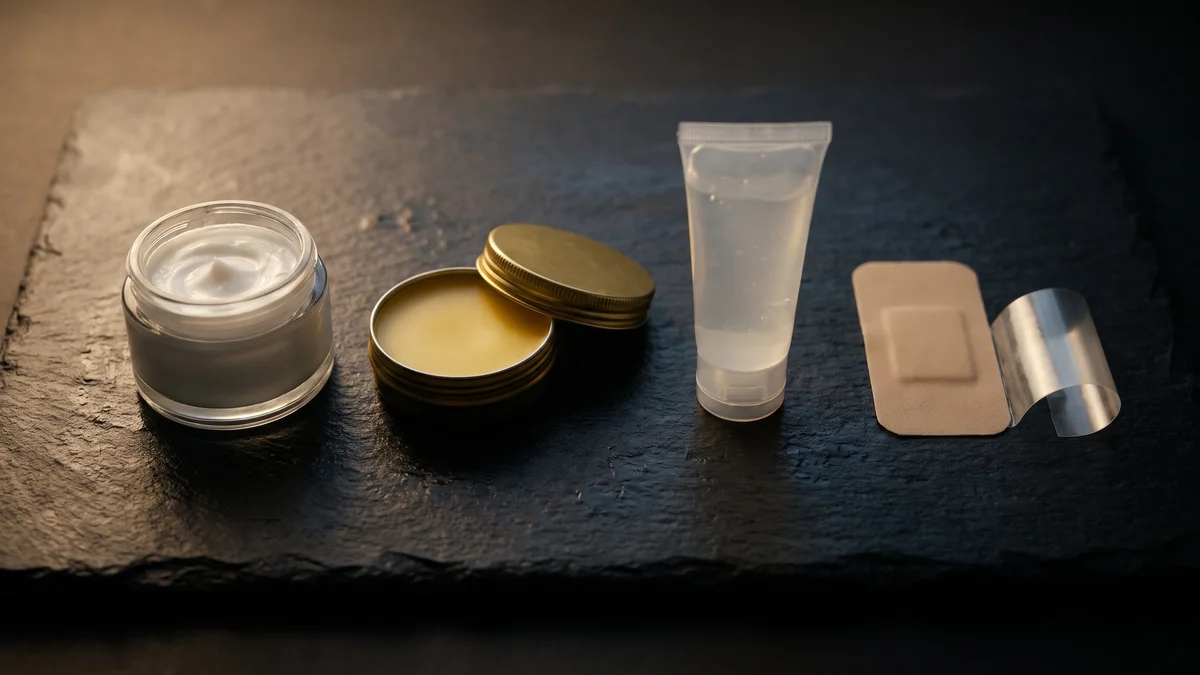
The Johns Hopkins trial is the only study that put several formats side by side. It gave 46 healthy adults a cream, lotion, patch, balm or gel, or a placebo, and measured blood, urine and oral fluid over 17 days. All five products were commercial CBD topicals with low THC. "Transdermal absorption of CBD was observed for three active products," and CBD levels were "highest for the lotion, which contained the most CBD and a permeation enhancer (vitamin E)" (Zamarripa et al., 2024). The same lotion group produced most of the oral fluid results discussed in the drug-test section below.
The JAMA Network Open market study, which shares six authors with the trial, bought 105 products, including lotions, creams, balms, salves and patches, at Baltimore stores and online. It found that "patches contained less CBD than all other product types" (Spindle et al., 2022). Less cannabinoid in the patch does not by itself mean less reaches you, because a patch is worn against the skin for hours rather than rubbed in once. That is the delivery-design point again.
Keep the trial's scale in mind before comparing formats. Each format group had six to eight people, each format was a single commercial product, and the placebo was "matched to an active formulation." The trial can show differences between these five products. It cannot settle which format is safest in general.
| Format | How it is used | What the human studies show | For a cautious buyer |
|---|---|---|---|
| Lotion or cream | Rubbed into the skin and absorbed | Johns Hopkins lotion, with vitamin E: highest blood CBD, and 7 of its 8 users had oral fluid THC at or above 2 ng/mL. Johns Hopkins cream: 0 of 8 | Check for enhancer ingredients and the THC milligrams per container |
| Balm or salve | Rubbed on | No THC detected in blood or urine (Hess salves, 3 people); no oral fluid positives (Johns Hopkins balm, 8 people) | Low measured exposure so far, though the Johns Hopkins cream also had no oral fluid positives and the samples are small |
| Gel | Spread thin and dries on the skin | Johns Hopkins gel: 1 of 6 users reached the oral fluid threshold. Alcohol raised skin flux in lab tests (Stinchcomb) | Look at whether alcohol or another enhancer is listed |
| Patch | Adhesive pad worn for hours | Johns Hopkins patch: 1 of 7 users reached the oral fluid threshold | Check whether it is sold as transdermal, and if so assume it is built to reach the blood |
Read the table as a map of what has been measured, not a ranking, since a different lotion or patch could behave differently. The pattern worth keeping is narrower: the product that combined the most cannabinoid with an enhancer moved the most into the body.
How Strong Is the Evidence? Sample Sizes and Funding
Only three studies have measured THC topicals in people, as far as we could find, and each answers a slightly different question. The table below puts them side by side with their sample sizes, because the size of each study is part of the answer.
The Hess study started as a forensic question. A driver checked at a traffic stop had THC in his blood and claimed he had used two topical products. The researchers had volunteers use those two products, which contained 1.7 ng and 102 ng of THC per milligram, roughly 0.0002% and 0.01% THC by weight, and heavy use left no detectable THC or metabolites in blood or urine. That makes it reassuring for low-strength salves, and it says little about anything stronger.
The Johns Hopkins trial is the most rigorous of the three, with a placebo group, 17 days of sampling, and co-authors from SAMHSA's Division of Workplace Programs, the Department of Defense, RTI International and Clinical Reference Laboratory, a drug testing lab. One co-author is listed with a CBD company, worth weighing alongside the Varadi funding below. But its products were CBD-dominant with low THC, so it tells you more about CBD topicals that carry some THC than about a THC balm sold for its THC.
| Study | Who and how many | Product | What happened |
|---|---|---|---|
| Hess et al., 2017, Germany | 3 volunteers, 10 blood and 10 urine samples each | Two commercial THC salves, applied every 2 to 4 hours for 3 days over 50 to 100 square centimeters | All blood and urine samples negative for THC, 11-hydroxy-THC and THC-COOH |
| Zamarripa et al., 2024, Johns Hopkins | 46 adults: 37 on five active products, 9 on placebo | Commercial CBD-dominant cream, lotion, patch, balm and gel, twice daily for 9 days | No measurable effects; THC below detection in blood; no urine positives; 9 of 37 active users with oral fluid THC at or above 2 ng/mL |
| Varadi et al., 2023, Canada | 18 adults enrolled, 13 in the main analysis, no control group, funded by the maker | One cream with 100 mg THC and 100 mg CBD, designed to cross the skin | THC reached the blood at an average peak of 0.346 ng/mL; none of the 18 reported a high |
The Varadi study is the closest to a worst case: a high dose of THC in a product engineered to cross the skin. It is also the weakest design, with no control group and funding from the company that makes the cream, and its authors note "large variability" between people. Even so, on the question of a high, its result points the same way as the other two.
Can a THC Topical Make You Fail a Drug Test?
For urine, the studies we found say probably not for the low-THC products they tested, and no study we found checked urine after a THC-dominant topical. For blood, probably not with ordinary low-THC topicals; a cream built to cross the skin did put low levels of THC in the blood. For an oral fluid test, the answer is less settled, and the reason is a result even the researchers did not expect.
The urine results are reassuring as far as they go. In the Johns Hopkins trial, "no urine samples tested 'positive' for cannabis using current US federal workplace drug testing criteria," which means an immunoassay screen at 50 ng/mL and a confirmation test at 15 ng/mL, and THC and its metabolites were "below the limit of detection in blood for all products" (Zamarripa et al., 2024). The Hess volunteers were negative in every blood and urine sample over three days of heavy use.
Oral fluid broke the pattern. "Unexpectedly, nine participants (seven lotions, one patch and one gel) exhibited Δ9-THC oral fluid concentrations ≥2 ng/mL," which the study calls the current federal workplace threshold for a positive oral fluid test. Seven of the eight people in the lotion group crossed that line. The published abstract does not explain why, and we could not access the full paper, so we do not guess at the cause.
What this means in practice depends on the kind of test you face. For urine, the evidence that a low-THC topical will not cause a positive is the strongest we have. The study also describes a federal workplace cutoff for oral fluid, the 2 ng/mL threshold it used, and there the Johns Hopkins finding is a real warning, most of all for the one lotion it tested. Our hemp drug test guide covers how each test type works and how long THC metabolites stay detectable.
A separate risk is the label. Spindle and colleagues found THC in 37 of the 105 topicals they bought, and "4 (11%) were labeled as THC free" while 19 "did not reference THC on the label" (JAMA Network Open, 2022). If you are tested and want a margin, the conservative choice is a product whose batch COA shows no detectable THC, used on the skin. As a precaution, wash your hands after applying and keep the product away from your mouth (more in the checklist below). That is a cautious reading of small studies, not a guarantee, and it is not medical or legal advice.
Does the Federal 0.4 mg Cap Reach Topicals?
Yes, in our reading of the statute. The new federal definition applies its per-container cap to finished "hemp-derived cannabinoid products," and it defines that term as a product intended for use "through any means of application or administration, such as inhalation, ingestion, or topical application" (P.L. 119-37, Sec. 781). Topicals are named in the text. The definition's only exclusion is for FDA-approved drugs, which does not cover ordinary lotions, balms or patches.
That matters because the cap is a total per package, not a strength. Once the cap applies, a finished product falls outside federal hemp if it contains "greater than 0.4 milligrams combined total per container" of total THC, which counts THCA, plus any cannabinoids with similar effects. "Container" means "the innermost wrapping, packaging, or vessel in direct contact" with the product, "such as a jar, bottle, bag, box, packet, can, carton, or cartridge." For a lotion, that is the jar or bottle. For patches sealed one to a pouch, our reading is that each pouch is the container.
Update, November 13, 2026: The federal deadline discussed on this page now comes in two parts, and the first has arrived. Under Section 2019 of Public Law 119-103, signed September 2, 2026, the narrowest piece of the new hemp definition took effect on November 12, 2026. It covers only cannabinoids the plant cannot naturally make. The rest waits until December 11, 2026, including the 0.4mg total THC per container cap that reaches most finished products (Section 2019, enrolled text). For nearly everything sold at a Triangle hemp shop, delta-8 made from CBD included, December 11, 2026 is the date that matters. Nothing has changed it since September, but it falls on the same day federal funding runs out, so watch the next funding bill. See our NC hemp bill tracker for current status, and our December 11 report for how many Triangle shops sell what it reaches.
The cap is far stricter than the concentration test topicals have been sold under. Every one of the 37 THC-containing products in the JAMA study "contained less than 0.3% THC," so all would pass a concentration limit. But measured as a total per container, the THC-containing products bought in stores held a median of 7.9 mg and those bought online a median of 15.5 mg, with one product at 100.2 mg (Spindle et al., 2022, Table 2). Every store-bought product with THC was over the 0.4 mg cap, at 4.0 to 20.1 mg. Online products ran from 0.03 to 100.2 mg, so at least half, but not all, would exceed it.
The arithmetic is simple. A jar holding 57 grams of lotion, about 2 ounces, at 0.03% THC by weight contains about 17 mg of THC, more than 40 times the cap, while passing a 0.3% test with room to spare. The threshold is tiny: in that same 57-gram jar, the cap is crossed at about 0.0007% THC. In our reading, a CBD topical with as little as about 0.001% THC in a 2-ounce jar exceeds the cap, not just products sold for their THC, unless it is reformulated or sold in a very small container. A COA showing no detectable THC clears the cap only if the lab's detection limit is low enough for the container size: at a 0.01% limit, a 57-gram jar could still hold 5.7 mg. Our P.L. 119-37 consumer guide covers the rest of the federal definition, and our THCA ban guide covers what the dates mean for products you already own.
North Carolina Law on THC Topicals
North Carolina's own law treats a topical like any other hemp product today. State law exempts THC from Schedule VI in a product whose delta-9 THC concentration is "not more than three-tenths of one percent (0.3%) on a dry weight basis" (G.S. 90-94(b)(2)). The state has no per-container cap and no minimum age for any hemp product.
North Carolina status, November 20, 2026: HB 328, the state hemp crackdown, passed the Senate in July but still awaits a House vote. The November 16 to 19 session ended without one, so it can now come only in the reconvened session of November 30 to December 18. If it does not pass by December 18, it dies with the session. Today North Carolina sets no minimum age for hemp products, though many shops card at 21. Details in our NC hemp bill tracker.
HB 328, the state crackdown bill (status in the note above), would treat topicals differently from edibles and vapes. Its 0.4 mg per container rule applies to a "final-form consumable product intended for human ingestion or inhalation," and the age-21 article says its term for covered products "does not include hemp products intended for topical application" (HB 328 conference report). In our reading, the bill's total-THC concentration test, which counts THCA, would still reach topicals, because it rewrites the general Schedule VI exception for every product, not just consumables.
| Rule | NC law today | HB 328 as we read it (not law) | Federal law once the cap applies, in our reading |
|---|---|---|---|
| Concentration limit | Delta-9 THC at or under 0.3% dry weight | Total THC, counting THCA, at or under 0.3% | Total THC, counting THCA, at or under 0.3% |
| Per-container cap | None | 0.4 mg, but only for ingested or inhaled products | 0.4 mg total THC, and the definition names topical application |
| Minimum age | None | 21, but topicals are excluded | Not set by the hemp definition |
| Where topicals land | Legal if at or under the delta-9 limit | Outside the cap and the age rule; still under the concentration test | Inside the cap |
One detail in the bill deserves care. It defines ingestion as consuming "through the mouth, by swallowing into the gastrointestinal system or through tissue absorption." In our reading, a product applied in or around the mouth is a closer call than a lotion on your knee, so do not assume every product labeled topical sits outside the bill. None of this is law unless the House adopts the conference report and it is enacted, and our HB 328 breakdown follows its status.
The upshot for a Triangle buyer is a gap between the two systems. As we read them, state law today and HB 328 as written put only a concentration test on a CBD lotion with some THC. Under federal law, in our reading, once the cap applies the same jar falls outside the hemp definition if it holds more than 0.4 mg of total THC, even though no one has shown it gets anyone high.
How to Read a Topical's Label and COA
Start with the format, then the numbers. The point of this check is to answer two questions: is this product built to reach the bloodstream, and how much THC is actually in the container?
- Format and delivery words. "Transdermal," "deep penetrating," "enhanced absorption" or a named permeation enhancer are signs the product was built to cross the skin. In the Johns Hopkins trial, the lotion with vitamin E listed as a permeation enhancer moved the most CBD into the body.
- THC in milligrams per container, not just percent. A percentage tells you whether a product passes a concentration test. The per-container total tells you whether it fits under the federal cap, and it is the better measure of how much THC you are putting on your skin.
- Total THC, including THCA. A COA that reports delta-9 alone can understate THC. The federal definition counts THCA, and so would HB 328's concentration test.
- "THC free" backed by a COA. In the JAMA study, 4 products labeled THC free contained THC. Ask for the batch COA and check that THC reads as not detected, with the lab's detection limit shown.
- A batch number that matches. The COA should name the same product and batch as the jar in your hand. Our COA reading guide walks through each section of a typical report.
Two more habits follow from the drug-test evidence. The study's abstract does not explain its oral fluid results, so as a precaution, wash your hands after applying a topical and keep it away from your mouth. And if you are drug tested, choose a product made to stay on the skin rather than one sold as transdermal, with a COA showing no detectable THC at a detection limit low enough for the container size. Those steps reduce exposure; they do not guarantee a result, and if a test matters for your job, ask your employer's program what it tests for.
This guide stays on THC delivery and the law. For what the research does and does not show about CBD topicals for pain, see our CBD for pain relief guide. For oils and tinctures, see the CBD oil guide, and older readers starting out can read our guide for seniors.
THC Topicals in Triangle Shops
Topicals barely register in how our directory describes Triangle shops. We counted on November 23, 2026. The directory has no topical category, so the closest measure is CBD: of the 95 listings, 55 carry our CBD product category, and only 15 listing descriptions, which we write from each shop's website and other public information, mention topicals, creams or salves at all.
That does not mean the other shops lack topicals. A shop can stock a shelf of balms without mentioning it in a listing, and we have not checked inventories. It does mean you will usually need to ask, and it is worth calling ahead with the questions from the checklist above: is the product made for the skin or to go through it, what is the THC per container, and can you see the batch COA?
To find shops near you, start with the CBD product page, browse the Triangle dispensary directory, or use the Raleigh city guide.
Frequently Asked Questions
Do THC topicals get you high?
Not in the human studies we found. A Johns Hopkins trial found no measurable effects in 37 people using CBD topicals with low THC, none of 18 people given 100 mg of THC in a cream designed to cross the skin reported a high, and a third study detected no THC in blood or urine. The studies are small and tested specific products, so the fair summary is that topicals have not been shown to cause a high, not that they never could.
Does THC lotion show up on a drug test?
In the two studies that tested blood and urine for a positive result, none came back positive, but both used products with very little THC. A cream designed to cross the skin did put low levels of THC in the blood, so products sold as transdermal are the exception to watch. But 9 of 37 people using an active product, 7 of them lotion users, reached 2 ng/mL in oral fluid, which the study calls the federal workplace threshold for a positive test. Products labeled THC free can also contain THC, so check the batch COA.
What is the difference between a topical and a transdermal product?
A topical is designed to stay on or in the skin where you apply it, though in one trial three of five commercial CBD topicals let some CBD through. A transdermal product, such as a patch or a cream with permeation enhancers, is designed to carry cannabinoids through the skin into the bloodstream. A transdermal cream is the one product that, in the studies we found, put measurable THC in the blood.
Are THC patches stronger than lotions?
Not necessarily in milligrams. The JAMA study found that patches contained less CBD than every other topical type it tested. But a patch is worn against the skin for hours, and one sold as transdermal is designed to carry what it contains into the blood. In the Johns Hopkins trial, 1 of 7 patch users reached the oral fluid threshold, against 7 of 8 on one lotion.
Does the federal 0.4 mg cap apply to topicals?
In our reading, yes, once the cap takes effect. The federal definition of a hemp-derived cannabinoid product names "topical application," and the cap counts total THC, including THCA, per container. In a 2022 study, the THC-containing topicals held a median of 7.9 mg (bought in stores) and 15.5 mg (bought online) per container, even though all tested under 0.3% THC by concentration.
Are THC topicals legal in North Carolina?
Under state law today, yes, if the product is at or under 0.3% delta-9 THC by dry weight, and North Carolina sets no minimum age. HB 328, a state bill that has not become law, limits its per-container cap to products for ingestion or inhalation and excludes topicals from its age-21 rule. In our reading, its total-THC concentration test, which counts THCA, would still apply to them. Federal law is separate: in our reading, once the federal cap applies, a topical with more than 0.4 mg total THC per container is no longer federal hemp, whatever state law says.
The Bottom Line
THC topicals have not been shown to get anyone high, and low-strength salves left nothing detectable in blood or urine. What changes the picture is dose and delivery design together: transdermal patches and enhancer-loaded creams are built to reach the blood, and a lotion in the Johns Hopkins trial produced the surprising oral fluid results. For legality, the number to watch is THC per container, because the federal definition names topical application, so in our reading the cap covers topicals, and the THC-containing topicals in a 2022 study held medians of 7.9 mg (stores) and 15.5 mg (online) per container.
| Question | Short answer | Main source |
|---|---|---|
| Do topicals get you high? | No measurable effects in one trial of 37 users; no reported high in 18 on a transdermal cream | Zamarripa 2024, Varadi 2023 |
| Blood or urine positive? | None in Hess or Johns Hopkins; the transdermal cream put low levels of THC in blood | Hess 2017, Zamarripa 2024, Varadi 2023 |
| Oral fluid positive? | 9 of 37 active users, 7 of 8 on one lotion | Zamarripa 2024 |
| Does the federal cap reach topicals? | Yes in our reading; "topical application" is named | P.L. 119-37, Sec. 781 |
| NC law today | Legal under state law at or under 0.3% delta-9 THC, no state age limit; the federal cap applies separately | G.S. 90-94(b)(2) |
This article is educational information, not legal or medical advice. Federal and North Carolina hemp law are both moving on a short timeline, so check current status before buying, selling, or traveling with any hemp product.