Terpenes Explained: How They Shape Your Cannabis Experience
This article is for informational purposes only and does not constitute legal, medical, or product advice. Consult a qualified professional for guidance specific to your situation.
Walk into any Triangle hemp shop and ask what makes two THCa strains feel different, and you will almost certainly hear one word: terpenes. Budtenders point at a COA, name a dominant terpene, and tell you what it does. Strain menus print little citrus and pine icons next to each jar.
Most of that is folklore dressed up as chemistry. Terpenes are real, they are measurable, and there is genuine science behind a few of them. But the popular terpene chart circulating online gets the numbers wrong, and the "myrcene equals couch lock" story rests on a mouse study that used doses no human will ever encounter. This guide separates the two.
Terpenes are the aromatic compounds that give cannabis its smell. They average about 2% of flower by weight, and individual terpenes are rarely above 0.5% (PLOS ONE, 2022, 42,843 samples with terpene data). The three most abundant in commercial flower are myrcene, beta-caryophyllene, and limonene. Only two terpene claims have strong human or receptor-level evidence: beta-caryophyllene binds the CB2 receptor (Ki = 155 nM, PNAS, 2008), and vaporized D-limonene reduced THC-induced anxiety in a Johns Hopkins trial (Drug and Alcohol Dependence, 2024). Terpene profile predicts the experience better than the Indica or Sativa label on the jar. All the products discussed here are legal in North Carolina today under N.C. Gen. Stat. 90-87.
What Are Terpenes?
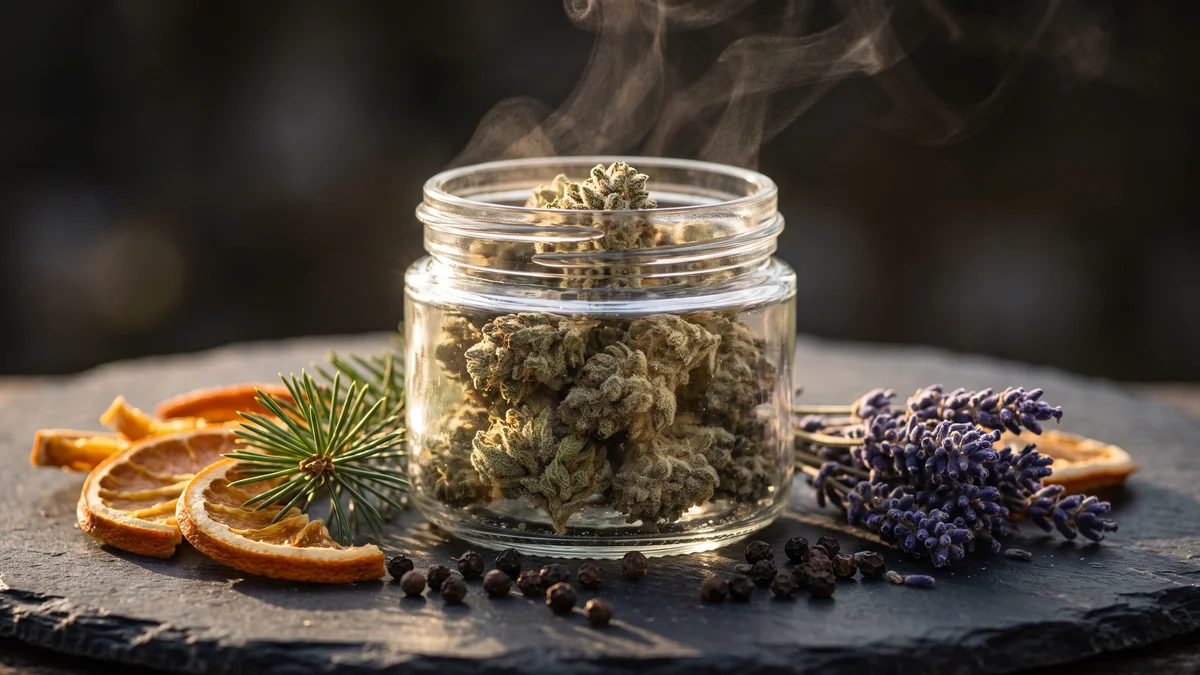
Terpenes are volatile aromatic compounds produced in the resin glands of the cannabis plant, the same trichomes that make THCa and CBD. They are not unique to cannabis. Limonene is what makes an orange peel smell like an orange. Alpha-pinene is what a pine forest smells like. Beta-caryophyllene is the bite in black pepper.
The plant makes them for its own reasons, mostly to repel insects and attract pollinators. They happen to be what your nose registers when you open a jar of flower, and they are the reason two batches with identical THCa percentages can smell nothing alike.
There are more than 100 terpenes identified in cannabis, but a handful dominate. When researchers at PLOS ONE analyzed 89,923 commercial flower samples across six states in 2022, they found that myrcene, beta-caryophyllene, and limonene were present at the highest levels on average, and that most THC-dominant samples fell into one of three chemical families (Smith et al., 2022).
How Much Terpene Is Actually in Your Flower?
This is the number that reframes everything else. Across the 42,843 samples in that dataset that carried terpene data, total terpene content averaged about 2% by weight. Individual terpenes were rarely present above 0.5%, and most sat below 0.2%.
Run the arithmetic on a real purchase. A one gram THCa flower preroll at the high end of the range, 0.5% myrcene, contains roughly 5 milligrams of myrcene before you light it. Combustion destroys a large share of that. Now compare it to the same gram of 20% to 25% flower, which carries roughly 200 to 250 milligrams of THCa. The cannabinoid outweighs the terpene by a factor of forty or more, which is why terpenes are not driving the experience the way THC is.
That does not make them irrelevant. Cannabis researcher Ethan Russo noted that terpenoid components above 0.05% are considered of pharmacological interest, and that while terpenoid yield is under 1% in most cannabis assays, terpenoids may represent 10% of trichome content (Br J Pharmacol, 2011). Milligram quantities of aromatic compounds are not nothing.
But it does mean you should be skeptical of anyone who tells you a terpene will produce a specific, reliable, dose-dependent effect at the levels found in a joint. Keep that scale in mind for everything below.
The Six Terpenes You Will See on an NC COA
When a lab runs a terpene panel, it usually reports a couple dozen compounds. These six are the ones that show up in meaningful quantity often enough to matter.
Myrcene
The most common terpene in commercial cannabis and a defining terpene in two of the three chemotype families. PubChem lists its odor simply as a terpene odor; in practice people describe it as earthy, musky, and slightly herbal. It also occurs in hops, where Russo notes it is a recognized sedative as part of preparations used to aid sleep in Germany. Myrcene is the source of the sedation folklore, and the section below explains why that story is weaker than it sounds.
Beta-Caryophyllene
The one terpene with a genuine mechanism. Beta-caryophyllene selectively binds the CB2 cannabinoid receptor with a binding affinity of Ki = 155 ± 4 nM and acts as a full CB2 agonist, while showing no significant affinity for CB1 (Gertsch et al., PNAS, 2008). CB2 receptors sit mostly outside the brain, in immune tissue, which is why caryophyllene is not intoxicating. It is the peppery note in the jar, and the same compound found in black pepper, oregano, and cinnamon essential oils.
Limonene
Citrus odor, per PubChem, and the terpene with the best human evidence. It is common to lemon and other citrus essential oils and is the chemotype partner to caryophyllene in Cluster I, one of the two big families. The Johns Hopkins trial covered below is the strongest terpene result published to date, and limonene is the compound it tested.
Alpha-Pinene
PubChem describes it as having the characteristic odor of pine. It appears in conifers, it is the sharp resinous note in strains that smell like a Christmas tree, and it pairs with myrcene in Cluster II, the other big family. Russo proposed that its activity as an acetylcholinesterase inhibitor could counteract short-term memory deficits induced by THC, but that remains a hypothesis rather than a demonstrated human effect.
Linalool
Floral, spicy and woody, PubChem notes, with an odor reminiscent of bergamot oil and French lavender. It is the terpene most often marketed for calm, largely by association with lavender aromatherapy. Direct human trials on isolated cannabis linalool have not been run.
Terpinolene
A sweet, pine odor. PubChem also records it in allspice, nutmeg, and juniper oils, and it marks the smallest of the three chemotype families, about 12.6% of samples. It tends to show up in strains marketed as bright or energizing. Like linalool, that association is descriptive, not demonstrated.
The Entourage Effect: What the Evidence Actually Shows
The entourage effect is the theory that cannabis compounds work together, so whole-plant products feel different from isolated THC. It is repeated constantly and tested rarely. Two studies define the honest boundaries.
On the skeptical side, researchers tested the six most common cannabis terpenoids (alpha-pinene, beta-pinene, beta-caryophyllene, linalool, limonene, and beta-myrcene) against human CB1 and CB2 receptors and found that none of them directly activated either receptor or modulated the signaling of THC, alone or in combination. The paper is titled, bluntly, "Absence of Entourage" (Cannabis and Cannabinoid Research, 2019). Whatever terpenes do, they are not doing it by changing how THC hits the cannabinoid receptors.
On the supportive side, a Johns Hopkins team ran a double-blind trial with 20 healthy adults who inhaled vaporized THC alone (15 or 30 mg), D-limonene alone (1 or 5 mg), both together, or placebo. A subset of 12 participants also received 30 mg THC plus 15 mg D-limonene. That combination significantly reduced ratings of "anxious/nervous" and "paranoid" compared with 30 mg THC alone, while every other measured effect stayed unchanged. D-limonene on its own did not differ from placebo (Spindle et al., Drug and Alcohol Dependence, 2024).
Read those two results together and you get the real picture. Terpenes can shape a cannabis experience, but through routes other than the cannabinoid receptors, in narrow and specific ways, and at doses that a flower jar may not deliver. The 15 mg of limonene in that trial is about three times what a gram of high-limonene flower contains at the 0.5% ceiling.
Why Indica and Sativa Labels Miss the Point
The same 89,923-sample study tested whether Indica, Hybrid, and Sativa labels tracked the underlying chemistry. They did not. Labeling by dominant terpene or by algorithmic clustering captured the actual chemical diversity significantly better than the Indica and Sativa designations (P < 0.0001), and the authors concluded that commercial labels do not consistently align with the observed chemical diversity.
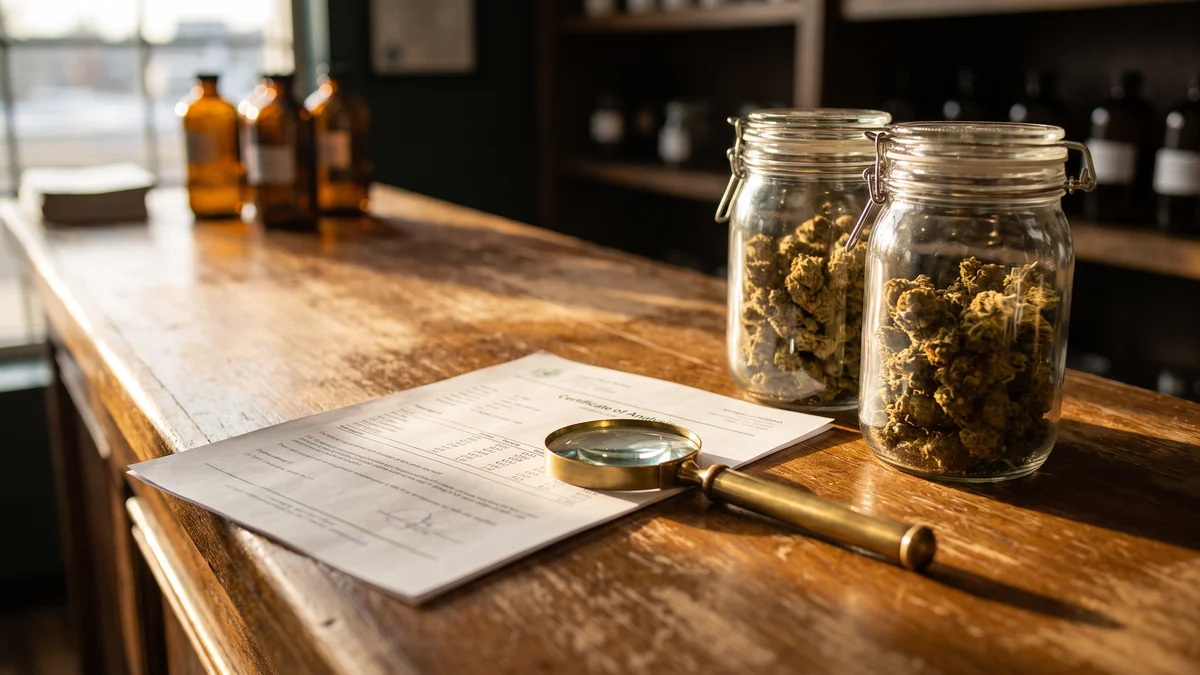
This is the practical takeaway from the whole terpene conversation. If two jars both say Indica but one is a myrcene and pinene profile while the other is caryophyllene and limonene, they are chemically different products wearing the same label. The terpene panel on the COA tells you more than the category name on the sticker, which is exactly why learning to read one is worth the ten minutes.
About Those Terpene Boiling Point Charts
If you have seen a terpene chart online, it probably listed beta-caryophyllene at 119 degrees Celsius or humulene at 106. Those numbers get copied from chart to chart, and several of them are measured at reduced pressure rather than at normal atmospheric pressure, which makes them look far lower than they are.
At standard pressure, PubChem's entries drawn from the CRC Handbook of Chemistry and Physics and the Merck Index put beta-caryophyllene at 256 degrees Celsius, not 119. Alpha-pinene is 156, myrcene 167, limonene 178, terpinolene 187, and linalool 198. Alpha-humulene's commonly cited figure of about 100 degrees is a reading taken at 3 mmHg, roughly a four-hundredth of atmospheric pressure, so it is not comparable to the rest of the list at all.
Why does this matter to a shopper? Because the boiling point chart is usually deployed as a temperature guide, with the promise that dialing in a precise number lets you isolate one terpene. The spread between the real values is much narrower than the folk chart suggests, and it sits well inside the range a typical session already passes through. You are not selecting terpenes by degree. You are heating all of them together.
None of this means temperature is irrelevant to vaping. It means the specific "set your device to 119 for caryophyllene" advice is built on a misread number.
How to Use Terpene Data When You Shop in NC
Terpene panels are not on every product. Cannabinoid potency testing is the norm, and plenty of perfectly good products ship without a terpene column at all. When you do get one, here is how to read it.
Find the total. A good COA reports total terpenes as a percentage. The large lab dataset averaged about 2%, so as a rule of thumb (ours, not the study's), 1% to 3% is typical, above 3% is unusually aromatic, and a figure far below that often points to old stock or rough curing, because terpenes evaporate over time.
Look at the top two, not the top eight. The dominant pair defines the chemotype. Everything below about 0.1% is noise at consumption scale.
Match the panel to the smell. Open the jar. If the COA says limonene-dominant and it smells like hay, the product is old or the paperwork does not belong to that batch.
Use it for consistency, not prediction. The honest use of a terpene panel is repeatability. When you find a batch you like, write down its top two terpenes. Next time you shop, ask for a similar profile. That is a far better system than chasing an effects chart, and it works across flower, concentrates, and edibles alike.
Note what the format does to them. Live rosin and live resin preserve more terpene content than distillate, which is stripped during processing and often has botanical terpenes added back in. That is a quality difference worth asking about.
What Changes on December 11, 2026
Terpenes themselves are not regulated as controlled substances, and nothing in the coming federal change targets them. What changes is the products they arrive in.
P.L. 119-37 redefines federal hemp on December 11, 2026, capping the plant at 0.3% total THC including THCA and excluding finished products containing more than 0.4 milligrams of total THC per container. Separately, North Carolina's House Bill 328 cleared the Senate 37 to 6 on July 2, 2026 and awaits a House vote. Today, hemp remains legal in NC, and N.C. Gen. Stat. 90-87(16) still states that marijuana "does not include hemp or hemp products."
The practical upshot for terpene shoppers: high-terpene THCa flower and full-spectrum concentrates are the categories most exposed to the December 11 change. CBD-forward products with rich terpene profiles are the least exposed.
Frequently Asked Questions
Do terpenes get you high?
No. Terpenes are not intoxicating on their own. Even beta-caryophyllene, the one terpene that binds a cannabinoid receptor, binds CB2 rather than CB1, and CB1 is the receptor responsible for the high (PNAS, 2008). In the Johns Hopkins trial, D-limonene administered alone produced no effects different from placebo. What terpenes can do is modestly shape an experience that THC is already driving.
Does myrcene really cause couch lock?
The evidence is much thinner than the claim. The sedation finding traces to a 2002 study in which myrcene was injected into mice at 100 and 200 mg per kilogram of body weight, producing reduced movement and longer barbiturate sleeping time (Phytomedicine, 2002). Those are enormous doses delivered by injection, not the few milligrams you inhale from a gram of flower. The same study found no anxiolytic effect at all. Treat "myrcene equals couch lock" as an untested hypothesis.
Which terpene is best for relaxation?
There is no terpene with established human evidence for relaxation, and no product on a North Carolina shelf should be described as treating anxiety, insomnia, or any medical condition. The single strongest human terpene finding is narrow: 15 mg of vaporized D-limonene reduced self-reported anxious and paranoid feelings caused by a 30 mg THC dose. That is a study about blunting a THC side effect, not a treatment claim. Talk to a physician about medical questions.
Do terpenes affect drug test results?
No. Workplace drug tests screen for THC metabolites, not terpenes. A high-terpene product will not change your result one way or the other, but the THC in the same product certainly can. See our full guide on hemp and drug tests in NC.
Are added terpenes in vapes and gummies a problem?
Not automatically, but it is worth knowing. Distillate-based vape carts and many edibles have terpenes added back after processing, sometimes cannabis-derived and sometimes botanical, sourced from citrus or pine. A COA that lists cannabinoids but says nothing about the flavoring system tells you only half the story. Ask the shop whether the terpenes are cannabis-derived, and check that the product avoids ingredients like vitamin E acetate.
The Bottom Line
Terpenes are the most oversold and undersold part of cannabis at the same time. Oversold, because the effects charts on strain menus promise a precision that no published research supports. Undersold, because the chemotype a product belongs to genuinely predicts more about how it will smell, taste, and land than the Indica or Sativa word on the jar.
Use the terpene panel the way a sommelier uses a grape variety. It tells you what family you are in and helps you find the same thing twice. It does not tell you what the evening will feel like.
If you want to start reading panels for yourself, pick up something from a Triangle shop that posts full COAs, note the top two terpenes, and see whether the pattern holds across three purchases. That experiment will teach you more than any chart, including this one.
This article is educational and does not offer medical advice. Hemp products are not intended to diagnose, treat, cure, or prevent any disease. Consult a healthcare provider about your individual situation. Products discussed are for adults 21 and over.